

Ever feel hungry right after eating, only to realize you were just thirsty? It’s not just in your head. Your body often confuses thirst for hunger-and that’s just one way water quietly helps you lose weight. If you’re trying to shed pounds, drinking more water isn’t a trendy hack. It’s a science-backed tool with real, measurable effects on appetite, metabolism, and even fat burning. And you don’t need to change your diet or buy expensive supplements to start using it.
Water Turns Up Your Metabolism-Without Caffeine or Pills
Here’s something surprising: drinking a glass of cold water literally burns calories. Not a lot, but enough to add up. When you swallow 500ml of water (about two cups), your body spends energy warming it up to your core temperature. This is called water-induced thermogenesis. Studies in the Journal of Clinical Endocrinology & Metabolism show this process boosts your metabolic rate by 24-30% for about 30 to 40 minutes. That’s roughly 23 extra calories burned per liter of water you drink. Sounds small? Do this three times a day, and you’re burning over 70 extra calories daily-without lifting a finger.
But it’s not just about heat. Research from the University of São Paulo found that in animals, higher water intake directly triggered lipolysis-the breakdown of fat. While human studies are still refining the exact mechanism, we know this: being even slightly dehydrated slows down fat metabolism. Dr. Melinda Manore from Oregon State University explains that mild dehydration alters hormones that regulate fat burning, making your body hold onto stored energy instead of using it.
Drink Water Before Meals-It’s That Simple
If you want the biggest bang for your buck, drink 500ml of water about 30 minutes before each main meal. This isn’t guesswork. A 2010 study in Obesity followed 48 adults over 12 weeks. Half drank two cups of water before breakfast, lunch, and dinner. The other half didn’t. The water group lost 2kg more than the control group-and 92% of that extra loss came from eating less.
Why does this work? Your stomach stretches. That stretch sends a signal to your brain: “I’m full.” A Johns Hopkins study found people who drank two 8-ounce glasses of water before eating consumed 111 fewer calories per meal-about 22% less food. And the effect kicks in within 15-20 minutes. No waiting. No hunger pangs. Just a natural, built-in portion control system.
A 2024 meta-analysis in JAMA Network Open reviewed 18 trials and confirmed this: people who drank 1.5L of water before meals lost 44% to 100% more weight than those who didn’t. Some lost an extra 1.3kg to 2kg over 12 weeks. The timing matters. Drink too early, and the effect fades. Drink too late, and you’re already eating. 30 minutes before? Perfect.

Water Beats Diet Soda-Every Time
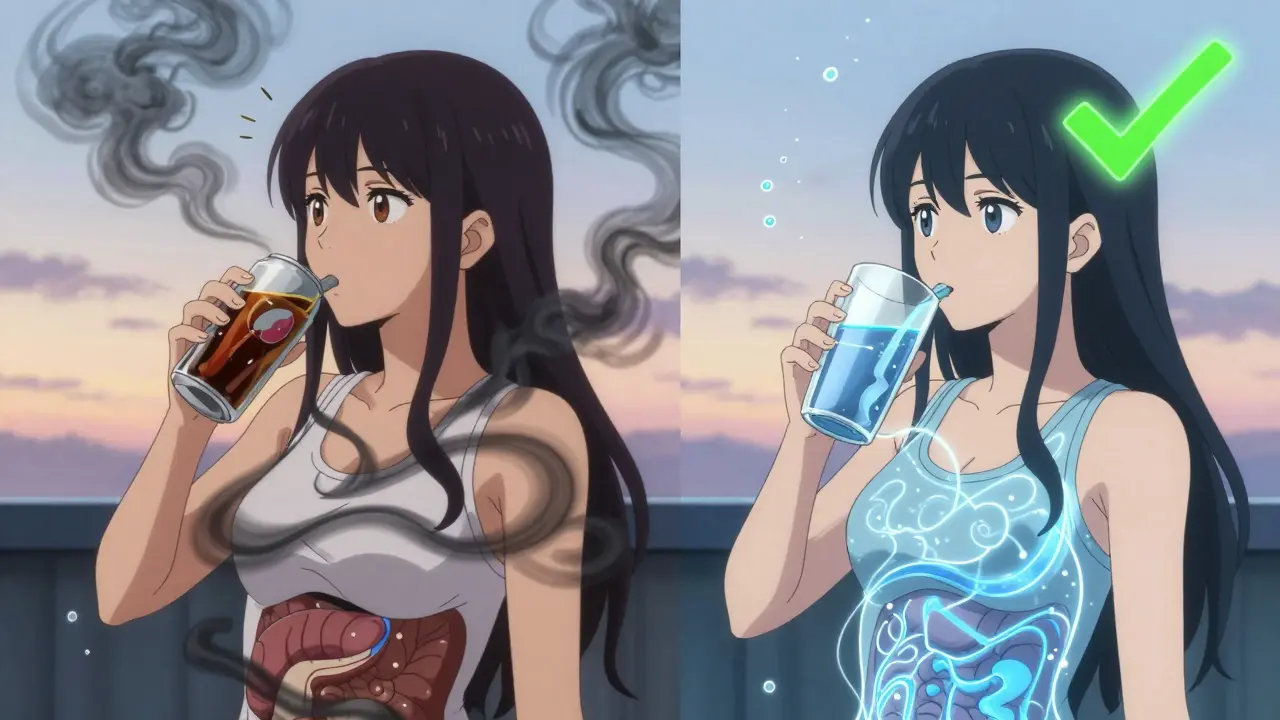
Many people switch from soda to diet soda thinking they’re doing the right thing. But here’s the truth: diet drinks might have zero calories, but they don’t help you lose weight like water does.
A groundbreaking 18-month trial presented at the American Diabetes Association in 2023 compared two groups of women with type 2 diabetes. One group replaced sugary drinks with water. The other switched to diet beverages. The water group lost an average of 6.82kg. The diet soda group? Just 4.85kg. And 44% of the water group went into diabetes remission. Only 22% of the diet soda group did.
Why? Artificial sweeteners may trick your brain into expecting sugar. That can spike insulin, increase cravings, and even mess with your gut bacteria. Dr. Hamid R. Farshchi, who led the study, says: “Diet drinks have potential negative effects for managing weight and blood sugar.” Water? It does the opposite. It hydrates, fills your stomach, and doesn’t send mixed signals to your body.
How Much Water Do You Actually Need?
You don’t need to chug 3 liters a day. The goal isn’t to drown yourself. It’s to add about 1.5 liters of water on top of what you normally drink.
- Start with 500ml before breakfast, lunch, and dinner. That’s 1.5L.
- Drink a glass when you wake up. Another before your afternoon snack.
- If you’re active, aim for 0.5-1 ounce per pound of body weight. So if you weigh 70kg (about 155 lbs), you need roughly 2.5-5 liters total per day.
Most people think they’re hydrated because they’re not thirsty. But thirst is a late signal. By the time you feel it, you’re already slightly dehydrated. A 2008 study in Obesity tracked 173 overweight women over a year. Those who increased their water intake by just 1% of their total beverage consumption lost an extra 0.13kg per month-just from drinking more water, no other changes.
Common Mistakes (and How to Fix Them)
People try this and fail-not because it doesn’t work, but because they do it wrong.
- Mistake: Drinking water during meals. Fix: Save water for 30 minutes before. Drinking while eating dilutes stomach acid and slows digestion.
- Mistake: Only drinking when thirsty. Fix: Set phone reminders. Or link it to habits: “After I brush my teeth, I drink a glass.”
- Mistake: Thinking you need to drink plain water only. Fix: Herbal teas, cucumber water, or broth count-just skip sugary or artificially sweetened drinks.
- Mistake: Expecting miracles. Fix: This isn’t a magic bullet. It’s a multiplier. Combine it with better sleep, protein-rich meals, and movement. You’ll see results faster.
Most people feel bloated or need to pee more at first. That’s normal. Your body adjusts in 1-2 weeks. After that, you’ll notice fewer cravings, less midday fatigue, and meals feeling more satisfying.
Why This Works Better Than Any Supplement
There’s no pill, powder, or potion that does what water does. It’s free. It’s safe. It has zero side effects. And it works whether you’re rich or poor, in Sydney or a village in Nepal.
The American Diabetes Association now officially recommends water as the preferred beverage for weight loss in people with diabetes. Harvard’s Dr. Walter Willett says promoting water requires no pharmaceuticals, no marketing, and no cost. It’s one of the most equitable health tools we have.
And it’s not going away. Smart water bottles that track intake and sync with fitness apps are growing fast-projected to hit a $3.5 billion market by 2028. Why? Because people are finally realizing: if you want to lose weight without drastic changes, start with the simplest thing.
Water doesn’t just quench thirst. It turns your body into a better fat-burning machine. It tells your brain you’re full before you overeat. It helps your metabolism wake up. And it does all of this without costing you a cent.
Can drinking water really help me lose weight without changing my diet?
Yes. Studies show that increasing water intake alone-without changing food or exercise habits-leads to measurable weight loss. One study of 173 overweight women found that each 1% increase in water consumption relative to total beverages led to an extra 0.13kg of weight loss per month over 12 months. The effect comes from reduced calorie intake, improved metabolism, and better appetite control.
How much water should I drink before meals to lose weight?
Drink 500ml (about 16.9 ounces or two standard glasses) of water 30 minutes before breakfast, lunch, and dinner. This timing maximizes gastric distension, which sends fullness signals to your brain before you start eating. Research shows this reduces calorie intake by about 22% per meal and leads to 1.3-2kg more weight loss over 12 weeks compared to not doing it.
Is diet soda just as good as water for weight loss?
No. A 2023 study comparing water substitution to diet soda in women with type 2 diabetes found the water group lost significantly more weight (6.82kg vs. 4.85kg) and had higher rates of diabetes remission. Artificial sweeteners in diet soda may disrupt hunger signals, insulin response, and gut health, making them less effective-even though they have zero calories.
What if I don’t like plain water?
You can add lemon, cucumber, mint, or a splash of 100% fruit juice. Herbal teas without sugar or artificial sweeteners also count toward your daily fluid intake. The key is avoiding sugary drinks and artificial sweeteners. Hydration is the goal-not taste. But if flavor helps you stick with it, make it work for you.
Does drinking water help with exercise performance during weight loss?
Absolutely. Even mild dehydration reduces endurance, strength, and recovery. When you’re well-hydrated, your muscles work more efficiently, your heart doesn’t have to work as hard, and you recover faster. That means you can train harder and longer-which burns more calories. Staying hydrated isn’t just about weight loss. It’s about making every workout count.
Start today. Fill a 500ml bottle. Set a reminder. Drink it before your next meal. Do it for a week. You might be surprised how much lighter you feel-not just on the scale, but in your body.
10 Comments
Katy Shamitz
10 March, 2026Oh my god, I finally get it. I was always confused why I felt so hungry after lunch-turns out I was just dehydrated. I started drinking a full glass of water before every meal last week, and honestly? I’ve been snacking way less. No more mid-afternoon cookie cravings. It’s like my body finally stopped screaming for sugar and started whispering, ‘Hey, maybe just chill with some H2O.’
I used to think hydration was just for athletes or people who do yoga. But now I see it’s the quiet superhero of weight loss. No supplements. No keto. Just water. And it works.
I even started carrying a bottle everywhere. My coworkers think I’m weird, but I don’t care. I feel lighter. My skin’s clearer. My energy? Non-stop. This isn’t a hack. It’s a revelation.
Nicholas Gama
11 March, 2026Water-induced thermogenesis? Cute. But the real science? It’s negligible. 23 calories per liter? That’s less than a single almond. You’re not ‘burning fat’-you’re just urinating more.
And don’t get me started on ‘drinking before meals.’ That’s just a placebo for people who need control. Real fat loss? Calorie deficit. Not hydration theater.
Mary Beth Brook
12 March, 2026Let’s cut through the fluff. The study you cited? It’s observational. Correlation ≠ causation. And ‘water before meals’ is a Band-Aid for poor portion control. If you’re eating like a pig, drinking water won’t fix your brain.
Also-diet soda isn’t the enemy. It’s the sugar industry that’s the enemy. Water is free. But so is air. Doesn’t mean it’s magic. Focus on protein intake. That’s the real game-changer.
Neeti Rustagi
12 March, 2026Thank you for this thoughtful and scientifically grounded piece. I have been practicing water intake before meals for the past six months, and I can personally attest to its profound impact on my appetite regulation.
In India, where sugary beverages are culturally entrenched, this simple habit has been transformative-not only for weight management but for overall mindfulness around consumption.
I encourage everyone to approach this not as a trend, but as a foundational practice of self-care. The body, when properly hydrated, communicates its needs with remarkable clarity. We simply must learn to listen.
And yes-herbal teas, especially jasmine or mint, are excellent alternatives. They honor tradition while supporting modern health.
Dan Mayer
13 March, 2026ok so i tried this and it kinda worked but i also started peeing every 20 mins and now my bladder feels like its in a war zone??
also i drank water before dinner and still ate 2 pizzas. so… idk. maybe its not that powerful??
also i think the study is bs because my cousin drank 10L a day and gained 10lbs. so… science is weird??
Janelle Pearl
14 March, 2026Wow. I’ve been so hard on myself for years trying to ‘fix’ my eating habits with diets that left me exhausted. This post? It felt like someone finally handed me a quiet, gentle tool instead of a sledgehammer.
I used to think I had no willpower. Turns out I just needed to stop confusing thirst for hunger.
I started with one glass before breakfast. Now I do it before every meal. I don’t even think about it anymore. It’s just… part of me now.
And the best part? I’m not obsessed. I’m not counting. I’m just… hydrated. And somehow, that’s enough.
Ray Foret Jr.
14 March, 2026bro this is legit 😍 i started doing the 500ml before meals and now i’m not craving sweets like crazy
also my skin is glowy?? idk if its water or just lucky but im not complaining 😅
do it for a week. i dare you. your body will thank you 🙏💧
Samantha Fierro
15 March, 2026While the physiological mechanisms described are compelling, I would urge readers to consider the broader context of behavioral sustainability. Hydration as a weight-loss strategy is most effective when integrated into a consistent routine-not as a temporary intervention.
Moreover, the emphasis on timing-30 minutes pre-meal-is critical. The gastric distension effect is time-sensitive, and deviations reduce efficacy.
I recommend pairing this with structured meal planning and mindful eating practices. Water is not a standalone solution, but a powerful facilitator of behavioral change.
Robert Bliss
15 March, 2026Just wanted to say thanks for this. I’ve been drinking more water since I read this, and honestly? I feel like a new person.
Used to think I needed to ‘detox’ or buy fancy water. Nah. Just plain tap water. My dog even drinks more now. We’re both happier.
No drama. No gimmicks. Just water. Simple works.
Peter Kovac
17 March, 2026The cited studies suffer from significant methodological limitations: small sample sizes, lack of control for macronutrient intake, and confounding variables such as physical activity levels. The 2024 meta-analysis in JAMA Network Open includes studies with high heterogeneity, rendering pooled effect sizes unreliable.
Furthermore, the claim that water ‘boosts fat metabolism’ lacks mechanistic evidence in humans. The animal studies referenced do not translate directly. This post is an oversimplification of complex metabolic pathways.
While hydration is essential for health, attributing weight loss primarily to water intake is pseudoscientific.