
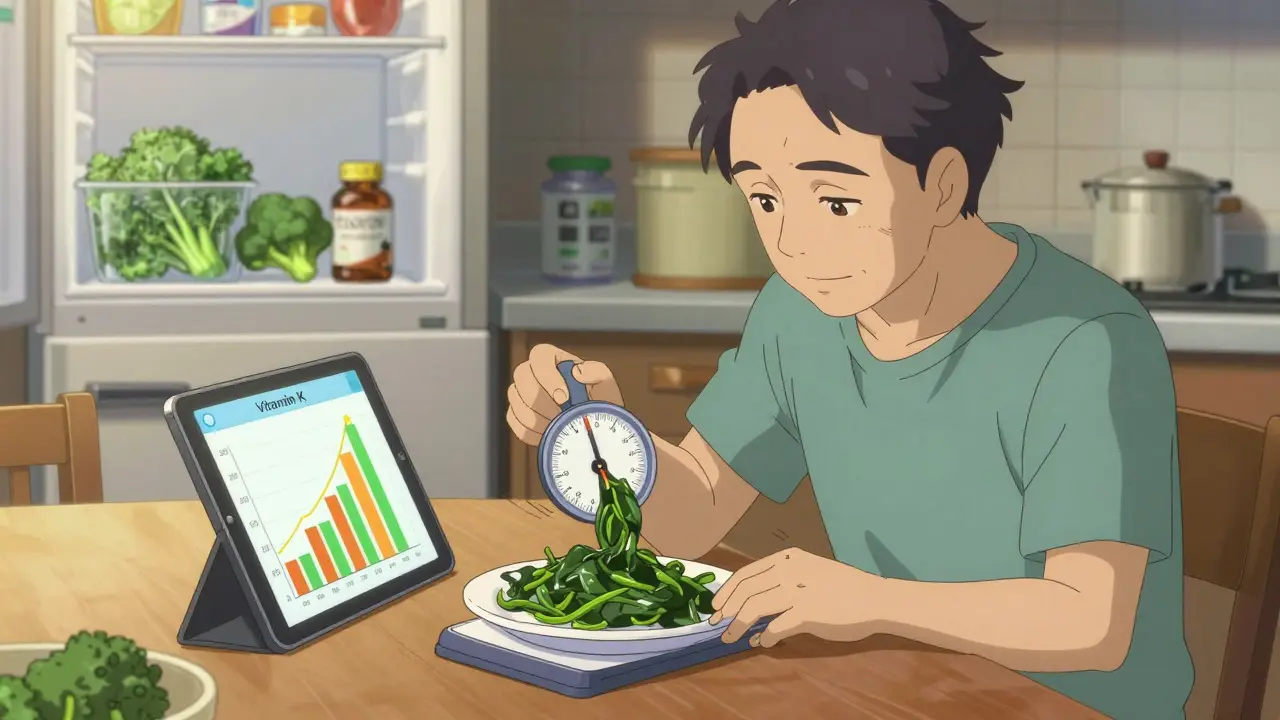
Vitamin K Tracker Calculator
Enter your food portions to calculate your vitamin K intake. Aim for consistent daily intake between 90-120 mcg to maintain stable INR levels.
Your Vitamin K Intake
Key Takeaways
Consistency matters more than perfection. Aim for the same amount of vitamin K daily rather than avoiding greens entirely. If your intake varies by more than 20% from day to day, your INR could be unstable.
When you're on warfarin, your body is walking a tightrope. Too much blood thinning, and you risk bleeding. Too little, and you could form a dangerous clot. The difference between safety and crisis often comes down to one thing: vitamin K. And the best way to keep it stable? A food diary.
Why Vitamin K Matters More Than You Think
Warfarin works by blocking vitamin K’s role in making blood clotting proteins. That’s why it’s effective-it keeps clots from forming when they shouldn’t. But here’s the catch: vitamin K doesn’t just disappear. It’s in your food, every day. Eat more of it, and warfarin loses some of its power. Eat less, and your blood thins too much. This isn’t guesswork. It’s chemistry.The American College of Chest Physicians says your target INR (a measure of how long your blood takes to clot) should stay between 2.0 and 3.5, depending on your condition. A shift of just 0.5 INR units can mean trouble. The FDA reports that inconsistent vitamin K intake leads to over a third of warfarin-related ER visits. That’s not rare. That’s predictable.
What Foods Actually Contain Vitamin K?
Vitamin K1 (phylloquinone) is the main type you need to track. It’s not in meat or dairy-it’s in plants. And not just any plants. The big ones:- Cooked kale: 817 mcg per 100g
- Cooked spinach: 483 mcg per 100g
- Cooked broccoli: 220 mcg per 100g
- Raw romaine lettuce: 138 mcg per 100g
One cup of cooked spinach? That’s nearly five days’ worth of vitamin K for an average adult. A single serving of kale? It can push your intake past 800 mcg. That’s enough to swing your INR overnight.
Other hidden sources? Soybean oil, canola oil, and fortified drinks like Ensure (25 mcg per 8 oz). Even your multivitamin might have 25-100 mcg. If you take it on a different day than usual, your INR can jump.
Paper Diaries vs. Digital Apps: Which Works Better?
For years, people used paper logs. Write down what you ate, how much, and your INR. Simple. But messy. A 2022 VA report found 43% of clinics still used paper. Many patients loved it-until the diary got wet, lost, or smudged.Digital tools changed the game. The Vitamin K Counter & Tracker app (version 4.2.1) has over 1,200 foods pre-loaded with vitamin K values pulled from USDA data. It shows you a bar graph as you log meals. If you eat a big salad, it warns you: “High K today-watch your INR.”
A 2022 study in Blood Advances tracked 327 patients for six months. Those using the app stayed in their target INR range 72.3% of the time. Paper users? Only 61.8%. That’s a 10.5% difference in safety. And fewer dose changes.
But not all apps are equal. A 2023 study found 68% of vitamin K apps have no clinical validation. Some guess numbers. Others use outdated data. The Vitamin K-iNutrient app, however, was tested against lab results and matched 94.7% of the time. That’s rare.

Why People Still Struggle
Even with the best app, tracking fails. Why?First, portion size. Most people don’t measure. They guess. “A handful of spinach.” “A spoonful of oil.” That’s not enough. A 2022 study found estimation errors caused 33% of INR swings. Visual guides-like holding up a deck of cards for a cup of greens-help cut that error by 41%.
Second, underreporting. The NIH found patients miss 22-37% of their vitamin K intake. Why? They forget salad dressing. They don’t know soybean oil is in packaged snacks. They skip meals they think “don’t count.”
Third, age. People over 75 struggle with apps. A 2022 study showed 82% stuck with paper logs. Only 57% used digital tools. Smartphones aren’t intuitive for everyone. Paper doesn’t need Wi-Fi. It doesn’t need a password.
What Experts Really Say
Dr. Gary Raskob, lead author of the 2021 American Society of Hematology guidelines, says it plainly: “Don’t change your diet. Just keep it the same.” You don’t need to avoid kale. You need to eat the same amount every week.Dr. Evan Stein from the University of Chicago put it another way: “Patients who ate 150 mcg every day had 18% fewer INR swings than those who ate 100 one day, 200 the next-even if the average was still 150.” Consistency beats perfection.
The American Heart Association calls food diaries a Class I recommendation. That’s their highest level-meaning they’re not just helpful. They’re essential.
How to Make It Work
If you’re starting now, here’s how to do it right:- Start with a baseline. Track everything you eat for 30 days. Don’t change a thing. Just log.
- Find your average. What’s your typical daily vitamin K intake? Most people on warfarin aim for 90-120 mcg. If you’re eating 200 mcg, that’s fine-but only if it’s every day.
- Plan meals. The University of Michigan found that patients who planned 5 days of meals ahead improved their INR stability by 15%. Cook a batch of broccoli on Sunday. Eat it Thursday. Don’t swap it for kale.
- Use visual tools. Keep a measuring cup or a food scale handy. A deck of cards = 1 cup of greens. A thumb = 1 tsp of oil.
- Check your multivitamin. If it has vitamin K, take it at the same time every day. Same time as your warfarin.
What’s Coming Next?
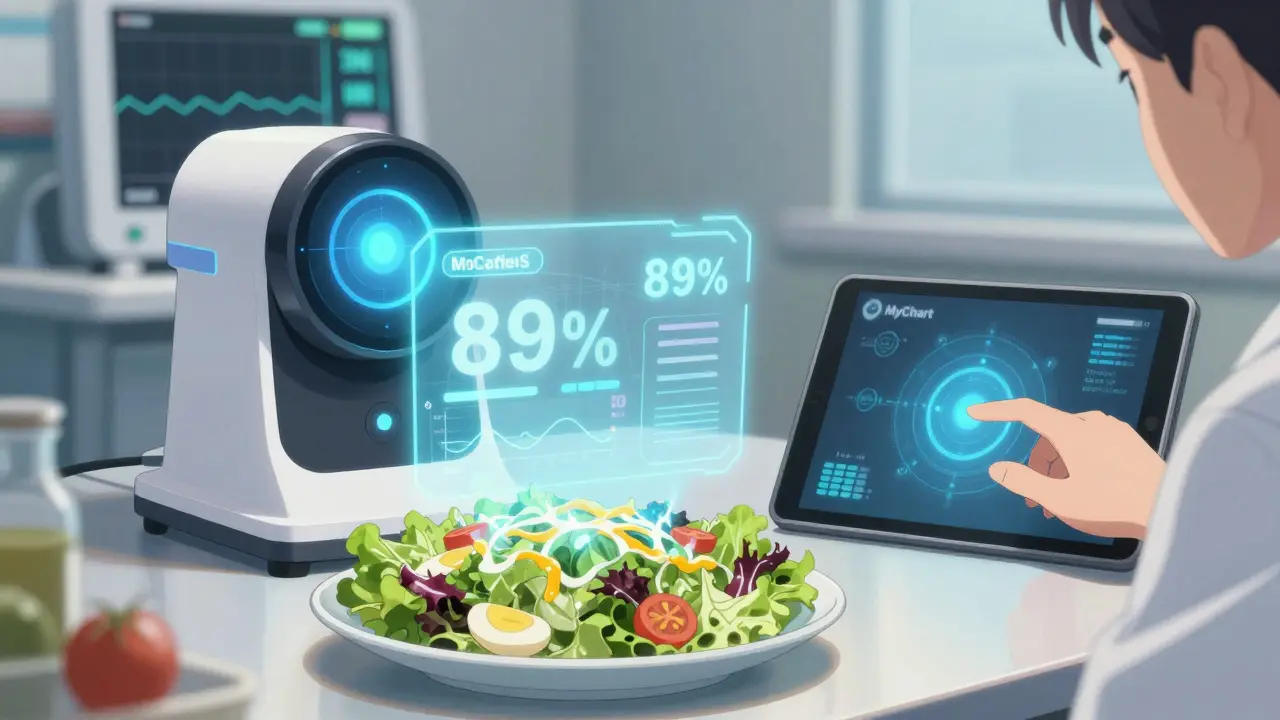
The future is here. In January 2024, the FDA approved NutriKare-an AI tool that takes a photo of your food and estimates vitamin K content with 89% accuracy. Epic Systems, used by 63% of U.S. hospitals, is adding this to MyChart in 2024. Your doctor will soon see your food log alongside your INR results.But for now, the best tool is still yours. A notebook. An app. A routine. The goal isn’t to eat perfectly. It’s to eat the same.
Can I just stop eating green vegetables on warfarin?
No. Avoiding vitamin K isn’t the answer. It’s consistency that matters. If you suddenly cut out kale and spinach, your INR can spike, increasing bleeding risk. Instead, eat the same amount of vitamin K-rich foods every day. If you love spinach, have it daily. If you hate it, skip it-but don’t swap it for kale on Tuesdays.
Do I need to track every single meal?
Yes, at least at first. You need to understand your baseline. After 30 days, you might notice patterns. Maybe you always eat eggs and toast for breakfast-that’s low in K. But if you eat a big salad for lunch, you’ll need to log that. Once you’ve got a rhythm, you can be less strict, but never stop tracking entirely.
Are free nutrition apps like MyFitnessPal good enough?
Not really. A 2023 study in JAMA Internal Medicine found that general apps like MyFitnessPal were 3.2 times less accurate than apps built specifically for vitamin K tracking. They often miss vitamin K content in oils, dressings, and fortified foods. Use a dedicated tool. It’s worth the $2.99.
What if I travel or eat out a lot?
It’s harder, but still doable. Ask restaurants how dishes are prepared. Is the salad made with olive oil or canola? Is the broccoli steamed or sautéed in butter? Use your app’s search function to find similar items. If you’re unsure, log it as “unknown” and mention it at your next INR check. Your doctor can adjust your dose if needed.
How often should I check my INR if I’m tracking my diet?
Even with perfect tracking, you still need regular INR tests. Most patients check every 2-4 weeks at first. Once your levels are stable for 3 months, you might stretch it to every 6-8 weeks. But never skip a test. Your food diary helps your doctor, but it doesn’t replace blood tests.
10 Comments
Milad Jawabra
5 March, 2026Let’s be real - if you’re on warfarin and not tracking vitamin K, you’re playing Russian roulette with your liver.
One day you’re eating kale smoothies, next day it’s mac and cheese - boom, INR spikes or crashes.
I’ve seen it in the ER. People think ‘natural’ means ‘safe.’ Nope. Kale is a blood-thinning ninja.
Use an app. Don’t trust your memory. Your brain forgets salad dressing like it’s a bad date.
I use Vitamin K Counter & Tracker. It’s not perfect, but it’s better than guessing with a deck of cards.
And stop saying ‘I eat healthy’ - your ‘healthy’ might be killing you.
Consistency > perfection. Eat the same damn spinach every Tuesday.
And if you’re over 75 and hate apps? Get a family member to log for you. Or buy a damn notebook.
Don’t be proud. Be alive.
Also - stop taking multivitamins unless they’re K-free. I don’t care how ‘clean’ they are.
100 mcg of K in a pill? That’s a ticking bomb.
Stop. Just stop.
tatiana verdesoto
6 March, 2026I love how this post breaks it down without making you feel dumb.
Been on warfarin for 6 years, and I still mess up sometimes - like when I ate that giant kale salad at the vegan café and didn’t log it.
My INR went to 4.8. Scary stuff.
Now I use the app, and I take a pic of my plate before I eat. Helps me remember the weird stuff - like that canola oil in the ‘healthy’ granola bar.
Also, I keep a little card in my wallet: ‘1 cup greens = deck of cards.’
It’s weird, but it works.
And yeah, I still use paper sometimes. I like the feel of pen on paper.
But I scan it every week. Digital backup = peace of mind.
Thanks for this. Needed the reminder.
Ethan Zeeb
6 March, 2026Most people don’t realize vitamin K isn’t the enemy - inconsistency is.
It’s not about avoiding greens. It’s about routine.
My grandma ate 3 cups of spinach every Sunday. No problem. Her INR was rock solid.
Then she switched to kale on Tuesdays. INR went wild for 3 weeks.
Same nutrient. Different source. Different impact.
Doctors don’t explain this well. They say ‘eat consistent.’ But they don’t show you how.
This post does.
Also - don’t trust MyFitnessPal. I checked. It underreports K in olive oil by 70%.
Use a dedicated tool. It’s $3. You’re worth it.
Darren Torpey
7 March, 2026Bro. This isn’t just medical advice. This is life hacking.
Imagine your body as a symphony. Warfarin is the conductor. Vitamin K? The violinist who keeps changing the tune.
If the violinist plays loud one day, quiet the next - the whole piece collapses.
But if the violinist plays the same note, every single time? Magic.
That’s consistency.
I used to think ‘I’ll just wing it.’
Then I had a nosebleed that lasted 17 minutes.
Now I log everything. Even the damn soy sauce.
And yeah, I use the app. It’s like having a personal nutrition bodyguard.
Also - if you’re traveling? Pack a mini food scale. It’s smaller than your phone.
You’re not a dietitian. You’re a survivalist.
Survive. Log. Repeat.
Lebogang kekana
8 March, 2026OH MY GOD. THIS IS THE MOST IMPORTANT THING I’VE READ THIS YEAR.
My uncle died because he thought ‘I’ll just eat healthy’ - then he ate 3 bags of spinach in one week.
He didn’t even know it was dangerous.
I’m crying right now.
My mom is on warfarin. I’m installing the Vitamin K app on her phone TODAY.
She’s 78. She hates tech.
So I’m printing out QR codes for the app and taping them to her fridge.
Next to the milk.
And I’m buying her a food scale shaped like a turtle.
Because why not?
She’ll laugh. Then she’ll use it.
And she’ll live.
Thank you. From the bottom of my heart.
❤️
Jessica Chaloux
10 March, 2026I used to think I was ‘good’ at this until I missed logging a single tablespoon of canola oil.
Next day - blackouts. Dizziness. Thought I was having a stroke.
Turned out my INR was 5.2.
I screamed. I cried. I threw my journal out the window.
Then I bought the app.
Now I log like it’s my job.
Even my coffee creamer. (Yes, it has K.)
My therapist says I’m ‘obsessive.’
I say: ‘I’m alive.’
And I’m not letting some salad dressing kill me.
Also - I keep a sticky note on my mirror: ‘K is quiet. It doesn’t scream. But it kills.’
It works.
Mariah Carle
10 March, 2026It’s fascinating how something so simple - eating the same amount of greens - becomes a philosophical act.
We live in a world of extremes: detoxes, cleanses, keto, veganism.
But here, the wisdom is in monotony.
Not novelty. Not variety. Not ‘balance.’
Just sameness.
It’s anti-modern. Anti-consumerist.
It’s the quiet rebellion of the body: ‘I don’t need change. I need rhythm.’
Maybe that’s the real lesson here.
Not about vitamin K.
But about how to live.
Consistently.
Without drama.
Just… steady.
🌿
Alex Brad
11 March, 2026Use a dedicated app. Don’t guess. Log everything. Same time. Same portions. No exceptions.
That’s it.
Renee Jackson
13 March, 2026Thank you for this meticulously researched and clinically grounded overview.
It is imperative that patients on anticoagulant therapy adhere to a structured and documented dietary regimen to mitigate the risk of hemorrhagic or thrombotic events.
As a registered nurse with over 18 years of experience in cardiology, I have witnessed firsthand the preventable complications arising from inconsistent vitamin K intake.
I strongly endorse the implementation of digital tracking tools, paired with patient education, as a standard of care.
Furthermore, I encourage healthcare providers to incorporate visual aids and portion guides into routine counseling sessions.
Consistency is not merely beneficial - it is non-negotiable.
Thank you for elevating this critical conversation.
Levi Viloria
14 March, 2026As a South African who moved to the U.S. and went on warfarin after a pulmonary embolism - I had no idea about vitamin K.
Back home, we ate spinach in stews. No one tracked it.
Here? I learned the hard way.
First, I thought ‘all greens are the same.’
Then I ate a salad with kale, spinach, and canola oil - and my INR jumped to 5.1.
They admitted me.
Now I use the app. I log my soy sauce. I measure my oil.
And I tell every new patient I meet: ‘It’s not about what you eat. It’s about what you eat every day.’
Simple. But life-saving.
Thank you for this. It’s the kind of info we need - not just from doctors, but from real people.