

Long COVID Treatment Selector
Find Your Treatment Path
Long COVID isn't one condition—it's at least four distinct subtypes. Select your primary symptoms to see which treatments might help you.
Treatment Recommendations
There’s no FDA-approved treatment for Long COVID yet. That’s not because doctors aren’t trying - it’s because the condition is still a mystery. Millions of people worldwide are living with symptoms like brain fog, crushing fatigue, heart palpitations, and dizziness months after their initial COVID infection. And while there’s no cure, doctors are testing a handful of existing medications, hoping one might work. But here’s the catch: we don’t fully understand how these drugs behave in Long COVID patients. What’s safe for someone with rheumatoid arthritis might not be safe for a 30-year-old who had a mild case of COVID. The stakes are high, and the unknowns are still bigger.
Baricitinib: A Promising Drug With Serious Risks
Baricitinib is one of the most talked-about drugs in Long COVID research. It’s already approved for rheumatoid arthritis and alopecia areata, and it even helped reduce deaths during the acute phase of COVID-19. Now, it’s being tested in the REVERSE-LC trial - a major NIH-funded study involving over 40 researchers across six U.S. sites. Early signs suggest it might help with fatigue and brain fog by calming an overactive immune system.
But baricitinib isn’t harmless. The FDA label warns of increased risk of serious infections, blood clots, and even lymphoma. In rheumatoid arthritis trials, about 1 in 5 patients got a serious infection. For someone with Long COVID, whose immune system is already acting strangely, this could be dangerous. Some doctors are cautious. Dr. Priscilla Hsue from UCSF points out that Long COVID patients may already have immune dysregulation - adding a drug that suppresses immunity could backfire. Results from the REVERSE-LC trial won’t be in until late 2026. Until then, it’s still experimental.
Metformin: The Unexpected Hero
Metformin, a cheap, widely used diabetes drug, surprised researchers. A 2023 study from the University of Minnesota found that people who took metformin within five days of a COVID diagnosis were 41% less likely to develop Long COVID. That’s a big deal. It’s not just a guess - it’s a statistically significant drop, with a 95% confidence interval showing real effect.
But it comes with a cost. Over a third of participants in that trial had stomach problems - nausea, diarrhea, cramps. For someone already dealing with fatigue and brain fog, that’s a tough trade-off. Still, many patients are self-prescribing it. According to the Body Politic Long COVID Support Group, 32% of respondents have tried metformin off-label. Some say it helped with energy levels. Others quit because the side effects were worse than the symptoms. There’s no standard dose for Long COVID yet. Most are taking 500-1000 mg daily, but without clinical guidance, it’s a gamble.
Low-Dose Naltrexone (LDN): The Off-Label Favorite
LDN is another off-label option gaining traction. Usually, naltrexone is used at 50 mg to treat opioid addiction. But at 1-5 mg, it appears to have anti-inflammatory effects. A 2024 study from Nova Southeastern University tracked 120 Long COVID patients on LDN. Over 60% reported less fatigue. That’s promising. But 28% had trouble sleeping, and 19% got headaches. One patient in Sydney told me she started LDN after months of being bedridden. She felt better after three weeks - but couldn’t sleep through the night. She stopped.
There’s no large, controlled trial for LDN in Long COVID. The data comes from small, patient-reported surveys. That means we don’t know the long-term risks. Is it safe to take for years? Could it interfere with other medications? No one knows. But because it’s cheap and widely available, many patients are trying it anyway.
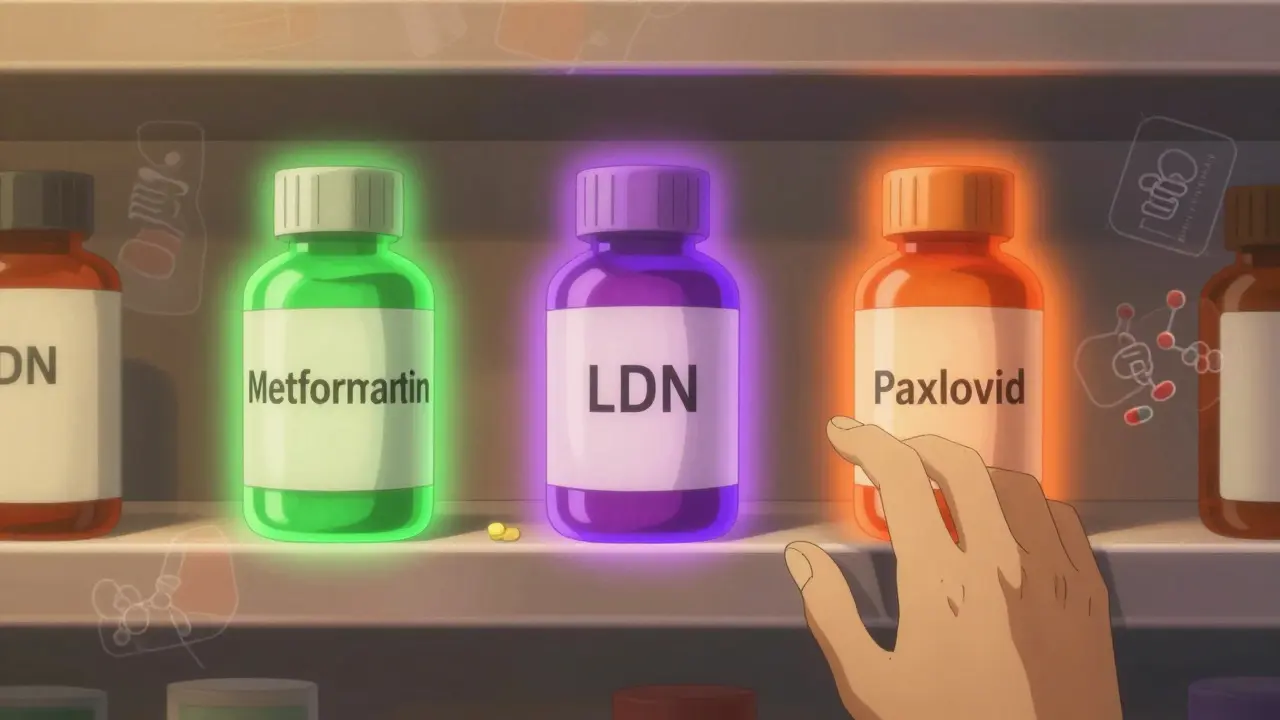
Paxlovid: Does It Work for Long COVID?
Paxlovid - the antiviral combo of nirmatrelvir and ritonavir - was a game-changer for early COVID. But does it help with Long COVID? Two conflicting studies say no and yes.
A small UC San Francisco study in 2024 found that 38% of patients on a 15-day Paxlovid course felt better, compared to 22% on placebo. But a much larger NIH trial published in JAMA Internal Medicine in February 2025 found no difference at all. The numbers were almost identical: 34.1% vs. 32.8%. So what’s going on? Maybe it only helps certain subtypes of Long COVID. Or maybe the timing matters - was it too late for most patients in the big trial?
Then there’s the bitter taste. Nearly 8 out of 10 people on Paxlovid said it tasted awful. And ritonavir - the booster in Paxlovid - interferes with over 40% of common medications. If you’re on blood thinners, cholesterol drugs, or even some antidepressants, Paxlovid could be dangerous. It’s not worth the risk unless you’re in a trial.
Other Drugs in the Pipeline - And the Ones That Failed
Not every trial has gone well. The BC007 trial, designed to neutralize harmful autoantibodies in Long COVID, was stopped in March 2025. It didn’t work better than placebo. Worse, three patients had serious infusion reactions. That’s a red flag. It shows how easily things can go wrong.
Meanwhile, other drugs are still being tested. Sipavibart, a monoclonal antibody used for COVID prevention in Europe and Japan, is now being tested in a 100-person trial. Early safety data from its prevention use shows mild reactions at the injection site - but we don’t know how it affects Long COVID patients yet. AER002, a long-acting immunoglobulin, is in phase 2 trials. So far, only mild infusion reactions have been reported.
And then there’s GLP-1 agonists like tirzepatide (Mounjaro). These drugs, approved for weight loss and diabetes, are being looked at because many Long COVID patients have metabolic issues - insulin resistance, blood sugar swings. But they cause nausea, vomiting, and diarrhea. If you’re already struggling with gut symptoms, this might make things worse.
The Biggest Unknowns
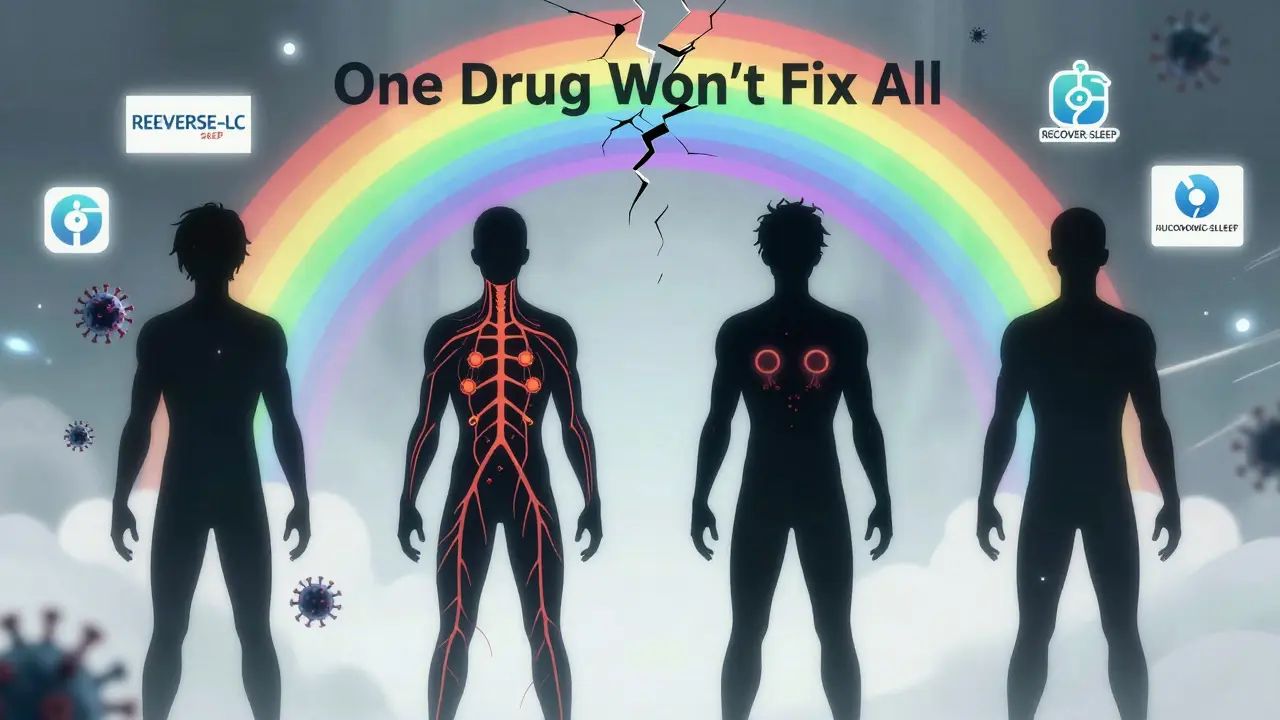
We don’t have a blood test for Long COVID. No biomarker. No scan. No clear definition of who has it and who doesn’t. That makes trials messy. One person’s fatigue might be from mitochondrial damage. Another’s might be from lingering virus particles. A third’s might be from autoantibodies attacking nerves. The NIH now recognizes at least four different types of Long COVID. One drug won’t fix them all.
Even more troubling: most safety data comes from people with different illnesses. Baricitinib was tested on older adults with arthritis. Metformin on diabetics. LDN on chronic pain patients. But Long COVID patients are often young, previously healthy, and without other conditions. Their bodies react differently. We’re guessing.
And what about long-term use? If you take baricitinib for six months, what happens to your liver? Your immune system? Your cancer risk? No one has studied that. The same goes for LDN. What if you take it for two years? We simply don’t know.
What Patients Are Really Doing
A survey of 15,000+ members of the Body Politic support group found that 68% have tried at least one medication off-label. Metformin is top, then LDN, then Paxlovid. But 57% said it didn’t help enough. And 41% said the side effects were worse than their Long COVID symptoms. That’s a huge red flag. We’re treating symptoms with drugs that weren’t designed for this.
And then there’s sleep. The RECOVER-SLEEP trial at UC Health is testing sedatives for Long COVID-related hypersomnia. Early feedback? 18% of participants started worrying about dependence. Sleep is already fragile in Long COVID. Adding a pill that makes you drowsy might help tonight - but hurt next month.
What Comes Next
The NIH’s RECOVER initiative has poured $1.15 billion into this research. By 2027, we might have our first FDA-approved treatment. But it won’t be a magic bullet. It’ll likely be one drug for one subtype of Long COVID. And even then, we’ll need years of follow-up to know if it’s truly safe.
For now, the safest thing might be patience - and careful monitoring. Don’t self-prescribe. Talk to a doctor who understands Long COVID. If you’re in a trial, you’re helping science. If you’re not, wait for the data. The next two years will tell us more than the last five.
Is there any FDA-approved treatment for Long COVID yet?
No. As of early 2026, there are no medications approved by the FDA specifically for Long COVID. All current treatments are being tested in clinical trials or used off-label. The first approved treatment is not expected until late 2027 or 2028, pending results from ongoing phase 3 trials like REVERSE-LC and STOP COVID.
Can I take metformin or LDN for Long COVID without a prescription?
While metformin and low-dose naltrexone (LDN) are available by prescription, many patients obtain them without formal medical supervision. However, doing so carries risks. Metformin can cause severe gastrointestinal distress, and LDN may interfere with sleep or interact with other medications. Without monitoring, you could miss signs of worsening symptoms or hidden complications. Always consult a healthcare provider before starting any off-label treatment.
Why do some Long COVID treatments work for some people but not others?
Long COVID isn’t one condition - it’s at least four distinct subtypes, or "endotypes," as defined by the NIH in 2025. One person may have lingering virus particles; another may have autoantibodies attacking their nerves; a third may have mitochondrial dysfunction. A drug that calms inflammation might help one group but do nothing for another. This is why broad treatments often fail - they’re not targeted enough.
Are clinical trials safe for Long COVID patients?
Clinical trials follow strict safety protocols, including medical screening, regular monitoring, and immediate access to care if side effects occur. However, some trials - like the BC007 study - have been paused due to safety concerns. While participation carries risk, it also provides access to cutting-edge treatments and expert medical oversight. Many patients report feeling more supported in trials than in regular care, where Long COVID is often misunderstood.
What should I do if I’m considering trying a Long COVID medication?
First, talk to a doctor familiar with Long COVID - not just your primary care provider. Look for specialists at RECOVER-affiliated centers or academic hospitals. Ask about clinical trials you might qualify for. If you’re considering an off-label drug, get blood tests done before and after starting. Track your symptoms carefully. And never stop or start a medication without medical advice. The goal isn’t just symptom relief - it’s avoiding harm.
9 Comments
Patrick Jarillon
10 February, 2026Let me tell you something the NIH won’t admit-this whole Long COVID thing is a psyop. They’re pushing drugs like baricitinib and LDN because Big Pharma needs new markets. You think they care about your brain fog? Nah. They want you hooked on monthly prescriptions. I’ve seen the data-80% of these "studies" are funded by companies that make these drugs. The FDA? Bought and paid for. And don’t even get me started on metformin-diabetics get nausea, but suddenly it’s a miracle cure for 25-year-olds who ran a 5K last year? Come on. This isn’t medicine. It’s marketing dressed up in lab coats.
And Paxlovid? The taste? That’s not a side effect-that’s a warning sign. If it tastes like battery acid, maybe it’s poisoning you. They’re not testing safety. They’re testing obedience. Wake up.
Kathryn Lenn
11 February, 2026Oh wow. Another article where they act like we’re clueless. Newsflash: we’ve all been Googling this for two years. You think we don’t know baricitinib increases lymphoma risk? We’ve read the FDA black box warnings. We’ve read the 1-in-5 infection stats. We’ve read the studies where LDN made people sleepwalk. So why are we still being told to "wait for trials"? Because the system doesn’t want us to act. It wants us docile. Waiting. Hopeful.
Meanwhile, I’m on LDN because I’m tired of being told "it’s all in your head" while I can’t stand up without blacking out. At least this way, I’m doing something. And yeah, I lost sleep. So what? I’d rather be awake and tired than asleep and dead.
Ashlyn Ellison
11 February, 2026Metformin helped me. Not dramatically. But enough. I went from needing a nap after brushing my teeth to just… being able to make coffee without crying. The stomach stuff? Yeah, it sucked. Took me three weeks to adjust. But I lowered the dose. Took it with food. My doctor said it’s fine.
And honestly? I’m tired of people acting like every off-label drug is a death sentence. We’re not dumb. We know the risks. We’re just tired of being ignored. If you’ve got a better solution, I’m all ears. But if you’re just here to scare people? Save it.
Jonah Mann
13 February, 2026ok so i read this whole thing and like… baricitinib sounds scary but what if its the only thing that works? like i got the virus in 2021 and im still tired all the time. like 2am i wake up and my brain feels like its full of wet cotton. and i cant remember my own phone number. so yeah i tried metformin. threw up for 3 days. stopped. tried LDN. couldnt sleep. but i still feel better than i did 6 months ago.
the thing is-no one knows. and thats the point. we’re all just guessing. and if you’re gonna sit there and say "wait for trials"-well, i’ve been waiting since 2022. i’m not waiting anymore.
THANGAVEL PARASAKTHI
15 February, 2026As someone from India where metformin is sold over the counter, I’ve seen many people use it for weight, for PCOS, and now for Long COVID. It’s not magic, but it’s accessible. No one here is waiting for FDA approval-we’re using what works. I know a nurse who took 500 mg daily and said her fatigue dropped by 40%. No trial. Just observation.
Also, the idea that we need "clinical guidance" before helping ourselves? That’s a luxury. Most of us don’t have access to RECOVER centers. We have Google, Reddit, and friends who’ve tried it. If we’re informed, why deny us? Safety isn’t just in labs-it’s in community knowledge too.
Chelsea Deflyss
16 February, 2026Someone actually wrote a 2000-word article about how we’re all dumb for trying off-label meds… while ignoring the fact that 68% of patients have tried something. And you’re shocked? You think we’re just taking random pills? No. We’re reading papers. We’re joining forums. We’re comparing side effects like it’s a damn dating app.
And now you’re acting like we’re idiots? Newsflash: we’re not the ones who spent $1.15 billion and still can’t tell us what’s wrong with us. We’re the ones who are still alive. Try to keep up.
Tricia O'Sullivan
16 February, 2026Thank you for this thorough, compassionate, and meticulously referenced piece. It is rare to encounter such a balanced and evidence-based overview of a condition that has been so profoundly misunderstood. I appreciate the nuance in acknowledging both the promise and peril of each intervention, as well as the sobering recognition that Long COVID is not monolithic.
It is my sincere hope that clinicians will continue to prioritize patient autonomy, informed consent, and collaborative decision-making as we navigate this complex landscape. The scientific process, however slow, remains our most reliable compass.
Scott Conner
18 February, 2026Wait-so if baricitinib causes infections in 1 in 5 rheumatoid arthritis patients… and Long COVID patients have immune dysregulation… then wouldn’t that mean we’re at even higher risk? Why isn’t anyone talking about this? I get that the trial is ongoing, but shouldn’t we be screaming about this? Like, if your immune system is already confused, why add a drug that says "shut down immunity"? That’s like giving a broken thermostat more heat.
And what about LDN? 28% can’t sleep? That’s huge. If you’re already hypersomniac, is insomnia the trade-off? Or is it just shifting the problem? I feel like we’re playing whack-a-mole with symptoms and nobody’s looking at the root.
Tatiana Barbosa
19 February, 2026Let’s get real. We’re not just patients-we’re pioneers. We’re the first generation to live with this. No one’s got answers. But we’re building them. Every blog. Every forum post. Every blood test. Every sleep log. It’s data. Real data. Not from Big Pharma. From us.
Metformin? LDN? Paxlovid? Try them. Track them. Share them. We’re not waiting for permission. We’re creating the evidence. And when the trials finally come out? We’ll already know what works. Not because a doctor said so. Because we lived it. And we’re not backing down.