
Vitamin C + Iron Absorption Calculator
Discover how much iron you're actually absorbing based on what you eat or take.
How It Works
This calculator uses science from the article: Vitamin C can boost non-heme iron absorption by 100-200% when taken together. For heme iron (meat sources), vitamin C has little effect.
Expected Results
Enter your values to see absorption results.
Many people take iron supplements to fight fatigue or low hemoglobin, but they don’t realize that vitamin C can make those supplements work far better-or worse-if taken at the wrong time. If you’re eating plant-based foods like spinach, lentils, or fortified cereal, your body struggles to absorb iron unless vitamin C is right there with it. The science is clear: without vitamin C, only about 2-20% of the iron in these foods gets used. With it, that jumps to 30-40%. But here’s the catch: timing matters just as much as what you eat.
Why Vitamin C Makes Iron Work Better
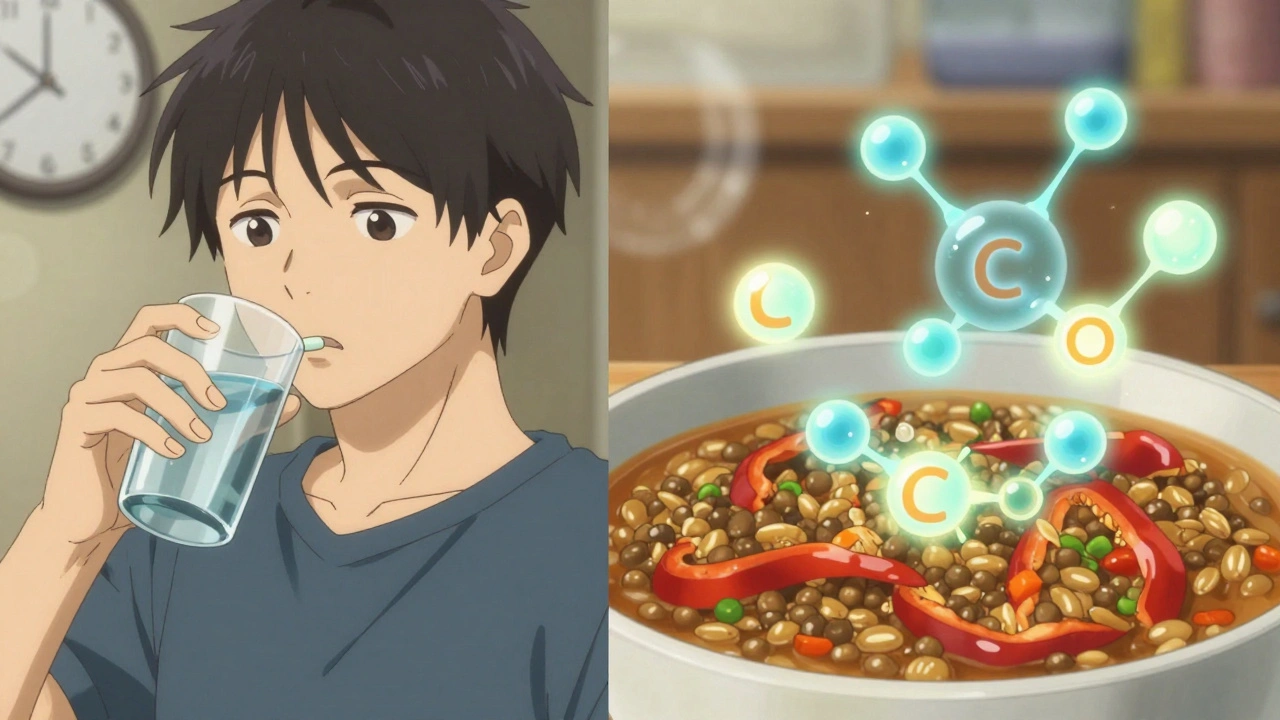
Your body can’t use iron the way it comes in food. Most plant-based iron is in a form called ferric iron (Fe³⁺), which doesn’t dissolve well in your gut. Vitamin C, or ascorbic acid, changes that. It donates electrons to convert ferric iron into ferrous iron (Fe²⁺), the form your body can actually absorb through the lining of your small intestine. This isn’t just theory-it’s been shown in lab studies using X-ray crystallography at Japan’s SPring-8 synchrotron. The process happens right in your duodenum, where vitamin C binds to a specific enzyme called Dcytb and hands off electrons to iron molecules.
Studies show that 100-200mg of vitamin C per meal boosts non-heme iron absorption by 100% to 200%. That’s the same amount you’d get from one medium orange, half a cup of red bell pepper, or a cup of strawberries. It doesn’t matter if you’re vegetarian, vegan, or just trying to get more iron from beans and grains-this trick works. Even better, vitamin C can fight off common inhibitors like tea, coffee, and calcium. One study found that 100mg of vitamin C cancels out the iron-blocking effect of up to 50mg of polyphenols from tea.
What Foods Have Enough Vitamin C?
You don’t need supplements to get the right dose. Real food works just as well, and often better. Here’s what gives you about 100mg of vitamin C:
- One medium orange
- One cup of sliced strawberries
- Half a cup of raw red bell pepper
- 6 ounces of orange juice
- One medium kiwi
- One cup of broccoli florets
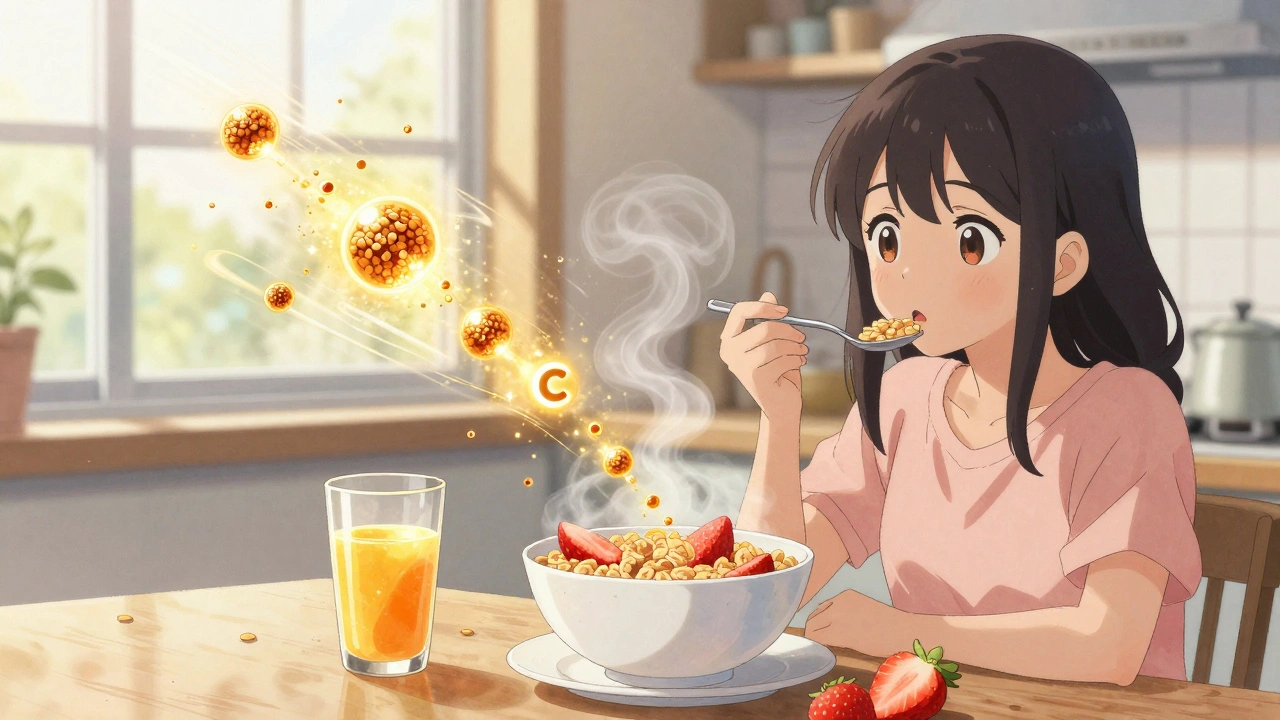
Pair any of these with your iron-rich meal. Try sliced strawberries on oatmeal, red peppers with lentil stew, or an orange after your fortified cereal. Even a small tomato and green pepper salad with your beans can help. The key is to eat them together-not 30 minutes before or after. If you wait too long, the effect drops by half.
When Vitamin C Doesn’t Help
Vitamin C doesn’t boost all types of iron. It has almost no effect on heme iron, which comes from meat, fish, and poultry. That’s because heme iron is already highly absorbable-15-35%-and doesn’t need the same chemical conversion. So if you’re eating steak or chicken, you don’t need to worry about vitamin C. But if you’re relying on plants, it’s essential.
It also doesn’t help if you’re taking too much iron at once. Studies show that above 65mg of elemental iron, adding more vitamin C doesn’t increase absorption. That’s why many doctors recommend splitting higher doses into smaller meals rather than taking one giant pill.
And it won’t work if your stomach acid is low. People with H. pylori infections, chronic gastritis, or those taking long-term antacids often have trouble absorbing iron-even with vitamin C. In those cases, you may need medical help, not just dietary tweaks.
Drugs That Interfere With Iron Absorption
If you’re on medication, vitamin C and iron can’t just be added to your routine without thinking about timing. Several common drugs block iron absorption, and vitamin C won’t fix that.
- Thyroid medication (levothyroxine): Iron and calcium bind to thyroid hormones and prevent absorption. Take your thyroid pill on an empty stomach in the morning, and wait at least 2 hours before eating anything with iron or vitamin C.
- Calcium supplements: Calcium competes with iron for the same absorption pathway. Taking them together cuts iron absorption by 50-60%. Space them out by at least 4 hours. If you take calcium at night, take your iron with dinner-but avoid dairy.
- Antacids and PPIs: Medications like Tums, Maalox, omeprazole, and ranitidine reduce stomach acid, which is needed to convert iron into its absorbable form. Even with vitamin C, these drugs can reduce iron absorption by 70-80%. If you’re on long-term acid reducers, talk to your doctor about iron testing.
- Some antibiotics: Tetracycline and quinolone antibiotics bind to iron and become less effective. Don’t take them within 2-3 hours of iron or vitamin C-rich meals.
Many people don’t realize this. A 2023 survey found that 67% of iron supplement users didn’t know they needed to time their vitamin C. And 44% said their supplement didn’t work-because they forgot to take it with food.
Real-Life Success Stories
A pregnant woman in Michigan, with a hemoglobin level of 9.8 g/dL (low for pregnancy), avoided IV iron therapy by changing her breakfast routine. She switched from plain fortified cereal to cereal with a cup of orange juice and a handful of strawberries. Within eight weeks, her hemoglobin rose to 12.1 g/dL-normal for her stage of pregnancy.
On Reddit, users in r/nutrition reported similar results. One person said, “I used to feel exhausted all day. I started taking my iron with a glass of orange juice instead of water. Within two weeks, I could walk up stairs without gasping.” But others warned: “I took 500mg of vitamin C with my iron and got terrible stomach cramps. Cut it to 100mg and it was fine.”
Amazon reviews back this up. Iron supplements that include vitamin C get 4.2 stars on average, compared to 3.6 for plain iron pills. The top positive comments? “No more constipation” and “Energy came back fast.”

What to Do If You’re Taking Iron
Here’s a simple plan:
- Take iron with food if it upsets your stomach-but only if that food has vitamin C.
- Pair 100-200mg vitamin C with every iron-containing meal or supplement. One orange or a cup of strawberries is enough.
- Avoid tea, coffee, and dairy within 2 hours of taking iron. They block absorption.
- Wait 2 hours after thyroid meds before eating iron-rich meals.
- Space calcium supplements by at least 4 hours.
- If you feel nauseous, lower your iron dose and keep the vitamin C. High doses of vitamin C (over 500mg) can cause stomach upset in 15-20% of people.
Most people get the hang of this within a week. WIC programs in the U.S. have trained millions of participants with just a 20-minute session-and 85% got it right on the first try.
What’s New in 2025?
The FDA now requires all iron supplements made from non-heme sources to include a label saying: “Take with vitamin C-rich foods for better absorption.” That’s new since 2022, and it’s a sign that this isn’t just a nutrition trend-it’s standard medical advice.
Researchers are now testing timed-release pills that deliver vitamin C and iron together in the right part of the gut. And in early 2024, scientists at SPring-8 announced they’re developing compounds that can boost vitamin C’s effect by 40-60% without increasing the dose. That could help the 30% of people who don’t respond well to vitamin C due to genetic differences in their iron transporters.
Apps like MyFitnessPal now have alerts that remind you to pair iron with vitamin C. And the WHO is rolling out SMS reminders in 15 countries to help low-income populations with iron deficiency get the right nutrients at the right time.
Final Takeaway
Vitamin C isn’t magic. It doesn’t turn bad iron into good iron. But it does make the iron you already eat or take-especially from plants-work much better. It’s cheap, safe, and natural. And it’s the most effective dietary trick we have for fighting iron deficiency without pills.
But it’s not a substitute for medical care. If you’re severely anemic, you still need iron supplements or even IV iron. Vitamin C just makes those treatments more effective and reduces side effects like constipation.
So next time you take your iron pill-or eat lentils for dinner-grab an orange. It’s that simple. And if you’re on thyroid meds or antacids? Wait two hours. That’s the difference between your supplement working… and gathering dust on your counter.
Can I take vitamin C and iron together in one supplement?
Yes, many iron supplements now include vitamin C, and that’s a good option. But check the label: you need at least 100mg of vitamin C per dose. Some combo pills only have 25mg, which isn’t enough. If you’re taking a combo pill, avoid extra vitamin C from food or other supplements unless your doctor says otherwise.
Does vitamin C help with iron absorption from meat?
No. Meat contains heme iron, which your body absorbs easily without help. Vitamin C doesn’t improve its absorption. But if you’re eating meat with beans or spinach, vitamin C will still help the plant-based iron in that same meal.
How long does it take to see results from taking vitamin C with iron?
You might feel less tired within 1-2 weeks, especially if your iron levels were low. But it takes 6-12 weeks for your hemoglobin to rise noticeably. Blood tests are the only way to know for sure. Don’t stop taking iron just because you feel better.
Can too much vitamin C cause problems with iron?
In healthy people, no. Vitamin C only helps absorb iron you need. But if you have hemochromatosis (a genetic iron overload disorder), extra vitamin C can make it worse by increasing iron absorption too much. If you have this condition, avoid high-dose vitamin C with meals and talk to your doctor.
Is it better to get vitamin C from food or pills?
Food is better. Whole foods like oranges and bell peppers come with fiber and other nutrients that help digestion. But if you can’t eat enough fruit or veggies, a 100mg vitamin C tablet is fine. Just don’t go over 500mg per day unless your doctor recommends it.
What if I forget to take vitamin C with my iron?
Don’t panic. Just take your next dose with vitamin C. Missing one meal won’t ruin your progress. But if you do it consistently without vitamin C, your iron levels won’t improve as fast-or at all. Try setting a phone reminder or pairing it with a daily habit, like brushing your teeth or drinking coffee.
14 Comments
Anna Roh
9 December, 2025So just eat an orange with your iron pill? That’s it? I’ve been wasting money on fancy supplements for years.
Tim Tinh
10 December, 2025Bro this is the kind of info that should be on every supplement bottle. I took iron for months and never knew to pair it with food. My energy finally came back after I started doing the orange thing. No more 3pm crashes. 🙌
Simran Chettiar
10 December, 2025It is indeed a profound revelation, this interplay between ascorbic acid and ferrous ions within the duodenal microenvironment. The biochemical elegance of electron donation by vitamin C to facilitate the reduction of Fe³⁺ to Fe²⁺ is not merely a nutritional hack-it is a testament to the intricate choreography of human physiology. One cannot help but marvel at how nature, in its infinite wisdom, has embedded this mechanism into the very fabric of dietary iron utilization. To overlook this is to ignore a symphony played in the silent chambers of our intestines.
And yet, the modern world, obsessed with quick fixes and synthetic formulations, reduces this sublime process to a mere dietary tip. We are taught to consume pills, not to understand the dance of molecules. The SPring-8 synchrotron studies, though cited, remain unappreciated by the masses who would rather scroll than synthesize knowledge. We have lost the art of digestion-not just of food, but of understanding.
It is not enough to say 'eat an orange.' We must ask: why does the orange work? Why does the bell pepper outperform the tablet? Because food is not a vehicle for isolated compounds-it is a living matrix of co-factors, fiber, and phytonutrients that guide absorption with grace. The body does not crave ascorbic acid in isolation. It craves context. And in this context lies the true remedy-not supplementation, but reconnection.
Moreover, the cultural neglect of traditional food pairings-lentils with lemon in India, beans with tomatoes in Mexico-is a tragedy of epistemological erasure. Colonial nutrition science discarded these wisdoms in favor of reductionist metrics. Yet, here we are, rediscovering what grandmothers knew all along. Perhaps the future of medicine is not in labs, but in kitchens.
And let us not forget the psychological dimension: the ritual of pairing food with intention. To eat with awareness is to reclaim agency over one’s biology. In a world of algorithmic diets and AI-generated meal plans, choosing an orange because you know it matters-that is rebellion.
So yes, take the orange. But do so mindfully. Let it be a meditation, not a checkbox.
Brianna Black
11 December, 2025OMG I just realized I’ve been taking my iron with coffee for two years. No wonder I felt like a zombie. I’m switching to orange juice now. This is life-changing. Thank you for writing this like a superhero guide to not being tired all the time. 🙏🍊
Asset Finance Komrade
12 December, 2025Interesting. But let’s not pretend this is new. Indigenous cultures have paired vitamin C-rich foods with iron sources for millennia. The West only 'discovers' things after they’ve been common knowledge elsewhere for centuries. Also, the FDA labeling change? More PR than science. The real issue is systemic malnutrition due to food deserts-not people forgetting their oranges.
And the WHO SMS reminders? Cute. But if you can’t afford oranges, a text won’t help. This reads like wellness content for the privileged. Iron deficiency is a poverty issue. Not a 'forget your fruit' issue.
Ronald Ezamaru
13 December, 2025Just want to add: if you’re on PPIs or have low stomach acid, vitamin C alone won’t fix it. I had a patient with H. pylori who took vitamin C with iron daily for 6 months-hemoglobin didn’t budge. Once we treated the infection and added HCl supplements under supervision, her levels shot up. Don’t assume it’s just timing. Underlying GI issues are common and often missed.
Shubham Mathur
15 December, 2025Guys I’ve been doing this for years with my lentils and tomatoes and I swear it’s the only reason I didn’t need supplements. My mom taught me to put lemon on dal when I was a kid. Why is this even a question? Also if you’re taking iron with calcium you’re doing it wrong. Calcium is the enemy of iron. Stop eating yogurt with your iron pill. Simple.
Stacy Tolbert
15 December, 2025I tried taking vitamin C with iron and got stomach cramps so bad I thought I was having appendicitis. Cut it to 50mg and it was fine. So don’t go overboard. Less is more. And if you’re not feeling better after 4 weeks, see a doctor. It’s not magic, it’s medicine.
Michael Robinson
17 December, 2025So eat fruit with your iron. That’s the whole thing? Seems too simple. But maybe that’s how it works. Simple things fix the big problems.
Tiffany Sowby
17 December, 2025Of course vitamin C helps. But why does the FDA only care now? Because someone made a supplement with it and got rich. This is capitalism disguised as science. They didn’t care until they could sell it. And now they’re pushing it on everyone like it’s a miracle. Wake up.
Andrea Petrov
19 December, 2025Did you know the WHO is pushing this because Big Pharma wants you to keep taking iron supplements instead of fixing the food system? This is a distraction. The real problem is glyphosate in our food destroying nutrient uptake. Vitamin C is just a bandaid. They don’t want you to know that.
Sarah Gray
19 December, 2025It’s amusing how casually people treat biochemistry as if it were a cooking tip. The notion that one orange ‘fixes’ iron absorption ignores genetic polymorphisms in DMT1 and ferroportin transporters. Not everyone responds. And your anecdotal ‘I felt better’ is not evidence. Peer-reviewed studies require controls, blinding, and statistical significance. Please stop treating nutrition like a TikTok trend.
Katie Harrison
20 December, 2025I’m Canadian, and we’ve been teaching this in school nutrition programs since the 90s. Why is this news in the US? Also, I’ve seen too many people take 1000mg vitamin C thinking it’s better. It’s not. It just gives them diarrhea. Stick to 100–200mg. And yes, food > pills. Always.
Tim Tinh
21 December, 2025Hey @5744 - you’re totally right about the H. pylori thing. My cousin had the same issue. She thought her iron pill wasn’t working, but it was her stomach. Got tested, treated it, and now she’s fine. Good call.