
Sun Protection Risk Calculator
Your Personal Sun Protection Assessment
This calculator determines your sun exposure risk based on medications, location, and protection methods. Results are based on medical guidelines for photosensitive skin.
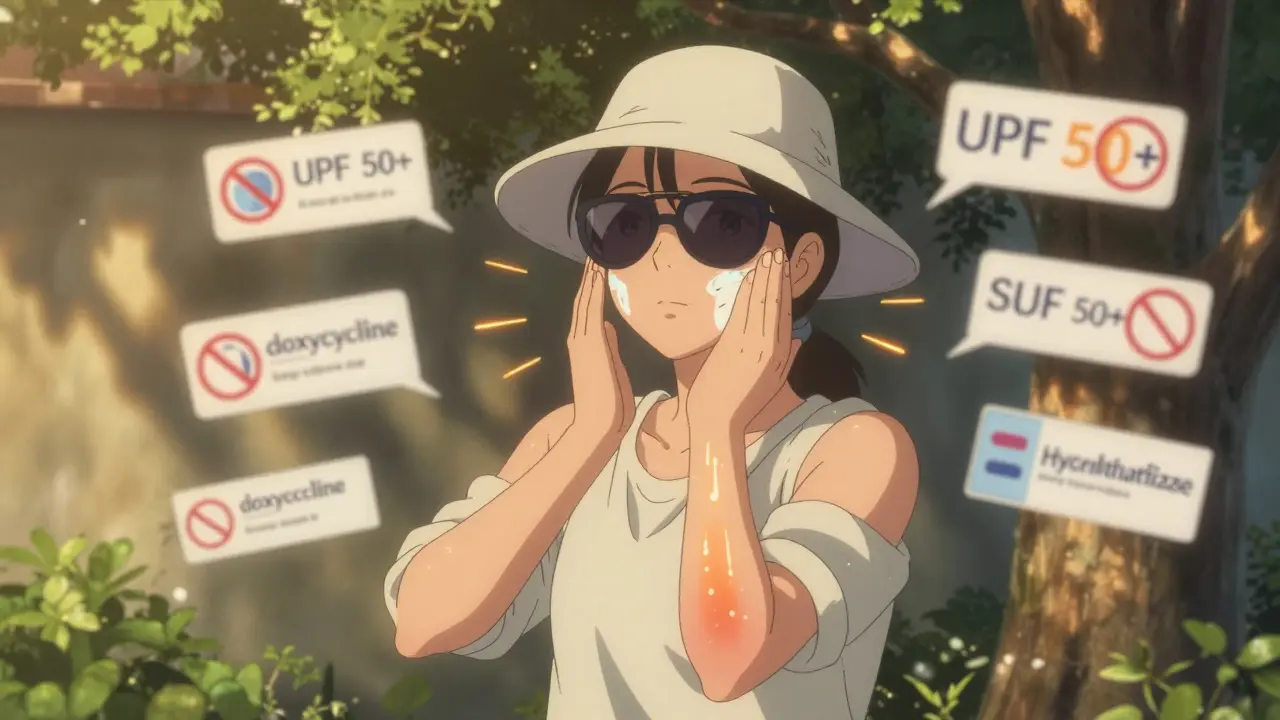
When your skin reacts badly to the sun - even with just a few minutes of exposure - it’s not just a bad sunburn. It could be photosensitivity, a condition where your skin becomes unusually sensitive to ultraviolet (UV) light. This isn’t rare. About 1 in 5 people in the U.S. will develop skin cancer by age 70, and for those with photosensitivity, the risk is even higher. If you’re on medications like doxycycline, ibuprofen, or hydrochlorothiazide, or have conditions like lupus or porphyria, your skin may be reacting to sunlight in ways most people never experience. The good news? You can prevent these reactions. Not with luck. Not with luck. With a clear, practical plan.
Understand What Photosensitivity Really Means
Photosensitivity isn’t one thing. It comes in two main forms: phototoxic and photoallergic. Phototoxic reactions are more common. They look like a severe sunburn - red, painful, sometimes blistering - and happen within minutes or hours of sun exposure. They’re dose-dependent: more sun, worse reaction. Photoallergic reactions are rarer. They’re immune-driven, can appear days later, and often spread beyond sun-exposed areas. Both are triggered by UV light, but the body’s response is different.
What makes this worse? Many everyday things increase your risk. Antibiotics. Diuretics. Anti-inflammatories. Even some skincare products with retinols, alpha-hydroxy acids, or bergamot oil. If you’re taking any medication, check with your pharmacist. Don’t assume it’s safe. Many people don’t realize their pill is making them sun-sensitive until they get burned in the shade.
SPF Isn’t Enough - Here’s What Actually Works
Most people think SPF 30 is enough. For someone with normal skin, maybe. For someone with photosensitivity? Not even close. The Skin Cancer Foundation recommends SPF 50+ for high-risk individuals. Why? SPF 30 blocks about 97% of UVB rays. SPF 50 blocks 98%. That 1% difference matters when your skin reacts to tiny amounts of radiation.
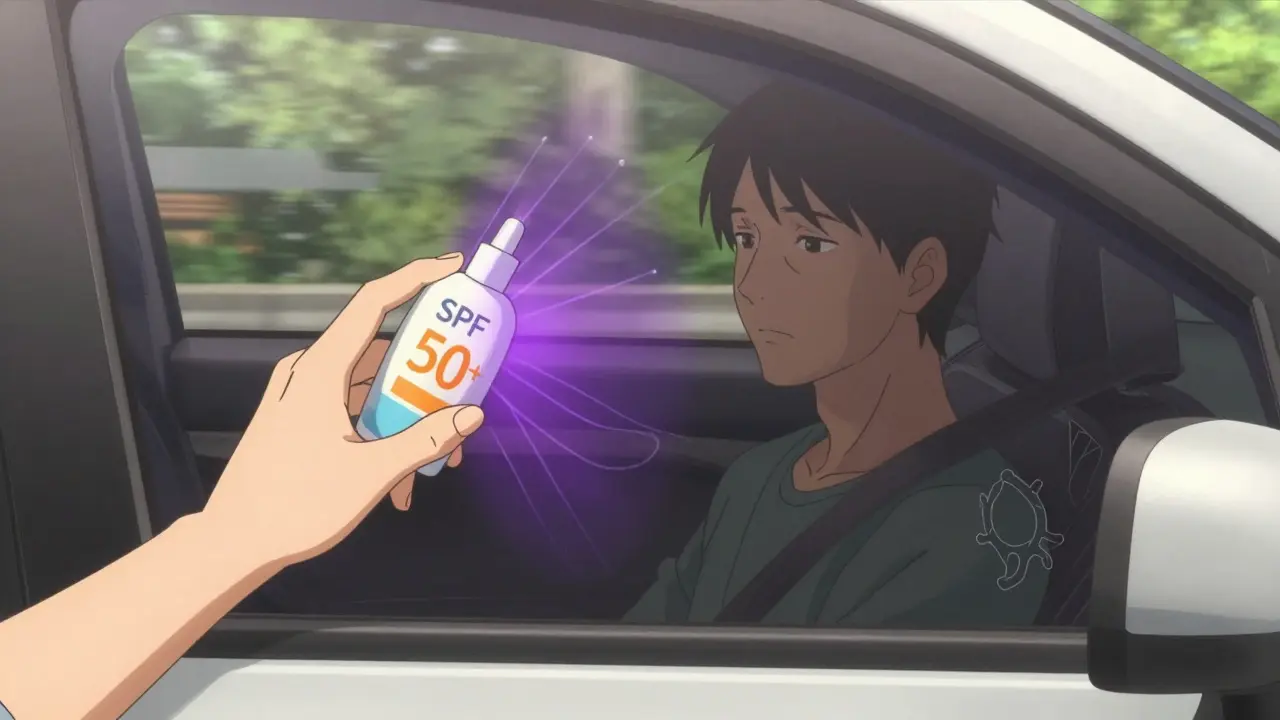
But SPF alone won’t save you. You need broad-spectrum protection - meaning it blocks both UVB (burning rays) and UVA (aging, deeper damage rays). Standard glass blocks 97% of UVB but only 37% of UVA. That means you can get a reaction sitting by a window, driving in your car, or working near a sunny office window. That’s why people with severe photosensitivity install UV-blocking film on windows. It blocks 99% of UVA. It costs $5-$15 per square foot. It’s worth it.
And sunscreen? Apply it right. You need about 1 ounce - a shot glass full - to cover your whole body. Most people use half that. And reapply every two hours. If you sweat or swim, reapply immediately. Set phone reminders. Yes, really. One Reddit user with lupus set hourly alarms for two years. It saved their skin.
Clothing Is Your Best Defense
Forget the thin white T-shirt. That offers almost no protection. A regular cotton shirt might block only UPF 5 - meaning 20% of UV gets through. You need UPF 50+ clothing. That means only 2% of UV radiation reaches your skin. It’s not magic. It’s science. Look for tightly woven fabrics like polyester, denim, or wool. Dark colors absorb more UV than light ones. But if it’s hot, lightweight UPF 50+ cotton blends exist. They’re breathable, cool, and effective.
Wear long sleeves. Wear a wide-brimmed hat. Wear UV-blocking sunglasses. Cover your ears. Cover your neck. People forget these areas. That’s where skin cancer often starts. A UPF 50+ sun shirt costs $40-$80. It lasts years. Compared to the cost of a dermatologist visit, a biopsy, or worse - it’s a bargain.
Shade, Sunscreen, and Timing - The Real Combo
Shade alone cuts UV exposure by 50-95%, depending on the structure. But it’s not foolproof. UV scatters in the air. You can still get burned under a tree or umbrella. That’s why you need shade plus clothing plus sunscreen. Don’t rely on one.
Timing matters too. UV radiation peaks between 10 a.m. and 4 p.m. - when your shadow is shorter than you are. Plan outdoor time for early morning or late afternoon. If you’re in Sydney, check the UV index daily. When it hits 3 or higher, protection is mandatory. In summer, it often hits 12-14. That’s extreme.
Oral Protection? Yes, But Not as a Replacement
Some supplements help. Not as a shield, but as extra armor. Polypodium leucotomos, an extract from a fern, has been shown in studies to reduce sun damage. It gives you about SPF 3-5 of systemic protection. Nicotinamide (vitamin B3) is even more powerful. A major 2015 study in the New England Journal of Medicine found that taking 500mg twice daily reduced new non-melanoma skin cancers by 23% in high-risk patients. It’s not a cure. But for people with a history of skin cancer or severe photosensitivity, it’s a proven layer of defense.
Don’t take these instead of sunscreen. Take them with it. Think of them like seatbelts - they don’t replace the airbag, but they help if something goes wrong.
What to Avoid - Even If It Seems Harmless
Some products you use daily can make things worse. Aloe vera? Great for sunburn. But if you use it before sun exposure, it might increase sensitivity. Essential oils like bergamot, lime, or lemon in perfumes or lotions? They’re phototoxic. Even some toothpastes with triclosan can cause reactions. Read labels. Ask your dermatologist. Keep a journal: note what you used, where you were, and when you reacted. Patterns emerge.
And don’t trust tanning lotions. Dihydroxyacetone (DHA) - the ingredient that gives fake tan its color - gives you SPF 3 at best. That’s nothing. It gives a false sense of security. You’re still burning.
When to Call a Dermatologist
If you’re having repeated reactions - even with full protection - see a specialist. You might need a phototest. That’s when your skin is exposed to controlled UV light to confirm photosensitivity and find your threshold. It’s not painful. It’s precise. And it tells you exactly how much sun you can handle - if any.
Also, if you’re on a new medication, ask: “Is this photosensitizing?” Don’t wait for a reaction. Prevention is easier than repair.
Real-Life Adjustments - Because Life Doesn’t Stop
People with severe photosensitivity adapt. Some work night shifts. Some install UV film on car windows. Some carry portable UPF 50+ canopies to the park. One woman in Melbourne started using a sun hat with a built-in neck flap and UV-blocking mesh - she says it’s the only way she can walk her dog without breaking out.
It’s not about living in the dark. It’s about living smart. You don’t have to quit the beach. You just need the right tools. And you don’t have to suffer. With the right plan, you can enjoy the outdoors without paying the price.
Can I still go outside if I have photosensitivity?
Yes, but you need a strict routine. Use UPF 50+ clothing, apply SPF 50+ broad-spectrum sunscreen every two hours, wear a wide-brimmed hat and sunglasses, and avoid being outside between 10 a.m. and 4 p.m. Install UV-blocking film on windows at home and in your car. With these steps, you can safely enjoy outdoor time.
Is SPF 30 enough for photosensitive skin?
No. SPF 30 blocks 97% of UVB rays. SPF 50 blocks 98%. That extra 1% makes a big difference when your skin reacts to tiny amounts of UV. For photosensitive skin, always use SPF 50+ with broad-spectrum coverage. Also, make sure it’s water-resistant and contains zinc oxide or titanium dioxide - these physical blockers are less likely to irritate sensitive skin.
Do I need to protect myself indoors?
Yes. Standard glass blocks UVB but lets through 75% of UVA radiation. You can get a reaction sitting by a window, driving, or working near sunlight. Install UV-blocking window film (blocks 99% of UVA). It’s affordable and effective. Also, avoid using skincare products with retinols or AHAs indoors if you’re near sunlight.
Can supplements like vitamin B3 help?
Yes. Nicotinamide (vitamin B3) at 500mg twice daily has been shown in clinical trials to reduce new non-melanoma skin cancers by 23% in high-risk individuals. It’s not a replacement for sunscreen or clothing, but it adds an extra layer of protection, especially for people with a history of skin damage or photosensitivity. Talk to your doctor before starting.
What clothing gives the best UV protection?
Look for clothing labeled UPF 50+. Tightly woven fabrics like polyester, denim, or wool offer the best protection. Dark colors absorb more UV than light ones. But if you live in a hot climate, lightweight UPF 50+ cotton blends are available and still block 98% of UV. Avoid thin, light-colored cotton - it lets through too much radiation. Always check the UPF rating, not just the color or thickness.
Are tanning beds safe for people with photosensitivity?
No. Tanning beds emit intense UVA and UVB radiation - often stronger than the midday sun. For someone with photosensitivity, they can trigger severe reactions, including blistering, long-lasting rashes, and increased cancer risk. Even one session can be dangerous. Avoid them completely. There’s no safe level of artificial UV for photosensitive skin.
Can I use regular sunscreen if I have sensitive skin?
Chemical sunscreens (like avobenzone or oxybenzone) can irritate sensitive or photosensitive skin. They need time to absorb and can trigger allergic reactions. Use mineral sunscreens with zinc oxide or titanium dioxide instead. They sit on top of the skin, block UV immediately, and are less likely to cause irritation. Look for fragrance-free, non-comedogenic formulas.
How do I know if my medication causes photosensitivity?
Ask your pharmacist or doctor. Common culprits include antibiotics (like doxycycline), diuretics (like hydrochlorothiazide), NSAIDs (like ibuprofen), and some antidepressants or diabetes drugs. Check the medication leaflet for warnings like "may increase sun sensitivity." If you’re unsure, assume it does - and protect yourself.
9 Comments
Brad Ralph
11 February, 2026SPF 50+? More like SPF ‘I-don’t-want-to-see-my-skin-again’.
Also, UV-blocking window film? Bro, I didn’t know my couch was a death trap.
Now I’m paranoid about my car seat. 😅
Autumn Frankart
11 February, 2026They’re lying. The government doesn’t want you to know this, but UVA rays are weaponized by Big Pharma to sell more sunscreen.
And those ‘UPF 50+’ shirts? Made in China with nanoparticles that leak into your lymph nodes.
Check the label - if it doesn’t say ‘Made in USA’, it’s a trap.
I’ve been wearing aluminum foil hats since 2018. Still alive. Coincidence? I think not.
Vamsi Krishna
12 February, 2026Bro, you think SPF 50 is enough? HA. I’ve been photosensitive since I took doxycycline in Goa. I wore a full-body burqa, three layers of UPF 50+ cotton, and still got blistered under a tree.
Turns out, the problem isn’t the sun - it’s the *cosmic radiation* that sneaks through the ozone layer.
Also, your ‘broad-spectrum’ sunscreen? Probably laced with glyphosate. I read a Reddit thread. Trust me, I’m a pharmacist.
Next time, try raw turmeric paste. It’s ancient Indian science. Works better than your fancy lab chemicals. Also, stop using deodorant - aluminum blocks your aura.
Robert Petersen
13 February, 2026This is the most practical, life-saving guide I’ve read in years.
Seriously - if you’ve got photosensitivity, treat your skin like it’s made of glass.
UPF clothing? Worth every penny.
UV film on your windows? Do it.
Nicotinamide? Talk to your doc.
You’re not being dramatic - you’re being smart.
And yeah, setting hourly alarms? I did it for six months. Saved my skin. No regrets.
You’re not alone. We’re all out here, hiding under hats like sun ninjas. And we’re winning.
Suzette Smith
14 February, 2026Wait - so you’re telling me I can’t just ‘be careful’? I thought I was being responsible by using SPF 30 and a hat.
Now I’m supposed to buy $80 shirts, install film on my windows, and take vitamin B3 pills?
What’s next? Do I have to wear sunglasses indoors? Am I gonna get fined if I forget my UPF 50+ socks?
Just let me live my life, please.
Also, I love aloe vera. I’m not giving it up.
steve sunio
15 February, 2026lmao u spent 1000 words to say ‘dont go in sun’
also u say ‘phototoxic’ like u r doctor
my cousin in lagos got sunburn in 5 min n he never even used sunscreen
u overcomplicating
just stay inside bro
and stop selling clothes
lol
athmaja biju
15 February, 2026As an Indian man who survived 40°C summers in Delhi without sunscreen, I find this article alarmingly westernized.
Our ancestors didn’t have UPF 50+ shirts - they had turbans, coconut oil, and discipline.
Why are we outsourcing survival to corporate sunwear brands?
Also, ‘nicotinamide’? That’s just niacin. We’ve been using it in Ayurveda for centuries.
Stop marketing fear. Start respecting tradition.
Reggie McIntyre
16 February, 2026Okay, real talk - I used to think I was just ‘fair-skinned and unlucky’ until I got a phototest.
Turns out, I’m photoallergic to my own laundry detergent.
Yeah. Detergent.
My dermatologist said it’s the fragrance + UV combo.
Switched to free & clear. No more rashes.
Also - I carry a portable UPF canopy to the park. I look like a weirdo. My dog thinks I’m a tent.
Worth it.
And yes, I set phone alarms.
And yes, I wear a hat in the car.
And yes, I still go outside.
Just… smarter.
Life doesn’t stop. You just upgrade your gear.
Stephon Devereux
17 February, 2026One of the most important things I’ve ever read - and I’ve read a lot.
Let me add this: if you’re on meds, ask your pharmacist *before* the sun hits your skin.
Don’t wait for a blister.
And if you’re scared to ask - I get it. I was too.
But here’s the truth: your skin isn’t fragile. It’s just *informed*.
And you’re not being overly cautious - you’re being proactive.
UPF clothing? It’s not fashion. It’s armor.
UV film? It’s not a luxury. It’s a necessity.
Nicotinamide? It’s not magic. It’s science.
You’re not alone. There’s a whole community out here - wearing hats, carrying sunscreen, and laughing about how ridiculous this all is.
But we’re still here.
And we’re still living.
Keep going. You’ve got this.