
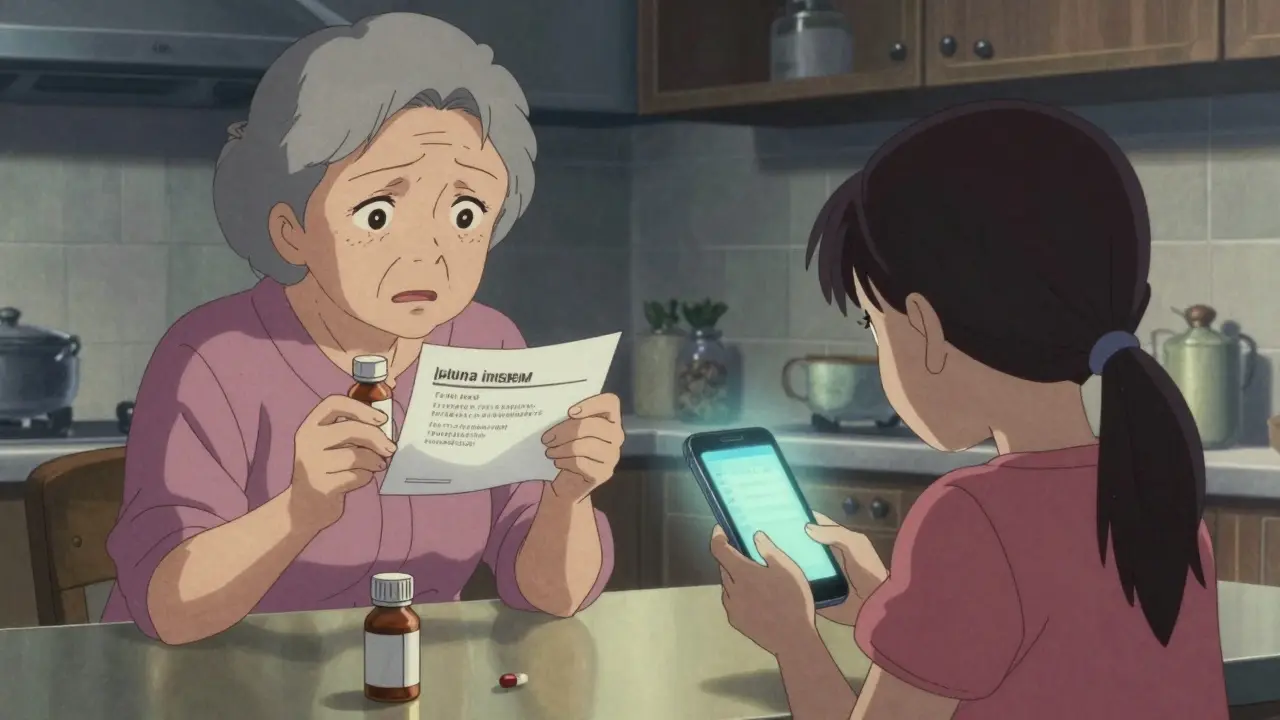
Every year, thousands of people in the U.S. end up in the hospital because they didn’t understand their medication instructions. Not because they were careless. Not because they didn’t care. But because the doctor, pharmacist, or nurse spoke a different language than they did. This isn’t rare. It’s common. And it’s dangerous.
What Happens When You Can’t Understand Your Prescription
Imagine you’re given a bottle of insulin. The label says "take one dropperful at bedtime." But you’ve never seen a dropperful. You don’t know if that’s a drop, a teaspoon, or half a cap. The pharmacist hands you a printed sheet in English. You can’t read it. Your child translates, but they’re 10 years old and don’t know what "bid" means. That’s not a mistake-it’s a system failure. Studies show that families with limited English proficiency (LEP) are twice as likely to make dangerous medication errors. In one 2022 study from Children’s Hospital of Philadelphia, 17.7% of LEP families reported an adverse drug event, compared to just 9.6% of English-speaking families. That’s not just a number. That’s a child with low blood sugar. A senior with a fall from dizziness. A parent who doesn’t know if they’re giving too much or too little. The problem isn’t just pills and doses. It’s timing, side effects, food interactions, refill dates. One Reddit user shared how their Spanish-speaking mother was told to take her blood thinner "every other day"-but the pharmacy’s Google Translate said "every day." She ended up in the ER with internal bleeding. That’s not an accident. It’s preventable.Why Family Members Aren’t Enough
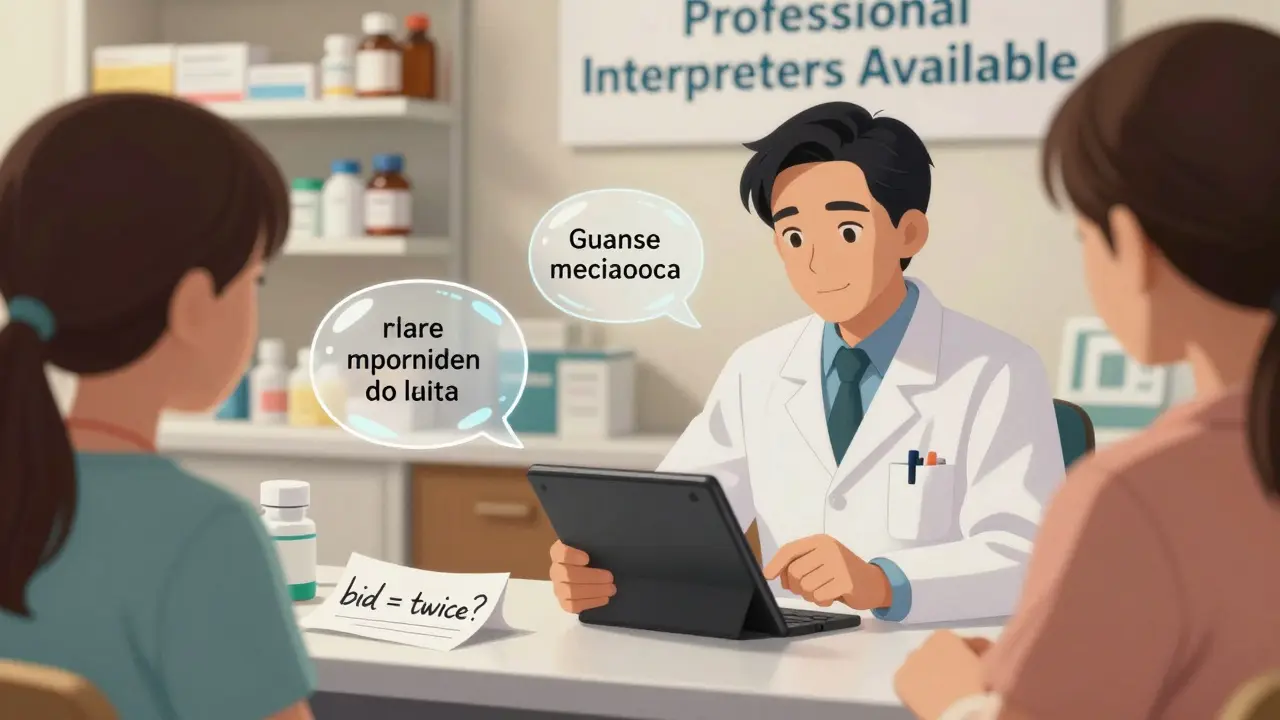
Many people rely on kids, neighbors, or friends to translate. It feels natural. It feels cheaper. But it’s risky. A 2020 review in the Journal of General Internal Medicine found that 25% of translations done by untrained people contain serious medical errors. Why? Because they don’t know the difference between "hypertension" and "tachycardia." They don’t know that "as needed" means something different than "every four hours." They might skip scary words like "allergic reaction" or "seizure risk" because they’re trying to be helpful, not accurate. In Milwaukee, a study found that nearly half of pharmacies never or only sometimes offered non-English instructions. And in 1 in 9 cases, they used family members instead of trained interpreters. That’s not care. That’s gambling with someone’s life.What Actually Works: Professional Help
There’s a better way. And it’s not expensive. It’s not complicated. It’s just not used enough. Professional interpreters-whether in person, over the phone, or via video-cut medication errors by up to 50%. That’s not a guess. That’s from a 2017 analysis of over 7,000 cases. Hospitals and clinics that use trained interpreters see fewer readmissions, fewer ER visits, and fewer lawsuits. Here’s what good language access looks like:- A nurse asks every patient, "What language do you speak best?" at check-in-not just when they look "foreign."
- Prescription labels are printed in Spanish, Mandarin, Arabic, Vietnamese, or whatever language the patient uses.
- Pharmacists use video interpreters during counseling, not just hand out a paper.
- Patients are asked to repeat back instructions in their own words-called the "teach-back" method.
- For high-risk meds like insulin or blood thinners, staff watch the patient take the dose first.
The Hidden Barriers: Why This Isn’t Fixed Yet
You’d think this would be standard by now. But it’s not. The biggest reason? Staff don’t know how to ask. A national survey found 68% of hospitals don’t identify LEP patients before they even see a doctor. That means the first interaction is already broken. Then there’s cost. Hospitals spend about $2.5 billion a year on language services. But Medicare and Medicaid rarely reimburse for it. So clinics cut corners. They skip interpreters. They rely on apps. They hand out Google Translate printouts. And the tech isn’t ready. A 2021 study in the Bronx found that pharmacy systems couldn’t translate basic terms like "dropperful" or "for thirty days." AI tools still mix up "once daily" with "twice daily." They don’t understand medical context. They don’t know when to pause for clarification. Even worse? Many staff feel awkward asking about language. They fear offending someone. They think, "They’ll tell me if they need help." But 37% of LEP adults say they’ve had fewer than half their visits with someone who spoke their language. And 15% had no language-concordant provider in three years.What You Can Do Right Now
You don’t have to wait for a hospital to fix this. If you or someone you care for speaks a language other than English, here’s what to do:- Always say your preferred language when you call to make an appointment. Say it again when you check in.
- Ask: "Can I get my prescription instructions in my language?" If they say no, ask for a supervisor.
- Don’t let a child translate critical meds. Request a professional interpreter. You have the right.
- Use the "teach-back" method: "Can you show me how you’ll take this pill?" If they can’t, they don’t understand.
- Bring a friend who speaks both languages. Not to translate everything-but to double-check the dose and timing.
9 Comments
Cheryl Griffith
16 January, 2026I saw this happen to my aunt last year. She’s from Guatemala and got prescribed warfarin. The pharmacist handed her a sheet in English, said ‘read this’ and walked away. Her grandson, 12, tried to translate but missed ‘take every other day’ - thought it said ‘every day.’ She bled internally for three days before anyone figured it out. We were lucky she didn’t die. This isn’t just about language - it’s about dignity. Everyone deserves to understand what’s going into their body.
Why do we treat non-English speakers like they’re optional patients?
It’s not hard. Just hire interpreters. Print labels in multiple languages. Teach-back. Done.
swarnima singh
18 January, 2026people always say ‘oh its just a language barrier’ like its some cute lil problem not a murder waiting to happen. we live in a world where a kid can translate ‘as needed’ to ‘every hour’ and no one bats an eye. we let corporations save 50 bucks by using google translate instead of a real person. and then we act shocked when someone dies. its not about language. its about who we decide is worth saving.
if you dont speak english you arent a patient. you’re a liability.
Rob Deneke
18 January, 2026My sister works at a clinic in Ohio and they started using video interpreters last year. Medication errors dropped by half. No magic. Just people who know medical terms. You wanna fix this? Fund it. Stop treating language access like a charity. It’s healthcare. Period.
And stop asking patients to bring a kid. That’s not help. That’s exploitation.
Corey Chrisinger
19 January, 2026There’s something deeply human about this. We’ve built entire systems to diagnose cancer, monitor heart rhythms, track gene mutations - but when someone says ‘I don’t speak English,’ we hand them a printout and call it good.
Language isn’t just words. It’s trust. It’s safety. It’s the difference between ‘I understand’ and ‘I hope I got it right.’
And yeah, AI is coming. But right now, it still thinks ‘dropperful’ is a typo. We don’t need more tech. We need more care.
🫂
Melodie Lesesne
19 January, 2026This is so important. I work in a pharmacy and we just started offering translated labels for Spanish, Mandarin, and Vietnamese. The feedback has been incredible. People cry. Not because they’re grateful - because they finally feel seen.
It’s not expensive. It’s not complicated. It’s just not prioritized. If we can print 100 languages on a cereal box, why not a life-saving pill bottle?
Let’s make this normal. Not heroic. Just normal.
Bianca Leonhardt
21 January, 2026Stop acting like this is a mystery. People who don’t speak English shouldn’t be allowed to manage their own meds. It’s not discrimination. It’s common sense. If you can’t read the instructions, you shouldn’t be trusted with dangerous drugs. Get a translator. Or don’t take it. Simple.
And stop blaming the system. It’s not the system’s fault people refuse to learn English. That’s their problem, not ours.
Travis Craw
23 January, 2026My mom’s from Mexico and she used to take her meds with me translating. I was 14. I didn’t know what ‘bid’ meant. I thought ‘take as needed’ meant ‘take when you feel bad.’ She ended up with liver damage. We didn’t know until it was too late.
They never asked her what language she spoke. Not once.
I’m not mad. Just tired. This shouldn’t be rare.
Christina Bilotti
24 January, 2026Oh wow. Another ‘poor immigrants can’t read’ sob story. Let me guess - next you’ll tell us they also can’t tie their shoes or use a toilet? 🤦♀️
It’s 2024. There are apps. Google Translate. Duolingo. People have phones. If you can’t be bothered to learn the language of the country you live in, that’s your problem. Not the hospital’s.
And ‘teach-back’? That’s just another woke buzzword for ‘make the poor feel guilty.’
Meanwhile, my cousin’s 75-year-old dad took his insulin correctly for 12 years. He learned English. He read the labels. He didn’t need a translator. Why can’t everyone do that?
brooke wright
26 January, 2026Can we just agree that using kids as translators is a crime? I’ve seen it so many times. A 9-year-old translating chemo instructions. A 13-year-old explaining ‘seizure risk’ to their grandma. No one bats an eye. But if a nurse asks a patient ‘what language do you speak?’ - suddenly it’s ‘racist’ or ‘weird.’
It’s not weird. It’s basic. It’s human. And if you’re a provider and you don’t do this - you’re not a healer. You’re a liability.