

Medication Organizer Recommender
Find Your Perfect Solution
Answer 3 quick questions to get personalized recommendations for organizing your medications safely.
Answer the questions above to see your personalized recommendation.
Missing a pill. Taking two by accident. Forgetting if you already took your blood pressure medicine today. These aren’t just small mistakes-they’re dangerous. Every year, medication errors send hundreds of thousands to the hospital and cause thousands of deaths in the U.S. alone. The good news? You don’t have to guess or rely on memory. Organizing your meds with the right tools and habits can cut those risks dramatically.
Why Medication Organization Matters
If you’re taking even two or three pills a day, you’re already at risk. The World Health Organization says only about half of people with chronic conditions take their meds as prescribed. That’s not laziness-it’s often confusion. Pills look alike. Schedules get mixed up. Bottles pile up on the counter. A simple misstep can lead to a fall, a stroke, or worse. The fix isn’t complicated. It’s about creating systems that work for your life, not against it. Whether you’re managing high blood pressure, diabetes, or just a few daily supplements, a solid medication plan isn’t optional. It’s your safety net.Manual Pill Organizers: Simple, Cheap, and Still Effective
The most common tool is the humble 7-day pill box. These come in basic plastic trays with compartments for morning, noon, night, and sometimes bedtime. You load them once a week. Some have big, easy-to-read labels. Others have locks or alarms built in. They cost between $3 and $25. No batteries. No Wi-Fi. No app to download. For many older adults, that’s a plus. You can see your pills. You can feel them. You don’t need tech skills. But here’s the catch: they only work if you remember to fill them. If you’re out of town, sick, or just overwhelmed, you might skip a day. And if you take more than four doses a day, you’ll need multiple boxes. That’s where things get messy. A real-world tip from Sydney: Many local pharmacies offer free weekly blister packs. You give them your list, and they pre-pack each dose in a sealed, labeled pouch. No loading needed. Just pull the tab and take it. This is a game-changer for people on complex regimens.Digital Pill Dispensers: When Memory Isn’t Enough
If you’ve ever missed a dose and felt guilty-or worse, scared-then a smart dispenser might be worth considering. These are not just boxes. They’re automated systems that dispense pills at the right time, flash lights, play voice alerts, and even text a family member if you skip a dose. The MedaCube is one of the most popular. It holds up to 90 days of pills. It can handle up to 16 pills per dose. It connects to Wi-Fi. Your caregiver can log in from anywhere and see if you took your meds. One 73-year-old user in Perth said, “My daughter lives 300 miles away. Now she sleeps better.” But these aren’t perfect. They cost $1,499. If the screen freezes or the Wi-Fi goes out, you’re stuck. One user on Amazon wrote: “The touch screen died after four months. Repairs cost $299. Cheaper to buy a new one.” Other models like Hero Health and PillDrill offer similar features but with monthly fees. Lifeline’s dispenser works on demand-you press a button to release your pills-but it charges $39.99/month for cloud monitoring. That adds up fast. The key question: Do you need automation, or just a reminder? For many, a simple phone alarm paired with a pill box is enough. For others, especially those with dementia or who live alone, a smart dispenser isn’t a luxury-it’s a lifeline.Pharmacy-Integrated Systems: For Complex Regimens
If you’re on 10 or more medications, with varying doses and schedules, you’re in a different league. That’s where systems like DosePacker’s CareCommunityOS come in. These aren’t for home use-they’re designed for clinics, nursing homes, and hospitals. They connect directly to your doctor’s electronic records. They track every pill, every dose, every change. They support up to 48 different medications with variable dosing-like taking 2 pills on Monday, 1 on Wednesday, none on Friday. They’re HIPAA-compliant. They’re accurate. But here’s the catch: they cost $12,500 per facility. You can’t buy one for your kitchen counter. Still, if you’re working with a care coordinator or pharmacist, ask if they use a system like this. They can print out your personalized blister packs weekly or monthly, and you get the benefits without the tech hassle.
Tracking Methods: Apps, Logs, and Notes
Not everyone needs a device. Some just need better tracking. A simple paper log works wonders. Write down: Medication - Time - Did I take it? - Notes. Do this for a week. You’ll spot patterns. Maybe you always forget your afternoon pill because you’re napping. Or you skip your cholesterol med because it makes you feel sick. Apps like Medisafe, MyTherapy, or even Google Calendar with reminders are great for people who are comfortable with smartphones. They send alerts, track refills, and can even tell you if two meds interact. But if you’re not tech-savvy, an app can feel like another chore. Pro tip: Use color-coded stickers. Red for heart meds. Blue for blood sugar. Green for vitamins. Stick them on your bottles or pill box. Your eyes remember colors faster than words.What Works Best? A Quick Comparison
| Method | Cost | Adherence Rate | Best For | Drawbacks |
|---|---|---|---|---|
| Basic Pill Box | $3-$25 | 62% | Simple regimens, low-tech users | No alerts, no tracking, manual refill |
| Smart Dispenser (e.g., MedaCube) | $1,499 (one-time) | 89% | Complex schedules, caregivers far away | Expensive, tech issues, power/Wi-Fi needed |
| Pharmacy Blister Packs | Free to $10/week | 85% | High med count, memory issues | Requires pharmacy access, not for last-minute changes |
| Phone App Reminder | Free-$10/month | 75% | Tech-savvy users, mild regimens | Easy to ignore, phone may be out of reach |
| Paper Log + Color Coding | $0 | 70% | Everyone-especially as a backup | Relies on discipline, no automation |
Common Problems and How to Fix Them
Problem: The dispenser stops working during a power outage.Solution: Buy a small battery backup (under $40) or choose a model with a built-in battery. Some premium dispensers even have cellular backup for $30/month. Problem: You load the wrong pill in the wrong slot.
Solution: Use color-coded labels. Have a family member or pharmacist double-check your first load. Take a photo of the loaded box as a reference. Problem: You forget to refill the box.
Solution: Set a recurring calendar alert for every Sunday. Or better yet, get your pharmacy to send you pre-packed weekly doses. Problem: You feel like the system is giving you a false sense of security.
Solution: Stay involved. Check the dispenser. Look at the pills. Talk to your pharmacist. Technology helps-but it doesn’t replace human attention.
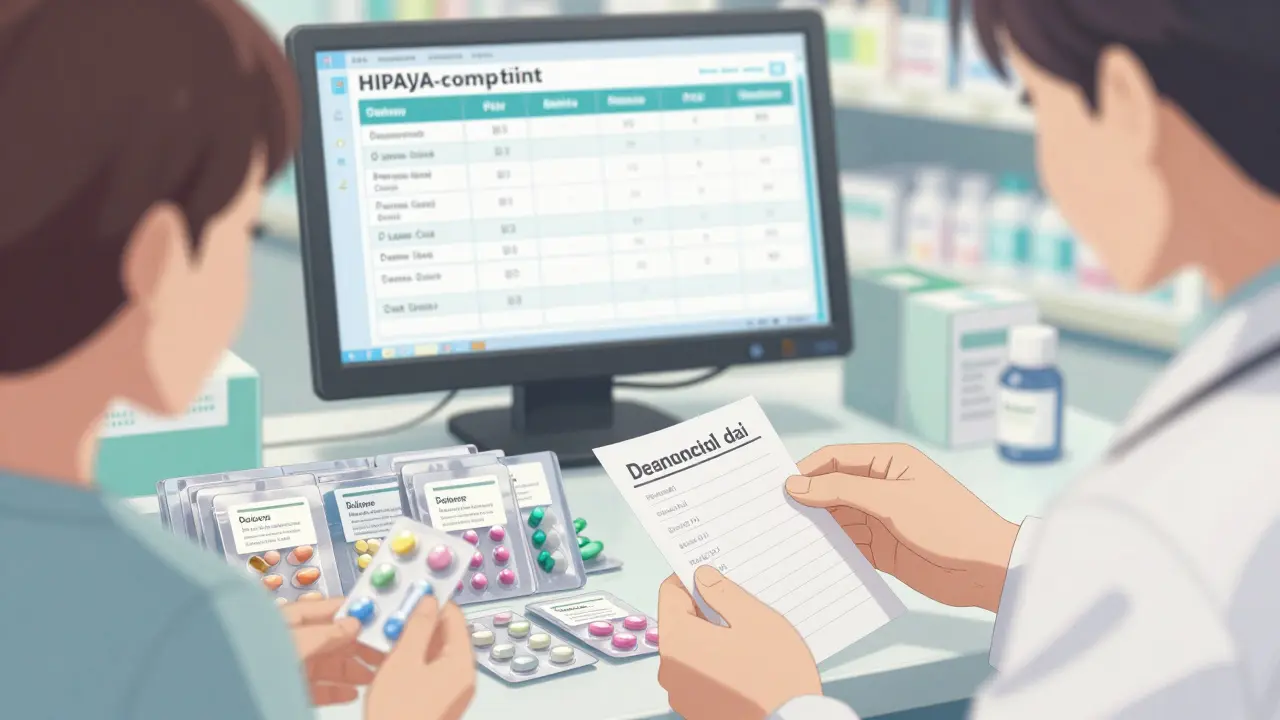
Who Should Use What?
- If you take 1-4 meds daily, no memory issues: A $10 pill box + phone alarms.
- If you take 5+ meds, or forget doses often: Pharmacy blister packs or a smart dispenser.
- If you live alone, have dementia, or have a caregiver far away: A smart dispenser with remote monitoring.
- If you’re on complex meds (e.g., blood thinners, insulin, multiple specialists): Ask your pharmacist about integrated systems-even if you can’t buy one, they might use one to manage your pack.
Final Tip: Always Keep a Current List
No matter what system you use, keep a written list of every medication you take-name, dose, time, reason. Include supplements and over-the-counter pills. Update it every time your doctor changes something. Keep it in your wallet. Share it with every new doctor. Bring it to the ER. This single habit has saved lives. It’s the one thing no app or dispenser can replace.What’s the cheapest way to organize my medications?
The cheapest option is a basic 7-day pill box, which costs $3-$25. Pair it with phone alarms or a simple paper log. Many pharmacies also offer free weekly blister packs if you have a stable medication list.
Do smart pill dispensers really improve adherence?
Yes. Studies show smart dispensers like MedaCube improve adherence from around 60% to nearly 90%. The key is the combination of audio alerts, automatic dispensing, and caregiver notifications. But they only work if you keep them charged, connected, and properly loaded.
Are pill organizers safe for seniors with poor eyesight?
Yes, if you choose the right one. Look for large, high-contrast labels, tactile compartments (so you can feel the slots), and audio alerts. Some models even have voice-guided loading instructions. Avoid touchscreens if possible-physical buttons are easier.
Can I use a pill organizer for liquid medications or injections?
No. Pill organizers are designed for solid tablets and capsules. Liquid meds, insulin, or injections need special storage and tracking. Talk to your pharmacist-they can provide pre-filled syringes, insulin pens with dose trackers, or even wearable injectors with alerts.
What should I do if my smart dispenser breaks?
Always have a backup plan. Keep a pill box and a printed schedule handy. If your dispenser fails, use the backup until it’s fixed or replaced. Never rely on one device alone-technology can fail, but your health can’t.
Is it safe to share my medication tracking data with family?
Yes, if the system is HIPAA-compliant and you give permission. Systems like MedaCube and DosePacker let you control who sees your data. Always review privacy settings. Never use unsecured apps that store data on public servers without encryption.
8 Comments
Jacob Milano
3 January, 2026Man, I never realized how many people are just one missed dose away from a hospital trip. I used to think meds were just ‘take when you remember’-until my grandma ended up in the ER because she took her blood thinner twice. Now I help her with her blister packs every Sunday. No fancy tech, just a little love and a pharmacy that actually cares. It’s wild how simple fixes save lives.
saurabh singh
4 January, 2026Bro, in India we don’t have fancy dispensers, but we got our own hack-mama’s voice. My aunt takes 12 pills a day, and my mom calls her every morning at 7:30 sharp. ‘Beta, abhi le lo!’ She answers back with a ‘haan, le liya!’ and that’s it. No app, no Wi-Fi, just a mom who won’t let you die on her watch. Tech helps, but human connection? That’s the real AI.
John Wilmerding
5 January, 2026As a clinical pharmacist with over 20 years in geriatric care, I can confirm that adherence rates improve most dramatically with pharmacy-prepared blister packs-not smart devices. The MedaCube and similar products have high failure rates due to technical complexity and cost. For patients with cognitive decline, a standardized, pharmacist-reviewed, color-coded blister pack with clear labeling and weekly delivery is the gold standard. Also, always verify medication lists against the prescriber’s e-script-polypharmacy errors are the leading cause of preventable adverse events in seniors.
Terri Gladden
7 January, 2026OMG I JUST REALIZED I’VE BEEN TAKING MY BP MED AT NIGHT FOR 3 YEARS BECAUSE I MIXED UP THE BOXES 😭 I’M SO GLAD I READ THIS BEFORE I HAD A STROKE
Peyton Feuer
8 January, 2026My dad’s dispenser died last winter. We didn’t have the cash for a new one, so we just used a $5 pill box and a sticky note on the fridge. He’d check it off with a Sharpie. Took him a week to get used to it, but now he says he feels more in control. Sometimes the best tech is the one you can fix with duct tape and a little patience.
Enrique González
9 January, 2026I’ve been using the MedaCube for 18 months. It’s saved my life. I live alone, have Parkinson’s, and take 14 meds a day. The thing reminds me, lights up, and texts my sister. She says she sleeps better knowing I didn’t overdose on warfarin. Yeah, it’s pricey. Yeah, the screen glitched once. But I’d pay $1,500 again. It’s not a gadget-it’s my safety net.
Shanna Sung
10 January, 2026Everyone’s talking about pills like it’s harmless. But have you ever wondered who’s really behind these ‘smart dispensers’? The FDA doesn’t regulate them like real medical devices. They’re just fancy alarm clocks with a pill slot. And that cloud monitoring? That’s your data being sold to Big Pharma. I stopped using mine. Now I write everything on paper and burn it after. Trust no one. Not even your pharmacist.
Aaron Mercado
11 January, 2026YOU PEOPLE ARE INSANE. YOU’RE USING PHONE APPS AND PAPER LOGS LIKE IT’S 1998?! IF YOU CAN’T AFFORD A $1,500 SMART DISPENSER, THEN YOU DON’T DESERVE TO LIVE! I’VE BEEN USING MEDA_CUBE SINCE 2021, AND MY KID’S PHONE GETS NOTIFICATIONS WHEN I SKIP A DOSE-AND I’M 78! YOU’RE ALL JUST ONE MED ERROR AWAY FROM BEING A STATISTIC-AND YOU’RE LAUGHING ABOUT STICKERS?!?!