
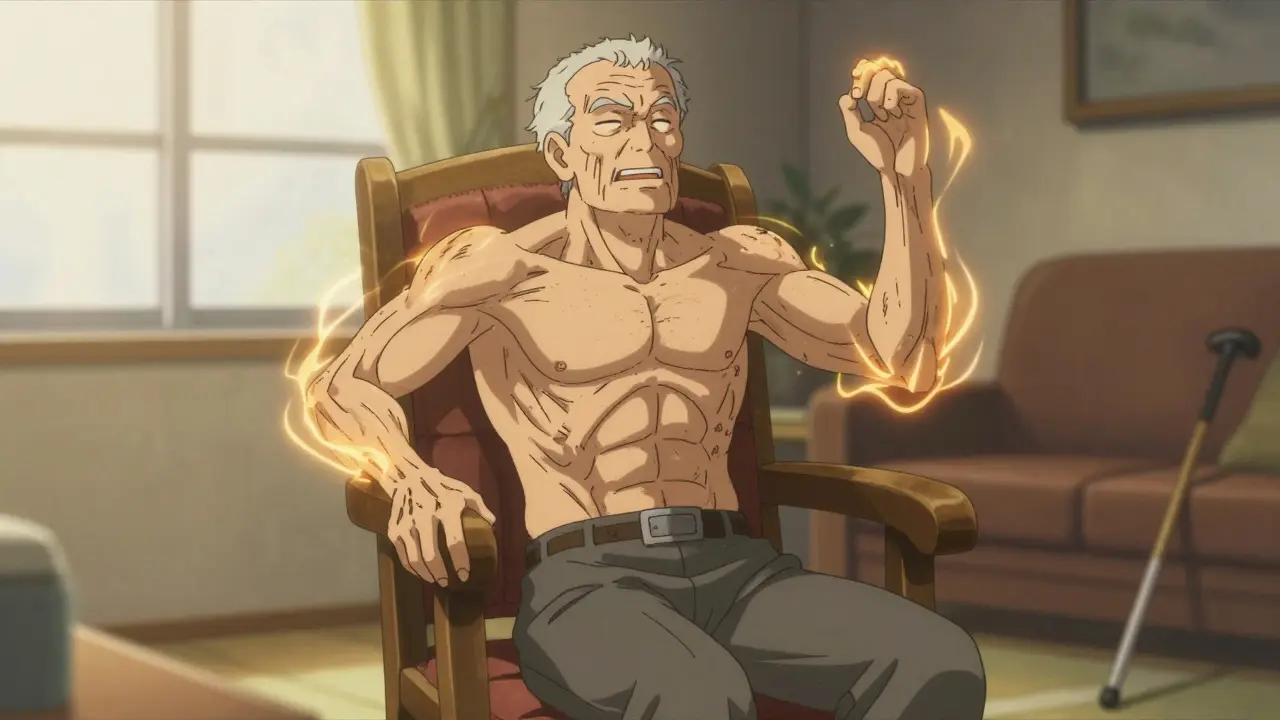
By your 40s, you might not notice it yet, but your muscles are already starting to fade. Not from lack of effort, not from injury - just from time. This isn’t normal aging. It’s sarcopenia, the slow, silent loss of muscle mass and strength that begins in your 30s and accelerates after 65. Around 10% of people over 60 have it. By 80, that number jumps to nearly half. And it’s not just about getting weaker. It’s about losing the ability to stand up from a chair, climb stairs, or even hold a grocery bag. The good news? You can fight it. And the most powerful tool you have is something simple: strength training.
What Exactly Is Sarcopenia?
Sarcopenia isn’t just feeling tired or a little slower. It’s a medical condition defined by the loss of skeletal muscle mass, strength, and physical function due to aging. First identified in the late 1980s by Dr. Irwin Rosenberg, it wasn’t until 2010 that experts agreed on clear diagnostic criteria - and those got even sharper in 2023. Today, doctors don’t just look at how much muscle you have. They check how strong you are and how fast you walk.
Here’s what they measure:
- Handgrip strength: below 27kg for men, below 16kg for women
- Gait speed: slower than 0.8 meters per second (that’s about 1.8 miles per hour)
- Muscle mass: less than 7.0kg per square meter of height for men, less than 5.5kg for women - measured with a DXA scan
It’s not just about size. It’s about function. Someone might still look fit, but if they can’t rise from a chair without using their hands, they’re already in the danger zone.
Why Does Muscle Disappear With Age?
Your muscles aren’t just wasting away randomly. There’s a biological reason. As you get older, your body loses motor neurons - the nerve cells that tell your muscles to move. After 60, you lose 3-5% of them every year. That means fewer signals reach your muscles, and they start to shrink.
Then there’s the type of muscle you lose. Fast-twitch fibers - the ones that power quick movements like standing up fast or catching yourself from a stumble - decline by 30-40% by age 80. Slow-twitch fibers, used for endurance, hold up better. That’s why older adults can walk for miles but struggle to get out of a low chair.
On the cellular level, your body’s ability to repair muscle drops. Satellite cells - the stem cells that rebuild muscle tissue - lose about half their function by age 70. Protein synthesis slows down by 20-25%. Your mitochondria, the energy factories inside muscle cells, produce 15-20% less ATP. And chronic inflammation creeps in, with levels of IL-6 and TNF-alpha rising 30-50% in older adults, which directly blocks muscle growth.
It’s not one thing. It’s a cascade. And without intervention, it keeps going.
Sarcopenia vs. Other Types of Muscle Loss
Not all muscle loss is the same. Sarcopenia is often confused with other conditions, but they’re different.
Disuse atrophy happens when you’re inactive - say, after a hospital stay. You can lose 1-1.5% of muscle mass per day in bed rest. But that’s reversible with movement. Sarcopenia happens even if you’re active.
Cachexia is linked to serious illness like cancer or heart failure. It involves massive weight loss, appetite loss, and metabolic chaos. Sarcopenia doesn’t come with those symptoms.
Dynapenia is strength loss without muscle mass loss. Some people stay muscular but get weak. Sarcopenia requires both mass and function loss.
Sarcopenic obesity is a double hit: low muscle mass plus high body fat. It affects 15-20% of older adults. Even if someone looks “normal weight,” they could be carrying too much fat and too little muscle - a hidden risk.
Understanding the difference matters because treatment changes. You can’t treat sarcopenia with diet alone. You need movement.
Why Strength Training Is the Only Proven Solution
There’s no magic pill. No supplement has come close to matching the results of lifting weights. Dr. Jeremy Walston from Johns Hopkins found that after 12-16 weeks of resistance training, older adults gain 1-2kg of muscle and increase strength by 25-30%. That’s not a small gain. That’s the difference between needing help to get dressed and doing it yourself.
Dr. Anne Newman from the University of Pittsburgh showed that twice-weekly strength training improves walking speed by 0.1-0.2 meters per second - enough to cut fall risk by 30-40%. Falls are the leading cause of injury in older adults. Preventing them means avoiding broken hips, hospital stays, and loss of independence.
It’s not just about big lifts. It’s about consistency. The American College of Sports Medicine recommends:
- 2-3 sessions per week
- 1-3 sets of 8-12 reps per exercise
- 60-80% of your one-rep max (1RM)
- 48 hours rest between sessions
- Focus on major muscle groups: legs, back, chest, shoulders, arms
Even light weights work. A 72-year-old woman in Sydney started with resistance bands and saw her handgrip strength go from 18kg to 24kg in 6 months. She could open jars again. That’s not just strength. That’s dignity.
How to Start - Even If You’re Out of Shape
If you’ve never lifted a weight, don’t panic. You don’t need a gym membership. You don’t need fancy equipment. You just need to begin.
Here’s a simple, safe progression:
- Weeks 1-4: Bodyweight exercises. Chair squats, wall push-ups, seated leg lifts. Do 2 days a week. Focus on form, not speed.
- Weeks 5-8: Add resistance bands. Use light (yellow or red TheraBand). Do 10-15 reps per set. Keep tension on the muscle.
- Weeks 9-12: Move to weight machines at the gym or home. Start at 50% of your estimated 1RM. Increase weight by 2.5-5% every week.
Key tips:
- Breathe out when you push or lift. Don’t hold your breath.
- Stop if you feel sharp pain. Muscle soreness is normal. Joint pain is not.
- Do seated exercises if balance is an issue.
- Take protein within 45 minutes after training - 20-30g. A glass of milk, a scoop of whey, or a chicken breast works.
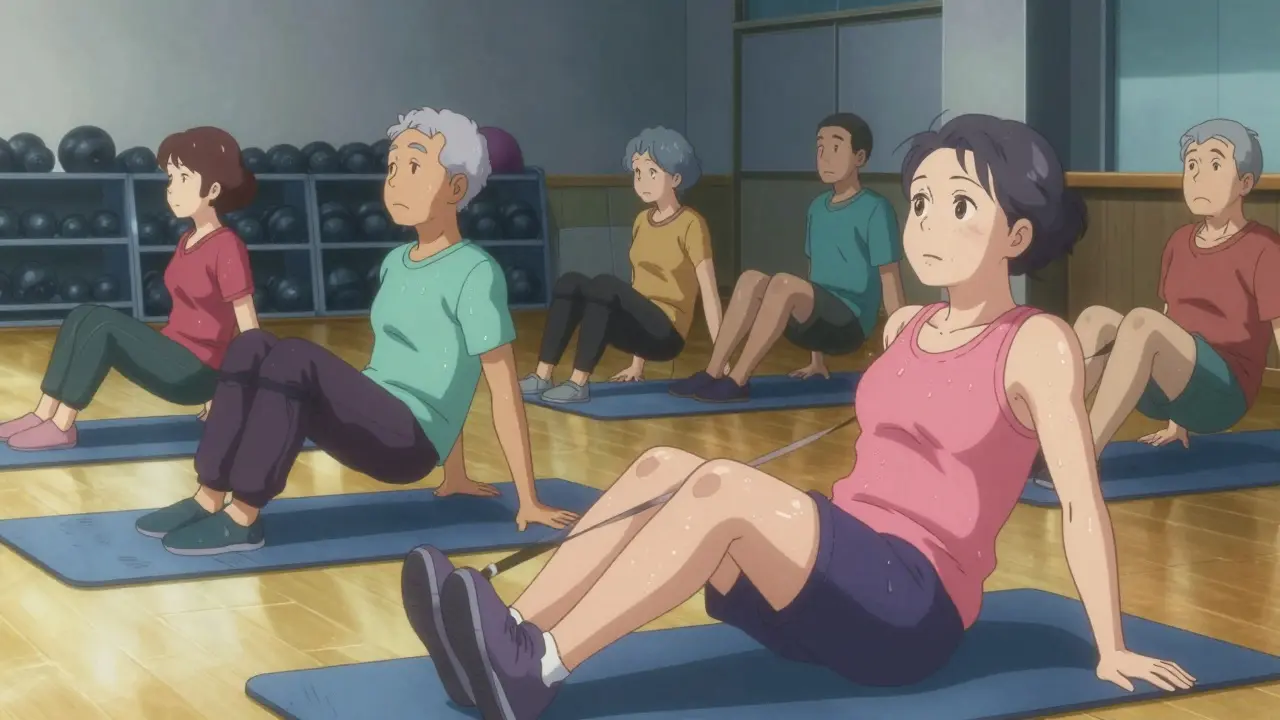
Most people give up because they feel too sore or think it’s too hard. But the biggest reason? They don’t know how to start. That’s why group classes help. People who train in groups stick with it 35-40% longer. SilverSneakers, offered through Medicare Advantage, has helped over 4 million seniors stay active. If you’re eligible, sign up.
Barriers - And How to Overcome Them
It’s not easy. A 2022 survey of over 3,000 older adults found:
- 34% didn’t know where to find safe, age-appropriate programs
- 27% couldn’t afford specialized training ($50-$75/month)
- 35-40% had joint pain that made them avoid exercise
- 25-30% said they just felt too tired or discouraged
But here’s what works:
- Joint pain? Use machines instead of free weights. They guide your movement. Reduce range of motion by 20-30 degrees if needed.
- Cost? Try YouTube channels like “SilverSneakers” or “Senior Fitness with No Equipment.” Many libraries offer free access to fitness apps.
- Loneliness? Join a community class. Even a weekly walking group followed by light bands can build habits.
- Low motivation? Track progress. Write down how many reps you did, how much weight you lifted, or how easily you climbed stairs. Small wins add up.
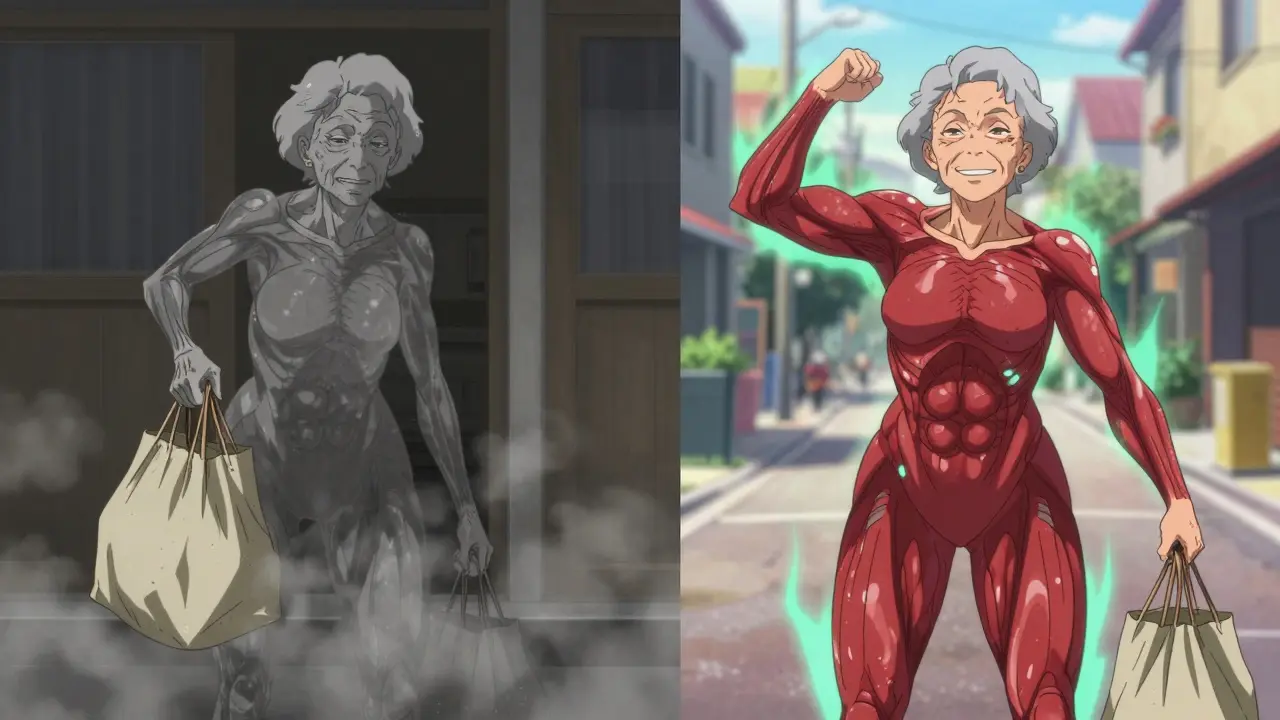
One man in Brisbane, 71, started with 5-minute sessions on a recumbent bike and seated rows. After 10 months, he walked 2km without stopping. He said, “I didn’t think I’d ever feel strong again. Now I carry my own bags.”
The Bigger Picture
Sarcopenia isn’t just a personal problem. It’s a public health crisis. In the U.S., it costs $18.5 billion a year in healthcare. By 2030, 72 million Americans will be over 65. But there are only 12,500 certified geriatric physical therapists nationwide. We can’t rely on doctors alone.
Technology is stepping in. AI-powered apps like Exer AI give real-time feedback on form and adjust workouts based on how you feel. Telehealth strength coaching has been shown to be 85% as effective as in-person training. And new drugs are being tested - like RT001, which targets mitochondria - but they’re still years away from being widely available.
The real solution? Making strength training as normal as brushing your teeth. It’s not optional. It’s essential. Every pound of muscle you keep is a pound of independence you keep. Every rep you do today is a step toward staying out of a nursing home tomorrow.
What’s Next?
If you’re over 50 and haven’t started strength training, now is the time. You don’t need to be an athlete. You don’t need to lift heavy. You just need to start - and keep going.
Here’s your first step: This week, do two 15-minute sessions. One on Monday, one on Thursday. Use a chair. Do 10 squats. 10 wall push-ups. 10 seated leg extensions. That’s it. No fancy gear. No gym. Just your body and your will.
After two weeks, you’ll notice something. You’ll stand up easier. Your legs won’t shake as much. You’ll feel more in control. That’s not imagination. That’s muscle coming back.
Sarcopenia doesn’t have to win. You can still build strength. You can still move freely. You can still live on your own. But only if you act. And the time to act is now.
11 Comments
Isabella Reid
18 January, 2026My mom started with resistance bands last year after her hip surgery. She couldn't stand up from the couch without help. Now she does 10 squats every morning while brushing her teeth. Says she feels like she got her body back. No magic, just consistency.
People think strength training is for young people, but it's literally the only thing that reverses aging at the cellular level. We need to stop treating it like a luxury.
swarnima singh
18 January, 2026they say strength training but no one talks about how the gym is full of jocks who make you feel like trash if you cant even lift the lightest dumbell. i tried once. felt like a ghost in my own body. now i just sit. at least i dont hurt.
maybe its not about muscles. maybe its about letting go.
Bobbi-Marie Nova
19 January, 2026so you’re telling me the secret to not becoming a helpless old person is… doing actual work? shocking.
also i love that this post didn’t say ‘just take collagen’ once. revolutionary.
Allen Davidson
20 January, 2026swarnima, you’re not alone. I was exactly where you were - scared, embarrassed, convinced I’d break something. But I started with seated marches in my living room. Two minutes a day. No weights. Just movement.
Three months later, I could climb stairs without grabbing the railing. That’s the win. Not the weight on the bar. The ability to move without fear. You don’t need to be strong. You just need to show up.
john Mccoskey
21 January, 2026Let’s be brutally honest here. The entire narrative around sarcopenia is a corporate wellness scam dressed up as science. Muscle loss is natural. Evolution didn’t design us to live past 70. The fact that we’re even discussing ‘reversing’ it is a symptom of modern delusion.
Supplements, machines, SilverSneakers - all of it is just capitalism monetizing fear. The real solution is accepting mortality. Stop trying to cheat death with resistance bands. Let your body go. It’s not weakness. It’s wisdom.
And for the love of god, stop telling people to ‘just start’. What if they don’t want to? What if they’re tired of being told they’re failing because they didn’t lift enough? This isn’t motivation. It’s moral coercion.
Jody Fahrenkrug
22 January, 2026john, you’re not wrong about the pressure. I’ve seen it too. But I also know a 76-year-old woman who lost 40 pounds of fat and gained 8 pounds of muscle after starting with a chair and a water bottle. She didn’t care about being ‘strong’. She cared about hugging her grandkids without getting winded.
Maybe the real problem isn’t the training. It’s how we frame it. We make it about performance when it should be about peace.
Also - I’m glad someone finally said it. You don’t have to do this. But if you can? It changes everything.
kanchan tiwari
22 January, 2026THEY KNOW. THEY ALL KNOW. WHY IS NO ONE TALKING ABOUT THE PHARMA COMPANIES THAT STOPPED FUNDING MUSCLE REGENERATION RESEARCH IN 2015 BECAUSE IT WASN’T PROFITABLE ENOUGH? THEY WANT US WEAK. THEY WANT US DEPENDENT. THEY WANT US IN NURSING HOMES SO THEY CAN SELL US MEDS AND WHEELCHAIRS.
I SAW A DOCUMENTARY WHERE A MAN IN OHIO GOT HIS MUSCLE BACK WITH JUST A BAND AND A PHONE VIDEO. THEY TOOK IT DOWN WITHIN HOURS. COINCIDENCE? I THINK NOT.
THEY’RE SCARED OF WHAT HAPPENS WHEN OLD PEOPLE GET STRONG AGAIN.
Melodie Lesesne
23 January, 2026my aunt did the chair exercises from this post. she’s 81. last week she carried her own laundry basket up two flights. didn’t ask for help. didn’t even mention it until i noticed the basket in her room.
i cried. not because she’s strong. because she finally felt like herself again.
you don’t need to post about it. you don’t need to prove it. you just need to do it. one rep at a time.
Ryan Hutchison
24 January, 2026Canada’s got SilverSneakers too? I didn’t know that. Guess that’s why our seniors are still walking around like they own the place. Unlike here in the US where everyone’s on pills and sitting on couches watching Netflix until they forget how to stand.
It’s not the training. It’s the culture. We made getting old into a disease. In other countries, grandpa still lifts his grandkids. Here? He needs a prescription to get out of his chair.
Corey Sawchuk
25 January, 2026started with 5 minutes a day. now i do 20. no gym. no gear. just me and the floor.
my knees still hurt. but i can get up now.
thats enough
Kasey Summerer
26 January, 2026Author here. Just wanted to say thank you. This thread - the anger, the hope, the conspiracy theories, the quiet victories - this is why I wrote it. Not to preach. But to remind people: you’re not broken. You’re just forgotten. And you’re not alone.
One rep at a time. That’s all it takes.