
Why Kids Need to Understand Generic Drugs
Every day, kids see medicine bottles at home-some with fancy names like "Advil," others with plain labels saying "ibuprofen." If they don’t know the difference, they might think one is stronger, safer, or better than the other. That’s not true. Generic drugs work the same way as brand-name ones. They have the same active ingredients, same dosage, same effects. The only real difference? Price. Generic drugs cost less because they don’t pay for flashy ads or fancy packaging.
Teaching children about this isn’t about making them pharmacists. It’s about giving them control. When a child understands that a plain pill can do the same job as a branded one, they stop seeing medicine as something mysterious or scary. They learn to ask questions: "What’s this for?" "Is there a cheaper version?" "Does it work the same?" These are smart habits that last a lifetime.
How to Explain Generic Drugs to Young Kids (Ages 5-9)
For little ones, keep it simple and visual. Think of it like shoes. You can buy red sneakers with a big swoosh on the side, or plain red sneakers with no logo. Both keep your feet warm and dry. One costs more because of the logo. The other works just as well.
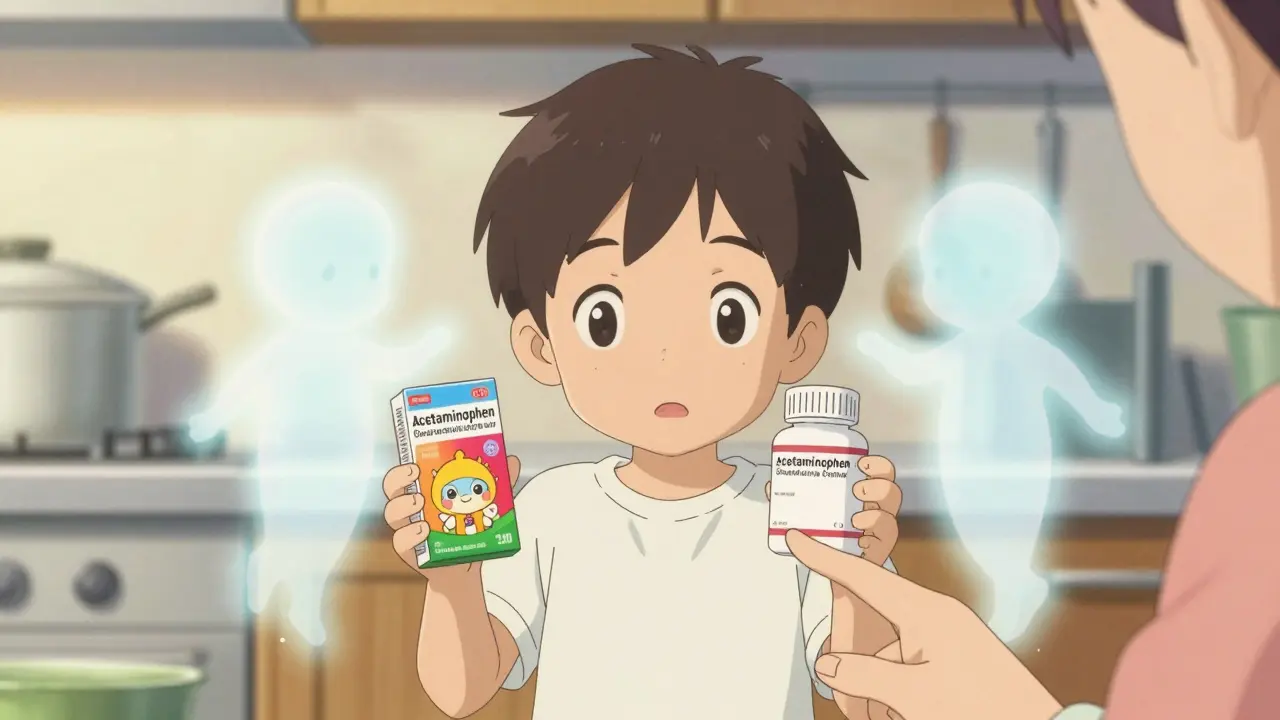
Use real medicine bottles-empty ones, of course. Show them two: one with a brand name like "Tylenol," and one labeled "acetaminophen." Say: "These are like twins. They fix the same thing-headaches or fever. One just costs less because it doesn’t have a cartoon mascot on the box."
- Play a matching game: pair brand names with generic names using flashcards.
- Draw two pills side by side-label one "Branded" and one "Generic." Color them the same.
- Use storybooks like "The Medicine Twins" (a free printable from Generation Rx) to reinforce the idea.
At this age, kids absorb lessons through play. If they learn early that medicine isn’t about the name on the bottle, they won’t grow up thinking expensive = better.
Teaching Tweens (Ages 10-13) About Cost, Safety, and Choices
By middle school, kids start noticing prices. They hear adults talk about "saving money on prescriptions." This is the perfect time to explain why generics exist.
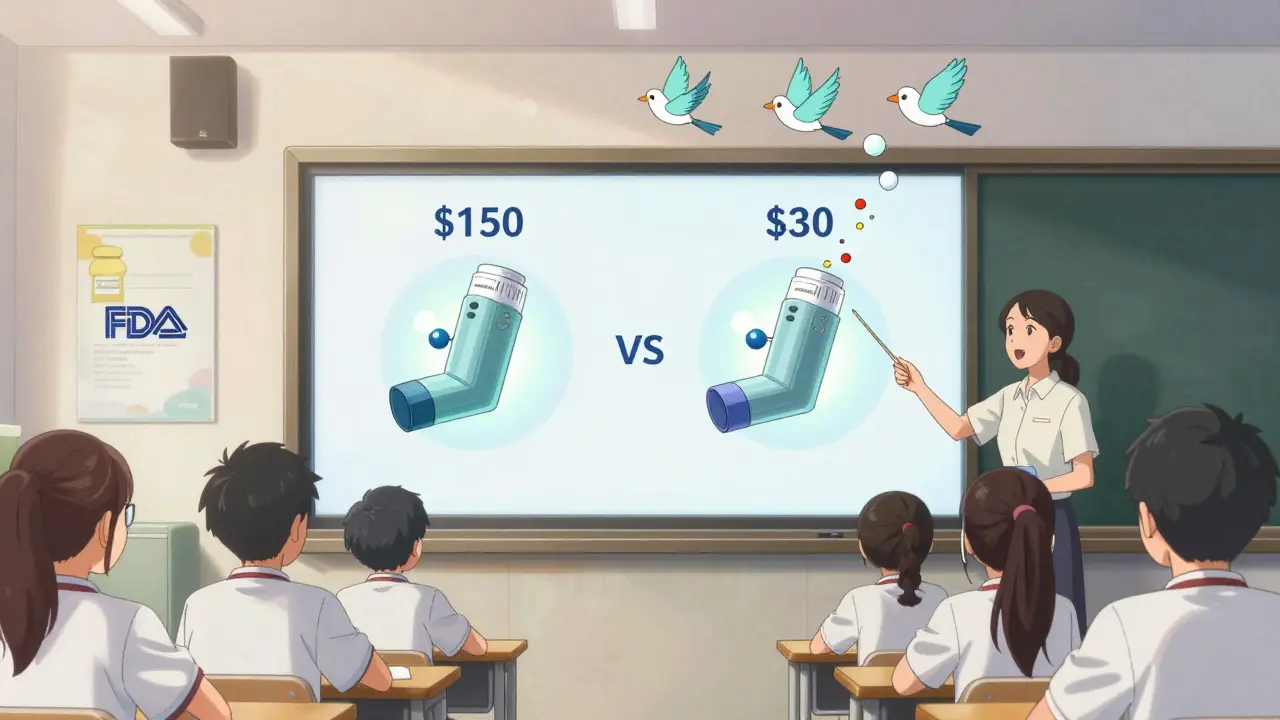
Start with a real example: "Your asthma inhaler costs $150 if it’s the brand name. But the generic version? $30. Both have the same medicine inside. The pharmacy gives you the generic unless your doctor says otherwise."
- Let them look up a medicine on a trusted site like Drugs.com (show them how to find the generic name).
- Compare prices: show them how much a 30-day supply of generic ibuprofen costs vs. Advil.
- Explain why generics are cheaper: no marketing, no patents, same FDA standards.
Then talk safety. Kids need to know: "Just because it’s cheap doesn’t mean it’s less safe." The FDA requires generic drugs to meet the same strict rules as brand names. Same manufacturing standards. Same testing. Same quality control.
One common myth: "Generics don’t work as well." That’s false. A 2020 study by the U.S. Government Accountability Office found no difference in effectiveness between 99% of generic and brand-name drugs. The only time a child might get the brand is if their body reacts differently to the filler ingredients-rare, but possible. That’s why doctors sometimes write "dispense as written" on prescriptions.
Teens and the Bigger Picture: Money, Access, and Empowerment
High schoolers are thinking about independence. They might be managing their own meds for allergies, ADHD, or asthma. Teaching them about generics isn’t just smart-it’s empowering.
Ask them: "If you had $20 to spend on medicine this month, would you rather buy the brand or the generic? Why?" Let them debate it. Then show them data: in Australia, 72% of prescriptions filled are generics. Why? Because they’re just as good, and they help families save money.
Also, talk about insurance. Many plans require you to try the generic first. If it doesn’t work, you can switch. This isn’t a punishment-it’s a system designed to help people afford care.
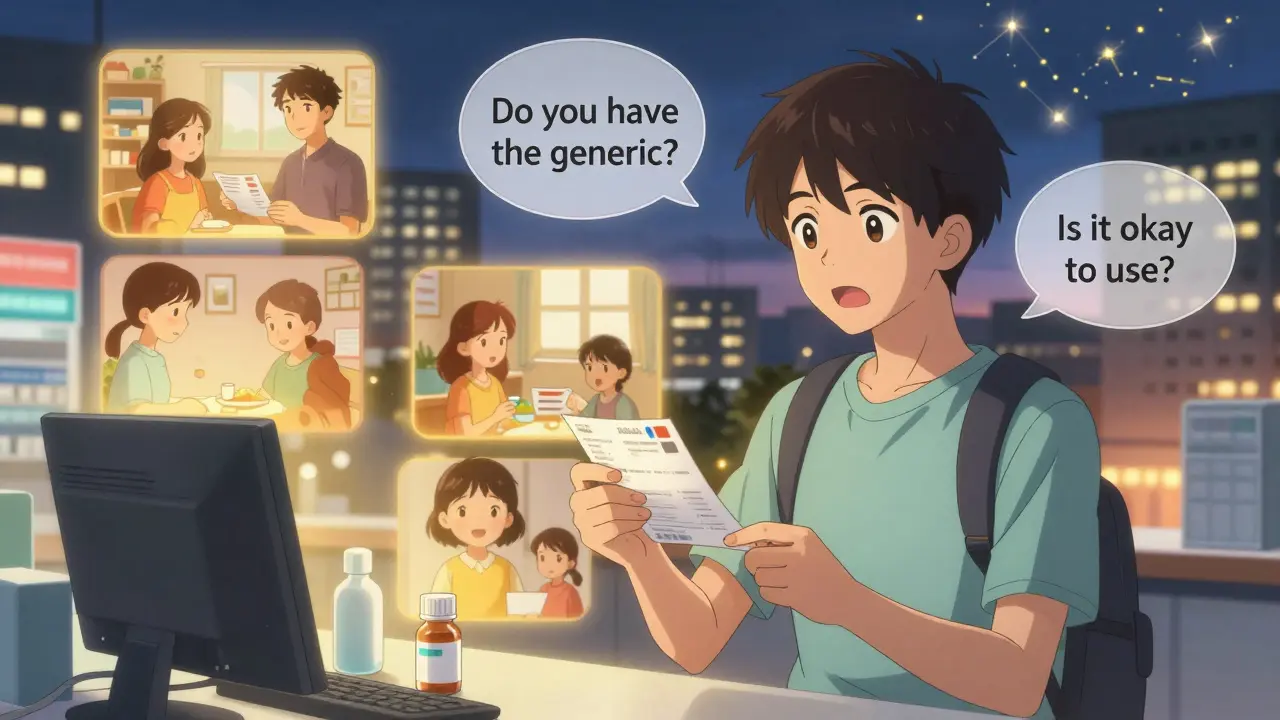
Teens also need to know how to talk to pharmacists. Practice this script: "Hi, I have a prescription for [brand name]. Do you have the generic version? Is it okay to use?" Many teens are too shy to ask. Teaching them how to speak up builds confidence and real-world skills.
What Parents and Teachers Can Do Right Now
You don’t need a degree in pharmacy to teach this. Start small.
- At home: When you pick up a prescription, say out loud: "This is the generic version of [brand]. It’s cheaper, and it works the same."
- At school: Use free lesson plans from Generation Rx. Their "Medication Safety Patrol" kit has activities for grades K-5. For older kids, NIDA’s "Science of Addiction" module includes a section on medication misuse.
- At the pharmacy: Bring your child along. Let them watch the pharmacist hand over the bottle. Ask: "Why did they give us this one?"
- At the dinner table: Make it a weekly question: "Did anyone take medicine this week? Was it generic?"
Don’t wait for a crisis. Don’t wait until your child is on medication. Start now. The goal isn’t to make them experts-it’s to make them informed.
Common Misconceptions (and the Truth)
- Myth: Generic drugs are made in worse factories.
Truth: The same factories often make both brand and generic drugs. The FDA inspects them all. - Myth: Generics take longer to work.
Truth: They absorb into the body at the same rate. The FDA requires them to be bioequivalent. - Myth: If I switch to generic, my child might get sick.
Truth: Over 90% of people have no difference in response. If there’s an issue, the doctor can switch back. - Myth: Only poor people use generics.
Truth: Everyone uses them. In Australia, even private health plans prefer generics. It’s not about income-it’s about smart choices.
What Happens When Kids Don’t Learn This
Without this knowledge, kids grow up thinking medicine is a mystery. They might:
- Refuse to take a cheaper pill because "it’s not the real one."
- Ask for brand-name drugs even when the generic is available-wasting money.
- Believe that more expensive = more powerful, leading to risky behavior like taking extra doses.
- Feel ashamed if they need to use generics, thinking it means their family can’t afford "good" medicine.
These beliefs aren’t just silly-they’re dangerous. They lead to non-adherence, waste, and misinformation. Teaching kids the truth helps break that cycle.
Resources You Can Use Today
- Generation Rx (generationrx.org): Free lesson plans, posters, and games for schools. Available in English and Spanish.
- NIDA for Teens (teens.drugabuse.gov): Interactive tools and videos explaining how medicines work.
- Therapeutic Goods Administration (TGA) (tga.gov.au): Australia’s official guide to medicines. Their "Understanding Your Medicine" booklet is perfect for older kids.
- Pharmacist visits: Many pharmacies offer free 10-minute talks for families. Ask for one.
These aren’t fancy tools. They’re simple, free, and proven. You don’t need to be an expert. Just start the conversation.
Final Thought: It’s Not About Drugs-It’s About Trust
When you teach kids about generic drugs, you’re not just teaching them about pills. You’re teaching them to question marketing, to value facts over labels, and to trust science over slogans.
That’s the real win. In a world full of ads, influencers, and fake claims, the ability to look at a medicine bottle and say, "I know what’s inside," is one of the most powerful skills a child can learn.
Are generic drugs safe for children?
Yes. Generic drugs for children are held to the same strict safety and quality standards as brand-name drugs by the FDA and Australia’s TGA. They contain the same active ingredient, in the same amount, and work the same way. The only differences are in the inactive ingredients (like color or flavor), which rarely cause issues. If a child has a known allergy to a filler, the doctor will note that on the prescription.
Why do generic drugs look different from brand names?
By law, generic drugs can’t look exactly like the brand name-that’s to avoid confusion. So they might be a different color, shape, or size. But the medicine inside is identical. Think of it like two identical cars painted different colors. Same engine, same performance. The outside just looks different.
Can I switch my child from a brand-name drug to a generic without asking the doctor?
In most cases, yes. Pharmacists are allowed to substitute generic versions unless the prescription says "dispense as written" or "no substitution." But it’s always a good idea to tell your doctor you’re switching. They’ll know if your child has ever reacted differently to a certain filler or if the medicine is one of the rare types where small changes matter-like thyroid or seizure meds.
Do generics work as fast as brand-name drugs?
Yes. The FDA requires generics to be bioequivalent, meaning they enter the bloodstream at the same rate and in the same amount as the brand name. So if a brand-name pain reliever starts working in 20 minutes, the generic will too. There’s no delay.
Is it true that generics are made in foreign countries?
Many medicines-both brand and generic-are made overseas. That’s true for about 80% of all active ingredients worldwide. But every factory, whether in India, China, or Australia, must pass strict inspections by the TGA or FDA. The country of origin doesn’t determine safety. The inspection process does.
9 Comments
Winni Victor
25 December, 2025Okay but have you seen the *flavor* of generic children's Tylenol? It tastes like regret and chalk dust. My kid gagged so hard he cried. Brand name? Orange dreamsicle. Worth the extra $5. 🤮
Linda B.
26 December, 2025The FDA doesn't inspect every factory. They inspect the paperwork. And the same factories? Yeah right. The ones making generics are in Mumbai and Guangzhou where the inspectors get paid in mangoes and silence. This is corporate propaganda dressed as education.
Christopher King
27 December, 2025Think about it. We're teaching kids to accept the lowest common denominator. That the logo is the enemy. That quality is a myth sold by Big Pharma to keep us docile. But what if the brand name *is* better? What if the filler is gentler? What if the placebo effect is the only thing keeping our children from collapsing into a puddle of existential dread? We're not teaching them to think-we're training them to surrender.
And don't get me started on the 'Medicine Twins' book. That's not education. That's emotional manipulation with clip art.
Katherine Blumhardt
29 December, 2025i just took my 7yo to the pharmacy and she asked why the green pill was cheaper than the blue one and i said 'because the blue one has a dragon on it' and she said 'but dragons are real right mom?' and now i'm crying in the parking lot
sagar patel
29 December, 2025Generic drugs are safe and effective. The data is clear. Teaching children this reduces unnecessary healthcare spending and promotes critical thinking. Simple. Logical. Necessary.
Harbans Singh
30 December, 2025I'm from India and here generics are the norm. My niece takes the same epilepsy med as her cousin in Texas-same pill, different label. No difference in seizures. No difference in school. The only difference? We didn't go bankrupt. Teach kids early. Money stress kills more than bad medicine ever could.
Rick Kimberly
1 January, 2026While the article presents a compelling case for the equivalence of generic and brand-name pharmaceuticals, one must consider the potential for bioequivalence variability in pediatric populations. The FDA's bioequivalence thresholds, while statistically valid for adults, may not fully account for developmental pharmacokinetic differences in children under twelve. Further longitudinal studies are warranted before institutionalizing this paradigm in educational curricula.
Terry Free
1 January, 2026You're telling kids to trust the government and the pharmacy. That's cute. Meanwhile, the same companies that make the brand name also make the generic. Same factory. Same CEO. Same profit margin. You're not teaching them to question. You're teaching them to nod and pay less.
Lindsay Hensel
3 January, 2026Teaching kids this isn’t about pills. It’s about teaching them to see through noise. To value substance over spectacle. To know that worth isn’t wrapped in glitter. This is the quietest rebellion against consumerism they’ll ever learn.