
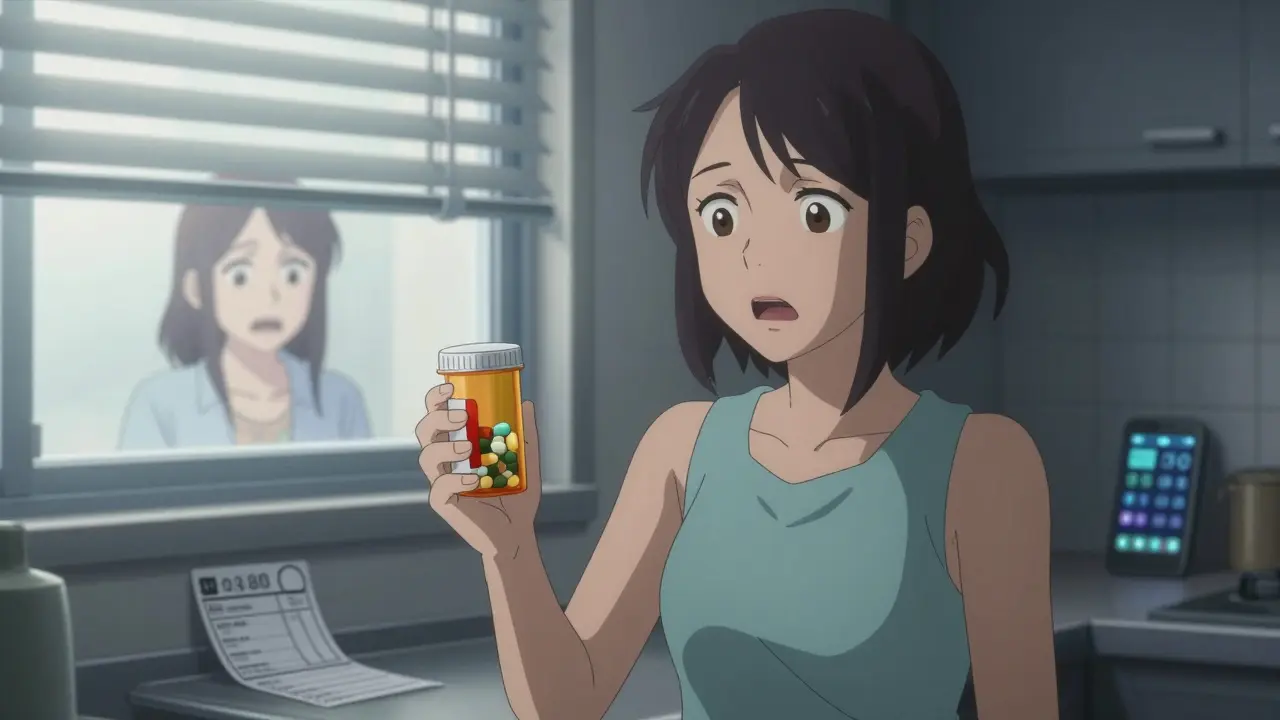
Imagine this: you pick up your prescription, walk home, and open the bottle. The pills don’t look right. The color’s off. The shape’s different. Or worse-you check the label and it’s not your medicine at all. Your heart drops. What do you do next?
You’re not alone. Around 1 in 5 medication errors happen at the pharmacy level, according to the National Coordinating Council for Medication Error Reporting and Prevention. These aren’t just mistakes-they can lead to hospital visits, long-term damage, or even death. The good news? If you catch it early, you can stop serious harm before it starts.
Stop Taking the Medication Immediately
The first and most important step? Don’t take another pill. Not one. Even if you think it might be harmless, or you’re worried about missing a dose, keep going. Wrong medications can interact with your body in unpredictable ways. A blood pressure pill instead of your thyroid med? A diabetes drug mistaken for an antibiotic? These aren’t minor mix-ups. They can trigger heart rhythm problems, dangerously low blood sugar, or toxic reactions.
Don’t wait to see if you feel sick. Don’t assume the pharmacist made a typo. If it doesn’t match what you were expecting-stop. Your safety comes before routine. Keep the bottle sealed. Don’t pour out the pills. Don’t flush them. Just set them aside.
Call Your Doctor Right Away
Once you’ve stopped taking the medication, contact your prescribing doctor immediately. Don’t wait until tomorrow. Don’t text them. Call. If it’s after hours, go to an urgent care center or emergency room. Your doctor needs to know what you took, when you took it, and how much.
They’ll ask you questions like: Did you feel dizzy? Nauseous? Your heart racing? Were you confused? Even if you feel fine now, some reactions don’t show up for hours-or days. Your doctor might order blood tests, an ECG, or a quick check-up to make sure your body hasn’t been affected.
They might also give you a new prescription or adjust your current one. If you were on a high-risk drug-like warfarin, insulin, or seizure medication-your doctor may need to monitor you closely for the next 24 to 48 hours.
Contact the Pharmacy and Speak to the Manager
Now call the pharmacy where you got the medication. Don’t just talk to the tech who handed you the bottle. Ask to speak with the head pharmacist or the manager. This isn’t about blaming someone-it’s about fixing the system so it doesn’t happen again.
Be clear: “I received the wrong medication. I did not take more than one dose, but I’m concerned. I need to know how this happened.”
Ask them to check their records. Was the prescription entered correctly? Was the right patient file pulled? Did someone confuse your name with someone else’s? Many pharmacies use barcode scanners to catch these errors-but not all do. Only 62% of U.S. pharmacies use them fully, according to the Agency for Healthcare Research and Quality.
Get the name of the person you spoke to. Write down the date and time of the call. If they offer to send someone to your house to replace the medication, say yes-but only after you’ve spoken to your doctor.
Save Everything as Evidence
Do not throw anything away. Not the bottle. Not the receipt. Not the original prescription label (if you still have it). Not even the empty box.
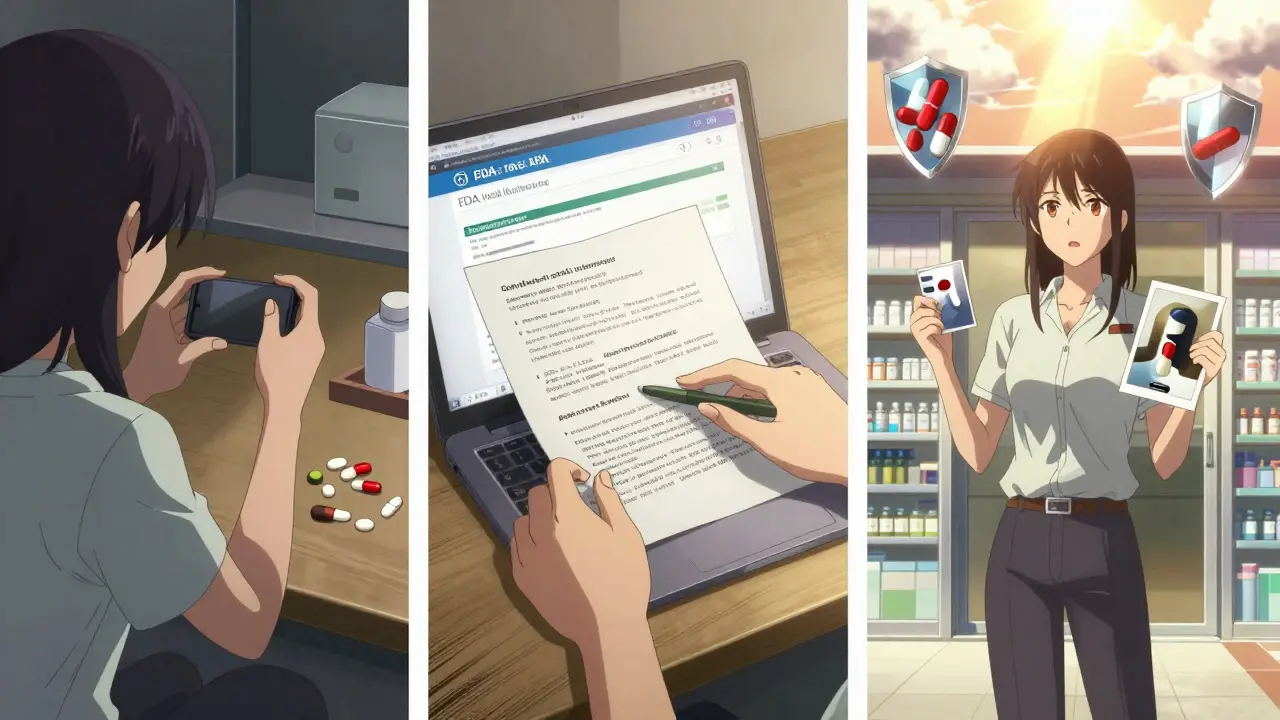
Take clear photos of:
- The incorrect medication inside the bottle
- The pharmacy label on the bottle
- The original prescription slip from your doctor
- The receipt showing the date and pharmacy name
Video is even better. A 30-second clip showing the bottle, label, and your name on the receipt can be powerful evidence. According to Matt Law’s case analysis, claims with video documentation settle 37% faster and for higher amounts.
Some people worry about giving back the wrong meds. Don’t. Keep them. The pharmacy might ask you to return them-but don’t hand them over until you’ve documented everything. This isn’t about suing anyone-it’s about protecting yourself in case things get worse.
Report the Error to the Right Authorities
Pharmacies are required to report serious errors-but many don’t. Only about 15% of all medication errors are officially reported, according to Dr. Robert Hall of the National Council on Patient Information and Education.
You can report it yourself-and you should. Here’s how:
- FDA MedWatch: File a report at medwatch.fda.gov. It’s free, anonymous, and helps track patterns across pharmacies.
- ISMP Medication Error Reporting Program: Submit a confidential report to the Institute for Safe Medication Practices. They’ve collected over 100,000 reports since 1991.
- Your state board of pharmacy: In Australia, report to the Therapeutic Goods Administration (TGA) via their online portal. In the U.S., each state has its own board-like the Georgia Composite Medical Board.
Reporting isn’t about getting revenge. It’s about making sure the next person doesn’t get the same wrong pills. And yes-it can help you if you need to take legal action later.
Know Your Legal Rights
If you suffered harm-physical, emotional, or financial-you may have a case. Pharmacy errors are considered medical malpractice. Around 70% of these cases settle out of court, with average payouts between $50,000 and $500,000. In extreme cases-like permanent disability or death-settlements have reached over $10 million.
But here’s the catch: you have to act fast. Statutes of limitations vary, but in most places, you have 1 to 3 years from the date you discovered the error to file a claim. In some states, it’s as short as one year.
Do not give a recorded statement to the pharmacy’s insurance company. Do not sign any paperwork they give you. Do not accept a “goodwill” payment without talking to a lawyer first. These offers are often far below what you’re entitled to.
If you’re unsure, contact a medical malpractice attorney. Many work on contingency-they only get paid if you win. And they’ll help you gather the evidence you’ve already saved: photos, medical records, pharmacy logs, and your doctor’s notes.
How to Prevent This From Happening Again
Pharmacies make mistakes-but you can reduce your risk.
- Always check your pills before leaving the pharmacy. Compare the label to your prescription. Is the name right? The dosage? The instructions?
- Ask the pharmacist to explain what the pill is for. If they hesitate, or can’t tell you, walk out.
- Use one pharmacy for all your prescriptions. This helps them spot drug interactions and catch duplicates.
- Keep a written list of all your meds-including dosages and why you take them. Bring it to every appointment.
- Use digital tools. Apps like MyTherapy or Medisafe can alert you if a new prescription doesn’t match your usual meds.
Some pharmacies now offer double-check systems for high-risk drugs like insulin or blood thinners. Ask if yours does. If they don’t, consider switching.
What Happens If You Don’t Act
Ignoring a wrong medication can have lasting consequences. A 2023 study in the Journal of the American Medical Association found that patients who took the wrong drug had a 28% higher chance of dying within five years. For those on heart or diabetes meds, the risk jumped to 42%.
And it’s not just physical harm. People report anxiety, loss of trust in healthcare, and even PTSD after these incidents. One Reddit user shared how she took the wrong antidepressant and spent three days in a fog-unable to work, speak, or sleep. She didn’t report it. She just stopped filling the prescription. Now she’s afraid to take any new medicine.
You don’t have to live like that. Catching the mistake early gives you control. Acting quickly gives you protection. Documenting it gives you power.
Final Thought: You’re Not Overreacting
If you’ve ever doubted whether you should have called the doctor, saved the bottle, or complained to the pharmacy-you shouldn’t have. You did exactly what you were supposed to do.
Medication errors are more common than most people think. But they’re also preventable. And you just became part of the solution-not by blaming, but by acting.
Stay vigilant. Stay informed. And never, ever ignore a pill that doesn’t look right.
15 Comments
Kevin Lopez
29 December, 2025Wrong med = Class I recall territory. Pharmacies are required to have CPOE and barcode verification under USP <797> standards. If they skipped it, that’s a CMS violation. Document everything-this is a reportable event under the Safe Medication Practices Act.
Paige Shipe
30 December, 2025I once got metformin instead of lisinopril. I didn’t notice until I started sweating and shaking. I called my doctor, who told me to go to ER. Turns out my blood sugar was 42. I didn’t report the pharmacy. I just switched. Don’t make the same mistake I did.
Emma Duquemin
31 December, 2025OH MY GOD. I JUST HAD THIS HAPPEN. I TOOK A PILL THAT LOOKED LIKE A PEANUT BUT WAS SUPPOSED TO BE A BLUE CAPSULE. I SPIT IT OUT AND STARTED CRYING. I CALLED MY DOCTOR AT 2 AM AND HE SAID I DID EVERYTHING RIGHT. I TOOK PHOTOS, SAVED THE BOTTLE, AND CALLED THE MANAGER. NOW I’M A PHARMACY WARRIOR. IF YOU’RE READING THIS AND YOU GOT THE WRONG MEDS-YOU’RE NOT CRAZY. YOU’RE A HERO. KEEP GOING. YOU’RE PROTECTING EVERYONE WHO COMES AFTER YOU.
Russell Thomas
1 January, 2026Wow. So what? You didn’t die. You’re lucky. Most people just take the damn pill and hope for the best. You called your doctor? You saved the bottle? Congrats. You’re now the poster child for overreacting. Next time, maybe just Google the pill and move on.
Samar Khan
2 January, 2026OMG I’M SO SORRY 😭 I GOT THE WRONG ANTIBIOTIC ONCE AND I THOUGHT I WAS DYING 😫 I FELT LIKE I WAS IN A MOVIE 🎬 BUT THEN I REALIZED I WAS JUST A STATISTIC 😔 PHARMACIES ARE SLOPPY AF 🤦♀️ I WISH I HAD KNOWN TO TAKE A VIDEO 😭
Louis Paré
2 January, 2026Let’s be real: this is just capitalism at work. Pharmacies are profit-driven machines. They don’t care if you live or die-they care if you refill. This whole guide is a Band-Aid on a gunshot wound. The real solution? Single-payer pharmacy system. Until then, you’re just a cog in the machine.
Joe Kwon
4 January, 2026Great breakdown. I work in pharmacy compliance and can confirm: 62% barcode adoption is still way too low. We implemented double-check protocols for high-risk meds last year-error rate dropped 78%. It’s doable. If your pharmacy doesn’t have it, ask. If they say no, take your business elsewhere. Your life > their convenience.
Marie-Pierre Gonzalez
4 January, 2026Dear author, I am profoundly moved by your meticulous and compassionate guidance. As a Canadian pharmacist with over two decades of service, I can attest that the protocols outlined herein align precisely with Health Canada’s Medication Safety Guidelines. I have distributed this document to my entire team. Thank you for elevating patient advocacy to an art form. 🙏
Amy Cannon
5 January, 2026So, I just want to say, I think this is so important, like, really, because I’ve had this happen to my aunt, and she didn’t know what to do, and she just took the pills, and then she ended up in the hospital for three days, and it was so scary, and I think people need to know this, like, everyone should read this, because it’s not just about pills, it’s about trust in healthcare, and I think we all need to be more careful, like, I’m going to start checking my meds every time now, and I’m going to tell my friends, and I think this is like, really, really, really important, and I hope more people see this because I don’t want anyone to go through what my aunt went through, and I’m just so glad you wrote this, honestly.
Tamar Dunlop
7 January, 2026My heart aches for anyone who has endured this violation of trust. In Canada, where pharmacists are gatekeepers of health, such an error is not merely a clerical misstep-it is a breach of the sacred covenant between healer and patient. I have witnessed the trembling hands of elders, the tear-stained receipts, the silence after a misdispensed dose. We must demand more. We must legislate more. We must humanize more. The bottle is not a commodity. It is a lifeline.
Manan Pandya
8 January, 2026Excellent guide. One addition: always check the NDC code on the bottle against your prescription. It’s a 11-digit number that uniquely identifies the drug, strength, and manufacturer. If it doesn’t match, the pharmacy made an error. I’ve caught two errors this way. Also, use GoodRx to cross-check pill images. It’s free and reliable.
Aliza Efraimov
8 January, 2026I was the one who got the wrong blood thinner. I didn’t know until my INR spiked to 8.5. I saved every scrap. Took video. Filed with FDA. Got a call from the state board. The pharmacy was fined $250k. They changed their entire workflow. Don’t let them get away with it. You’re not being dramatic-you’re saving lives. I’m alive today because I did this. You can too.
Nicole K.
9 January, 2026You people are ridiculous. Just take the pills. What’s the big deal? If you’re that scared of medicine, don’t take it. Stop making everything a crisis. This is why healthcare costs so much-because everyone acts like they’re in a medical thriller.
Fabian Riewe
10 January, 2026Man, I’m so glad this exists. I used to think I was overreacting when I checked my meds. Now I know I’m just being smart. I’ve started asking pharmacists to show me the pill before they hand it over. They’re usually surprised but impressed. One even said, ‘I wish more people did this.’ You’re not being paranoid-you’re being powerful. Keep going.
Janette Martens
11 January, 2026USA is so weak. In Canada we have strict pharmacy audits and every error is tracked. You people just complain and do nothing. Why are you so passive? If you lived here you wouldn’t even need this guide. We don’t tolerate this nonsense. Just saying.