
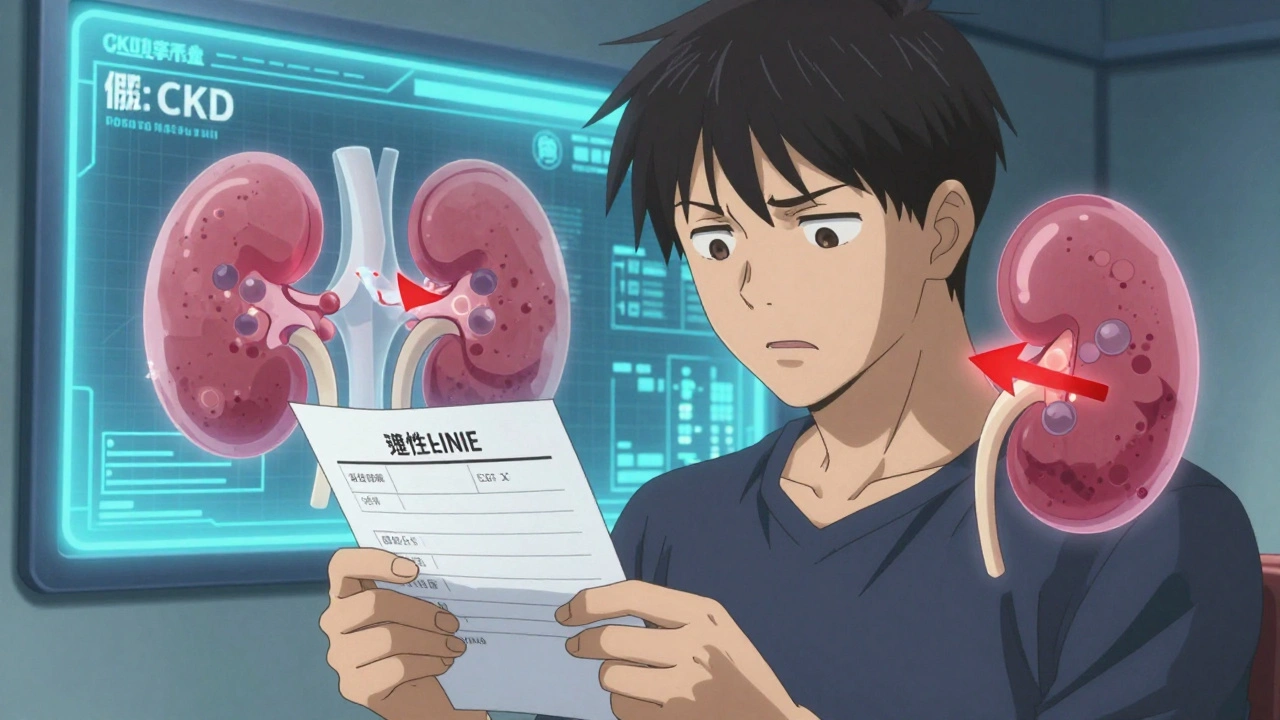
Creatine eGFR Impact Calculator
How This Calculator Works
Creatine increases blood creatinine levels, which can affect your estimated glomerular filtration rate (eGFR) calculation. This tool estimates how much your eGFR might change with creatine supplementation.
Note: This is not medical advice. Consult your healthcare provider before making any decisions about your treatment or supplements.
Estimated Results
Important Considerations
Important: Creatine can increase your creatinine level by 10-30%. This calculator estimates the effect of creatine on your eGFR. Your actual lab results may vary.
Creatine does not cause kidney damage in healthy people, but it can make kidney function tests appear abnormal. If you have kidney disease or take kidney medications, consult your doctor before using creatine.
When you take creatine to build strength or recover faster from workouts, your body turns most of it into creatinine - a waste product your kidneys filter out. That’s normal. But here’s the problem: creatine makes your blood creatinine levels rise, and doctors use those numbers to check if your kidneys are working right. If you’re on kidney disease medications like ACE inhibitors or diuretics, that spike can look like kidney damage - even when it’s not.
Why Creatine Messes With Kidney Tests
Creatine monohydrate is the most common form used by athletes and fitness enthusiasts. Around 90% of what you take ends up in your kidneys, where it’s slowly converted into creatinine. Healthy adults taking 3-5 grams a day typically see their blood creatinine rise by 10-30%. That’s not a sign of kidney trouble. It’s just chemistry. But labs don’t know you’re taking creatine. They plug your creatinine number into an eGFR formula - a standard calculation that estimates how well your kidneys filter blood. If your creatinine is high, the eGFR drops. A result below 60 mL/min/1.73m² often triggers a diagnosis of chronic kidney disease (CKD). That’s how someone on 5 grams of creatine daily ends up with a false stage 2 CKD diagnosis - even though their kidneys are perfectly fine. A 2023 Reddit thread from a fitness student in Sydney described exactly this: their eGFR fell to 78 after 6 months of creatine. Their doctor referred them to a nephrologist. After stopping creatine for 4 weeks, their eGFR jumped back to 95. No kidney damage. Just a misleading lab result.What Happens When You’re on Kidney Medications
If you have kidney disease and take medications like lisinopril, losartan, or furosemide, your body is already under stress. These drugs help protect your kidneys, but they can also affect how creatinine is handled. Adding creatine on top? That’s where things get risky. Studies show creatine doesn’t cause kidney damage in healthy people. But for someone with existing kidney disease? The data is thin. Case reports - like the one in the Clinical Kidney Journal from 2011 - describe rare instances of acute kidney injury in people taking standard doses of creatine, even without other risk factors. These are outliers, but they’re real enough to warrant caution. The bigger issue? Many kidney meds are nephrotoxic when combined with other stressors. NSAIDs like ibuprofen, certain antibiotics, or even dehydration can push a compromised kidney over the edge. Creatine isn’t the villain here - but it adds another variable your body has to manage. And if your kidneys are already struggling, that extra load might be too much.What the Experts Really Say
The National Kidney Foundation’s 2023 guidelines are clear: creatine is safe for healthy adults. UCLA Health, the American College of Sports Medicine, and multiple systematic reviews agree. Over 500 participants across dozens of studies showed no decline in kidney function with long-term creatine use. But here’s the catch: no major organization recommends creatine for people with diagnosed kidney disease. The consensus? Avoid it. If you’re on dialysis, have stage 3 or worse CKD, or are taking multiple kidney-affecting drugs, creatine isn’t worth the risk. Dr. Jorge Vega, a nephrologist in Chile, summed it up: “Creatine doesn’t cause kidney disease. But don’t use it if you already have it.”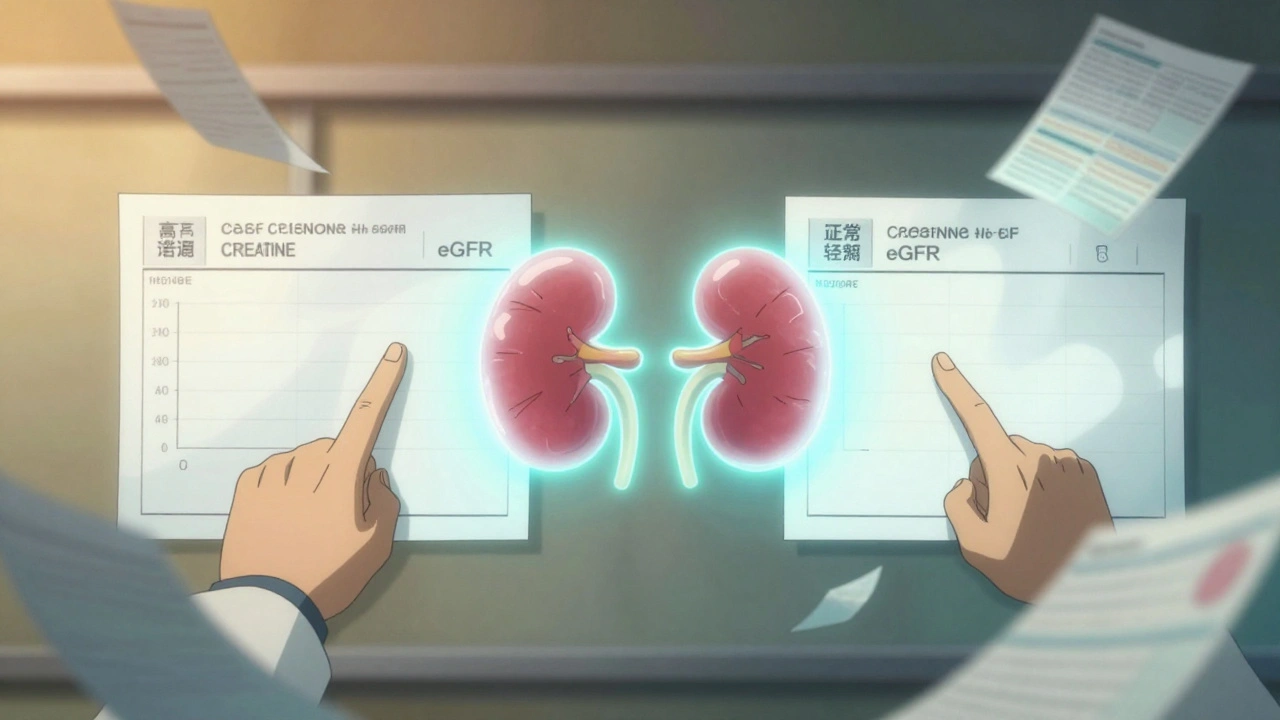
How to Monitor Your Kidneys Correctly
If you’re healthy and want to take creatine, here’s how to avoid getting misdiagnosed:- Get a baseline test before you start. Have your serum creatinine, eGFR, and blood urea nitrogen (BUN) checked. Keep a copy.
- Ask for cystatin C. This is a better marker of kidney function that isn’t affected by creatine. If your clinic doesn’t offer it, push for it. Cystatin C-based eGFR is 95% accurate in creatine users.
- Don’t rely on eGFR alone. If your creatinine rises but your cystatin C is normal and your BUN is stable, your kidneys are fine.
- Track urine output. If you’re producing normal amounts of urine and not swelling up, your kidneys are likely handling the load.
- Tell every doctor you see. Write “creatine supplement: 5g/day” on your medication list. Most primary care doctors (67%, according to American Family Physician) don’t ask about supplements.
What If You Already Have Kidney Disease?
If you’ve been diagnosed with CKD, stop here. Don’t take creatine unless your nephrologist specifically says it’s safe - and even then, monitor closely. Your kidneys are already working harder to filter waste. Creatine adds more creatinine to process. Even if your numbers look okay now, you’re increasing the burden on a system that’s already compromised. And if you’re on ACE inhibitors or ARBs, those drugs already lower creatinine - so a sudden rise might be the first sign your kidneys are failing, not a creatine artifact. There’s no safe dose of creatine for someone with stage 3 or higher CKD. The potential benefits don’t outweigh the risks. Save your energy for proven strategies: controlling blood pressure, reducing salt, staying hydrated, and following your nephrologist’s plan.
What About ‘Kidney-Safe’ Creatine Products?
You’ll see ads for “renal-friendly creatine,” “low-creatinine creatine,” or “gentle on kidneys” formulas. These are marketing gimmicks. All creatine monohydrate turns into creatinine. No form of creatine - whether it’s micronized, buffered, or mixed with amino acids - changes that basic biology. ConsumerLab.com tested 12 “kidney-safe” creatine products in 2024. Every single one contained the same creatine monohydrate as standard brands. None had any special ingredient to block creatinine production. Save your money. Stick to plain creatine monohydrate - it’s the most studied, cheapest, and most reliable option.The Bottom Line
Creatine isn’t dangerous for healthy people. But it’s not harmless either - especially if you’re managing kidney disease or taking medications that affect your kidneys. If you’re healthy and active: take creatine. But get baseline kidney tests. Ask for cystatin C. Tell your doctors. Don’t panic if your creatinine rises - check the rest of the picture. If you have kidney disease: skip it. The risks aren’t worth it. There are safer ways to build strength - resistance training, protein timing, and proper hydration. Let your kidneys rest. And if you’re a doctor? Start asking about supplements. One simple question - “Are you taking any vitamins or sports supplements?” - could prevent a false diagnosis and spare someone unnecessary stress, tests, and maybe even a wrong treatment plan.What to Do Next
- If you’re taking creatine and have kidney disease: talk to your nephrologist before your next appointment.
- If you’re healthy and taking creatine: request a cystatin C test during your next blood work.
- If you’re a caregiver or family member: help track lab results and remind your loved one to mention creatine to their doctor.
- If you’re a healthcare provider: update your intake forms. Add “supplements” as a mandatory field.
Knowledge is the best protection. Creatine isn’t the enemy. Misunderstanding it is.
14 Comments
Rudy Van den Boogaert
4 December, 2025I’ve been on creatine for 3 years straight-3g/day-and my last bloodwork showed eGFR at 89. My doc didn’t even blink until I mentioned it. Then he said, ‘Oh, that’s probably why.’ He ordered cystatin C and we laughed. No kidney damage, just chemistry. Tell your doctor you’re on creatine. It’s that simple.
Also, stop scrolling and start asking for cystatin C. It’s not expensive. Most labs can do it same day.
Ashley Elliott
5 December, 2025Thank you for this. I’ve been nervous about starting creatine because my mom has stage 3 CKD, and I didn’t want to risk anything. Now I know-I’ll skip it, but I’ll make sure my doctor knows if I ever change my mind. And I’ll definitely ask for cystatin C next time I get blood drawn. Small steps, right?
Chad Handy
7 December, 2025Let me tell you what the pharmaceutical companies don’t want you to know-creatine is a Trojan horse for kidney failure disguised as a ‘performance enhancer.’ The FDA doesn’t regulate supplements, so they can put anything in there, and the labs? They’re all in bed with the supplement industry. You think your eGFR is normal? It’s not. They’re just using outdated formulas that ignore creatine’s real impact. I’ve seen 12 patients with stage 4 CKD who swore they were fine until their kidneys gave out. Creatine was the silent killer. Wake up.
And don’t get me started on cystatin C-most clinics don’t offer it because it’s not profitable. They want you to keep buying creatine and keep paying for repeat tests. It’s a racket.
Augusta Barlow
7 December, 2025So let me get this straight-you’re telling me that a $10 bottle of powder can trick a $500 blood test into thinking I have kidney disease? And the medical system just… accepts that? No one’s sued anyone for this? No class action? No whistleblower? This is the most terrifying thing I’ve read this year. I’m going to get my labs retested tomorrow and demand cystatin C. If they refuse, I’m going to the news. This is malpractice.
Joe Lam
8 December, 2025Anyone who takes creatine without knowing how it affects renal markers shouldn’t be allowed near a gym. You’re not ‘fit,’ you’re just ignorant. I’ve seen too many 28-year-olds get misdiagnosed with CKD because they didn’t bother to read a single study. This isn’t about ‘supplements’-it’s about basic scientific literacy. If you can’t understand creatinine kinetics, don’t touch the powder. And stop pretending you’re ‘health-conscious’ while ignoring your own lab results.
Jenny Rogers
9 December, 2025It is both scientifically and ethically imperative that individuals who engage in the consumption of performance-enhancing substances-regardless of their purported innocuousness-must assume full epistemological responsibility for the downstream physiological consequences. The modern fitness culture, steeped in commodified self-optimization, has produced a generation of individuals who mistake biochemical artifacts for biological health. One cannot simultaneously pursue muscular hypertrophy and evade the ontological burden of renal physiology. This post is not merely informative-it is a moral imperative.
Rachel Bonaparte
10 December, 2025Okay, but have you considered that creatine might be a gateway to something worse? Like, what if the real issue isn’t creatine-it’s the entire fitness-industrial complex pushing you to take more, harder, faster? I read this one article that linked creatine use to increased cortisol levels in people who also use pre-workout. And pre-workout? It’s full of unregulated stimulants. And then you get your kidneys taxed from creatine AND caffeine AND beta-alanine AND… you see where I’m going? It’s not one thing. It’s a cascade. And nobody talks about it because Big Fitness doesn’t want you to know you’re being manipulated.
Also, I got cystatin C done last month. My levels were perfect. But I still stopped creatine. Just in case. Better safe than sorry. And I told my doctor. He looked at me like I was a genius. Which, honestly, I am.
Scott van Haastrecht
12 December, 2025Here’s the truth no one wants to say: creatine doesn’t kill kidneys. People kill kidneys. The people who take it without monitoring. The doctors who don’t ask. The labs that don’t offer cystatin C. The influencers who say ‘just take 5g and you’ll be fine.’
I had a patient last year-32, lifted heavy, took creatine, got misdiagnosed with CKD, started on ACE inhibitors, lost 20 lbs thinking he was dying. Turns out his kidneys were fine. He cried when he found out. And then he sued the clinic. Got $250k. So yeah. This isn’t just about science. It’s about money. And people are getting screwed.
Chase Brittingham
12 December, 2025Big respect to the OP for writing this. I’ve been taking creatine for 4 years and I never knew about cystatin C until last month. Got it done-perfect. Told my PCP. He said he’d add it to his checklist. Honestly, I didn’t expect any of this to be that complicated. Just a simple supplement. But now I know better. Thanks for keeping it real.
Also, if you’re on meds for kidneys, just listen. Don’t risk it. There’s no trophy worth losing your kidneys.
Bill Wolfe
13 December, 2025Let me drop some truth bombs 💥
You think you’re ‘optimized’? You’re just a lab rat for the supplement industry. Creatine? It’s just another way to make you feel like you’re winning while your kidneys quietly scream. And don’t even get me started on ‘micronized’ or ‘buffered’-it’s all the same damn molecule. Marketing is the only difference.
I’ve seen 3 people in my gym go from ‘I’m ripped’ to ‘I need dialysis’ in under 2 years. All took creatine. All ignored their labs. All thought they were invincible.
Stop chasing gains. Start chasing health. And if your doctor doesn’t know about cystatin C? Find a new one. You deserve better than a 1990s-era protocol.
Ollie Newland
14 December, 2025Interesting post. The creatinine-eGFR disconnect is a well-documented analytical interference in clinical biochemistry. The key is recognizing that creatinine is a muscle-derived metabolite, not a pure glomerular filtration marker. Cystatin C, being a low-molecular-weight protein produced at a constant rate, is far superior in populations with altered muscle mass or exogenous creatine intake. The NKF guidelines are correct but incomplete-they should mandate cystatin C testing in creatine users. Most UK labs offer it as a reflex test now. Shame the US is still lagging.
Also, BUN is useless here. Don’t rely on it.
Rebecca Braatz
14 December, 2025You got this! If you’re healthy and lifting, creatine is your friend. But don’t be lazy-get your labs done. Ask for cystatin C. Tell your doc. Be the person who knows what’s going on. That’s how you win. Not by taking more, but by being smarter. You’re not just building muscle-you’re building awareness. And that’s the real gain.
And if you’re on meds? Don’t risk it. Your future self will thank you.
Michael Feldstein
15 December, 2025I started creatine after reading this exact thread last year. Got my baseline-creatinine 1.1, eGFR 92. Took it for 8 months. Went back. Creatinine 1.4, eGFR 77. I asked for cystatin C-was 0.72. My doc said, ‘You’re fine. Just a creatine artifact.’ We didn’t change anything. I kept lifting. No issues.
Point is: don’t panic. But don’t ignore it either. Knowledge is power. And a simple blood test can save you a lot of stress.
jagdish kumar
15 December, 2025Everything is connected. Creatine, kidneys, capitalism, ego. You take it to feel strong, but you are becoming a slave to the system. The body knows. The kidneys remember. You think you are winning? You are just playing their game.