
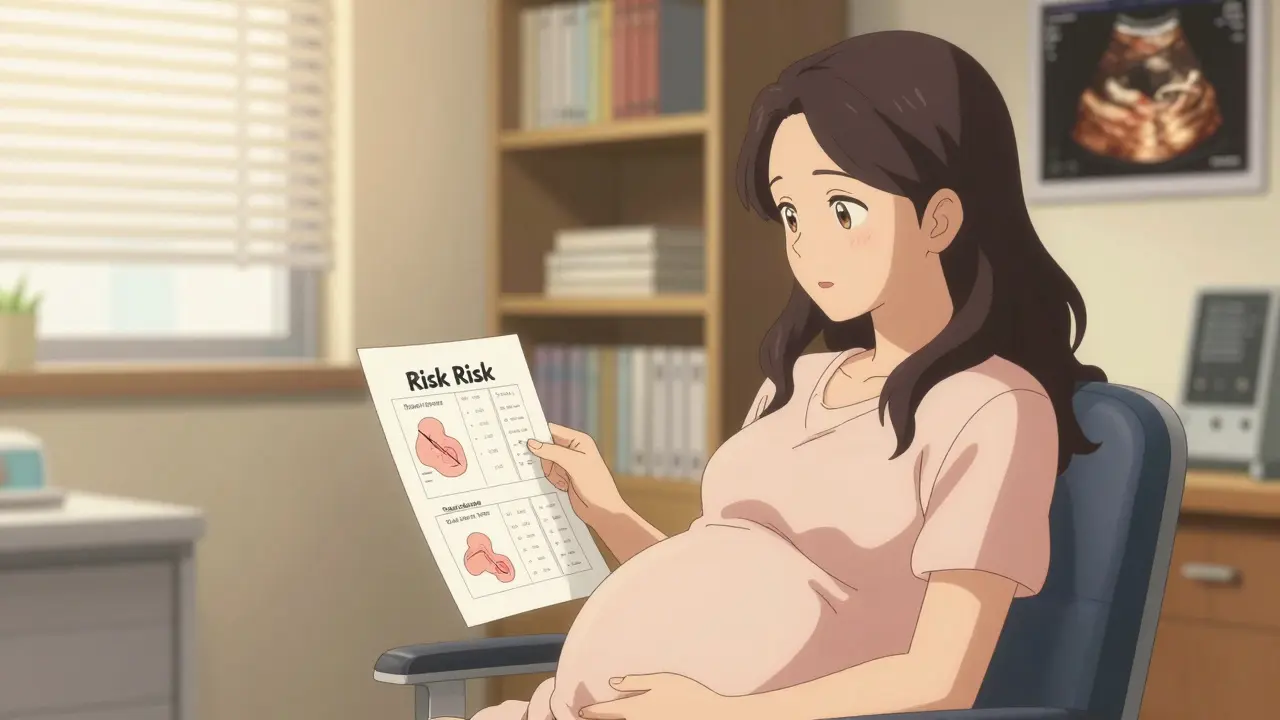
When you’re pregnant and struggling with depression, anxiety, or bipolar disorder, the question isn’t just whether to take medication-it’s how to decide. There’s no easy answer. Stopping your meds might feel safer, but untreated illness carries real risks: higher chances of preterm birth, difficulty bonding with your baby, and in severe cases, suicide. Starting or staying on medication brings fears of birth defects or long-term effects on your child. That’s why the conversation now isn’t about what doctors recommend-it’s about what you need, with clear facts and real support.
There’s No Risk-Free Choice
Many people believe they have to choose between being mentally well or having a healthy baby. But that’s a false choice. The truth is, both untreated mental illness and certain medications carry risks. The key is understanding which risks matter most for you.For example, if you’ve had severe depression before, stopping your antidepressant during pregnancy gives you an 80% chance of relapse, according to data from the National Pregnancy Registry. That’s not a small number. Relapse can mean hospitalization, inability to care for yourself, or even thoughts of harming yourself or your baby. On the other hand, paroxetine (Paxil), one of the older SSRIs, has been linked to a slightly higher chance of heart defects-rising from about 8 in every 1,000 births to 10 in 1,000. That’s a small increase, but it’s real.
That’s why doctors don’t tell you to stop or start. They help you weigh it. Your history, your symptoms, your values-those matter more than any general rule.
Which Medications Are Safer?
Not all mental health meds are the same. Some have decades of safety data. Others are still being studied.SSRIs like sertraline (Zoloft), citalopram (Celexa), and escitalopram (Lexapro) are often the first choice. They’re not perfect-some studies link them to a slightly higher chance of babies being small for gestational age-but overall, they’re considered the safest option among antidepressants. Fluoxetine (Prozac) is also used, though it stays in the body longer, which can be a concern near delivery.
Paroxetine (Paxil) is the exception. If you’re taking it and planning pregnancy, talk to your doctor about switching. The risk of heart defects is higher, and there are better alternatives.
For bipolar disorder, lamotrigine is the go-to. It doesn’t increase the risk of major birth defects. Lithium works well too, but your body changes during pregnancy-your kidneys process it faster-so your dose needs constant monitoring. Blood tests every few weeks are normal.
Valproic acid (Depakote) is off the table. It can cause neural tube defects like spina bifida, and studies show it increases autism risk. If you’re on it and could get pregnant, your doctor should help you switch before conception.
Bupropion (Wellbutrin) has a small link to miscarriage and heart defects. Tricyclics like nortriptyline are used when SSRIs don’t work. For psychosis, older antipsychotics like haloperidol have more safety data than newer ones like risperidone or brexpiprazole-which still lack long-term child outcome studies.

Shared Decision-Making Isn’t Just a Phrase
It’s a process. And it’s not something you do once at your first prenatal visit.Good providers start the conversation before you get pregnant. Why? Because stabilizing your mental health for at least three months before conception cuts your relapse risk by 40%. That’s huge.
When you’re pregnant, the conversation includes three parts:
- What’s your risk of relapse? If you’ve had three prior episodes of depression, your risk is high. Tools like the Edinburgh Postnatal Depression Scale help measure it.
- What are the actual numbers? Instead of saying “paroxetine might cause birth defects,” your provider should say: “Out of 1,000 babies born to mothers taking paroxetine, about 10 might have a heart defect. Without it, that number is about 8.” That’s concrete.
- What’s your plan if things get worse? What if you start feeling hopeless again at 28 weeks? Do you have a crisis plan? Who do you call? Is your partner or partner ready to step in?
And it’s documented. Not just in your chart, but in a way that shows you were part of the decision. Studies show this reduces legal risk for doctors by 65%-but more importantly, it gives you peace of mind.
What Happens When People Stop Without Talking to Their Doctor?
The data is heartbreaking.A survey by Postpartum Support International found that 68% of women felt completely unprepared for the mental health risks of pregnancy. Nearly half stopped their meds on their own because they were scared of birth defects. And what happened? 63% of those who quit without medical advice ended up worse-some hospitalized, some with suicidal thoughts, some unable to care for their newborn.
On Reddit, in r/PostpartumDepression, 78% of women said they felt pressured to go off meds-even when they were stable. One woman wrote: “I stopped Zoloft at 8 weeks because my OB said ‘it’s better to be safe.’ By 14 weeks, I couldn’t get out of bed. I had to be admitted.”
Women who had structured shared decision-making-using tools like the Maternal Outcomes Reflecting Treatment Intensities Scale-were over three times more likely to stick with their treatment plan. And six weeks after birth, their depression scores were 37% lower.

What’s New in 2025?
The field is changing fast. In 2023, the American College of Obstetricians and Gynecologists updated its guidelines to reflect new research: the risks of medication might be overstated because studies often don’t account for how severe the mother’s illness is. In other words, maybe it’s not the drug-it’s the depression-that’s causing the problems.The National Pregnancy Registry, which tracks 15,732 women since 2010, is now adding 12 new medications to its list, including newer antipsychotics. And in 2023, a pilot study at Massachusetts General Hospital used machine learning to predict how individual women would respond to meds based on their age, weight, mental health history, and genetics. It was 82% accurate.
By 2026, experts expect you’ll be able to walk into a clinic and see a personalized risk estimate: “Based on women like you-32 years old, history of two depressive episodes, taking sertraline-your chance of relapse if you stop is 78%. Your baby’s risk of a major defect is 1.2%.” That’s not guesswork. That’s data.
What You Can Do Right Now
If you’re pregnant or thinking about it:- Don’t stop your meds without talking to your doctor or a perinatal psychiatrist.
- Ask: “What’s my relapse risk?” and “What are the real numbers for this medication?”
- Request a copy of the ACOG Mental Health Medication Decision Aid-it’s free, updated quarterly, and lists risks for 24 common drugs.
- If your OB doesn’t know the latest guidelines, ask for a referral to a perinatal psychiatrist. Eighty-seven percent of OBs now consult them regularly.
- Write down your priorities: Is staying stable more important than avoiding a tiny increased risk? Is avoiding hospitalization worth a small chance of side effects?
You’re not choosing between two bad options. You’re choosing the best path forward for you and your baby-with facts, not fear.
11 Comments
Brian Furnell
21 December, 2025Okay, let’s break this down with some real-world pharmacokinetics: SSRIs like sertraline have a half-life of ~26 hours, which means steady-state concentration is reached in ~5-7 days-so switching meds pre-conception isn’t just ‘good advice,’ it’s biologically necessary. And the 80% relapse stat? That’s from the NPER registry, n=3,217, adjusted for baseline severity. We’re not talking ‘mild anxiety’ here-we’re talking recurrent MDD with prior hospitalizations. The real risk isn’t the drug-it’s the untreated neuroendocrine dysregulation during gestation that elevates CRH and cortisol, which directly impacts fetal HPA axis development. This isn’t scare-mongering; it’s neuropharmacology 101.
Siobhan K.
21 December, 2025So let me get this straight-doctors are now expected to be data scientists, genetic counselors, and emotional support providers all at once, while patients are supposed to weigh 1.2% defect risk against a 78% chance of screaming into a pillow at 3 a.m.? And we wonder why people panic and quit meds cold turkey? The system is designed to overwhelm, not empower. The ‘decision aid’ is a 47-page PDF no one reads before their 12-week scan. Real talk: if your OB says ‘it’s better to be safe’ and doesn’t follow up, that’s not shared decision-making-that’s negligence dressed in jargon.
Hannah Taylor
23 December, 2025wait so u r saying the gov is lying abt meds? like... i heard the FDA is in bed with big pharma and they’re hiding the real side effects like autism and brain damage? my cousin’s baby had seizures after she took zoloft and now she’s in a wheelchair? no one talks about that. they just say ‘1.2%’ like its nothing. but what if u r that 1.2%? then its 100% for u lol
mukesh matav
24 December, 2025Interesting. In India, many women continue fluoxetine during pregnancy without much discussion. The cultural norm is to endure, not to medicate. But when relapse happens, it’s hidden-no hospital visits, no therapy. The silence is its own kind of risk. Maybe the real issue isn’t the drug, but the lack of support systems anywhere.
Peggy Adams
24 December, 2025they just want you on meds forever. they make billions. you think they care about your baby? nah. they care about your insurance payments. stop listening to doctors. go herbal. chamomile tea and vibes only.
Jay lawch
25 December, 2025Look, the entire Western medical paradigm is built on reductionism-reduce a complex human experience like depression to a serotonin imbalance, then reduce pregnancy to a chemical equation where risk percentages are calculated like stock market fluctuations. But life isn’t a spreadsheet. The soul doesn’t care about 8 in 1,000 versus 10 in 1,000. The soul wants safety, connection, meaning. When you reduce a mother’s choice to a risk-benefit table, you’ve already lost the humanity. The real defect isn’t in the fetus-it’s in the system that forces this impossible calculus upon women who are already drowning.
Christina Weber
27 December, 2025There is a grammatical error in the original post: ‘That’s a small increase, but it’s real.’ should be ‘That’s a small increase, but it is real.’ Also, the phrase ‘neural tube defects like spina bifida’ is redundant-spina bifida is a neural tube defect, not an example of one. And ‘87 percent of OBs now consult them regularly’-percent should be spelled out in formal prose. These inaccuracies undermine the credibility of the entire piece, even if the intent is good.
Cara C
29 December, 2025I had severe postpartum anxiety and stayed on sertraline through pregnancy. My OB didn’t push me either way-she just said, ‘Tell me what you need.’ I cried because no one had ever asked that before. I didn’t want a statistic-I wanted someone to say, ‘Your mental health matters too.’ That’s what shared decision-making actually looks like: not a form, not a chart, not a risk calculator. Just someone sitting there, quiet, waiting for you to speak.
Erika Putri Aldana
30 December, 2025why do people even have kids if they’re scared of meds?? just take a nap and chill. babies are fine. you’re fine. stop overthinking. it’s not rocket science.
Grace Rehman
31 December, 2025There’s a difference between safety and control. The medical system offers us data to feel safe-but what if safety is just another form of control? What if the real question isn’t ‘what’s the risk?’ but ‘who gets to decide what risk looks like?’ A woman who’s been told she’s broken for years doesn’t need more numbers-she needs to be told she’s already whole. And maybe, just maybe, that’s the only medication that ever truly works.
Jerry Peterson
2 January, 2026I’m from the U.S. but my wife is from Nigeria. When she got pregnant, her mom said, ‘Don’t take pills. Pray more.’ We did both. She took sertraline, went to church every Sunday, and saw a therapist. No one in her family knew about the meds. But she stayed stable. That’s the real story-no one-size-fits-all. Just people doing what they can with what they’ve got. The data helps, but love? That’s the real treatment.