
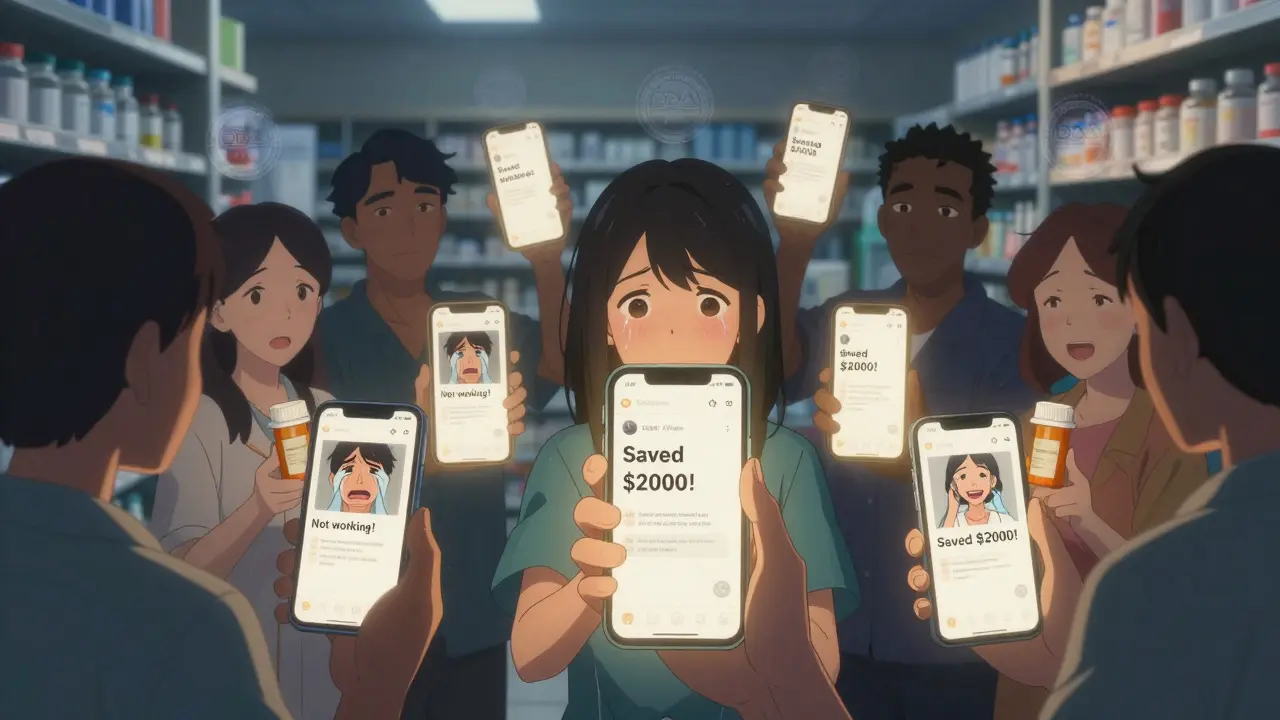
When you pick up a prescription, you might not think twice about whether it’s the brand name or the generic version. But for millions of people, that choice isn’t just about price-it’s about trust. And that trust is being shaped more by online reviews than by clinical studies.
Why People Doubt Generics, Even When Science Says They’re the Same
Generic medications contain the exact same active ingredients as brand-name drugs. They’re held to the same FDA standards for bioequivalence: their absorption rate in the body must fall within 80-125% of the brand version. That’s not a guess-it’s lab-tested, peer-reviewed, and legally required. Yet, nearly one in three patients still believe generics are less effective. The disconnect isn’t about science. It’s about experience. A patient switches from brand-name Lyrica to its generic version, pregabalin, and suddenly their nerve pain returns. They post on Reddit: “I’m convinced the generics aren’t made to the same standards.” That post gets 200 upvotes. Another person says they saved $2,000 a year on sertraline with zero side effects. That post gets 45 upvotes. The louder voices aren’t the ones who had smooth transitions. They’re the ones who felt something changed. And those stories stick.How Online Reviews Rewire Patient Expectations
A 2024 machine learning analysis of over 6,000 patient forum posts found that the phrase “not working as well” appeared nearly 2,000 times. “Different side effects” showed up almost 3,000 times. These aren’t random complaints-they’re patterns. The problem? Many of these reports aren’t about actual drug differences. They’re about the nocebo effect. That’s when expecting something to go wrong makes it happen. If you believe a generic is cheaper, so it must be worse, your brain can trigger real symptoms-even if the pill is chemically identical. One study gave patients identical tramadol pills, but labeled half as “brand” and half as “generic.” Those who thought they were taking the generic reported 18% more pain, took more over-the-counter painkillers, and stopped their treatment 23% sooner. The pill didn’t change. Their belief did. Online reviews amplify this. A single negative comment on a pharmacy’s website can deter dozens of others. And because people trust peer stories more than FDA pamphlets, these reviews become powerful, unregulated influencers.Who Believes the Reviews-and Who Doesn’t
Age matters. Patients under 35 are nearly twice as likely to trust generics as those over 65. Why? Younger people grew up with online reviews for everything-from smartphones to restaurants. They expect transparency. Older patients remember when generics were less reliable, or were told by doctors decades ago that “name brands are better.” Education plays a role too. People with higher education levels are 73% more likely to understand that generics are bioequivalent. But even among college grads, 40% still think generics have different side effects. The biggest factor? Who recommends it. When a pharmacist says, “This generic is tested to be just as strong as the brand,” patient acceptance jumps by 40%. When a doctor says it, adherence improves by 32%. But if the prescriber just checks the box-“generic substituted”-without explanation, patients feel ignored. And that breeds suspicion.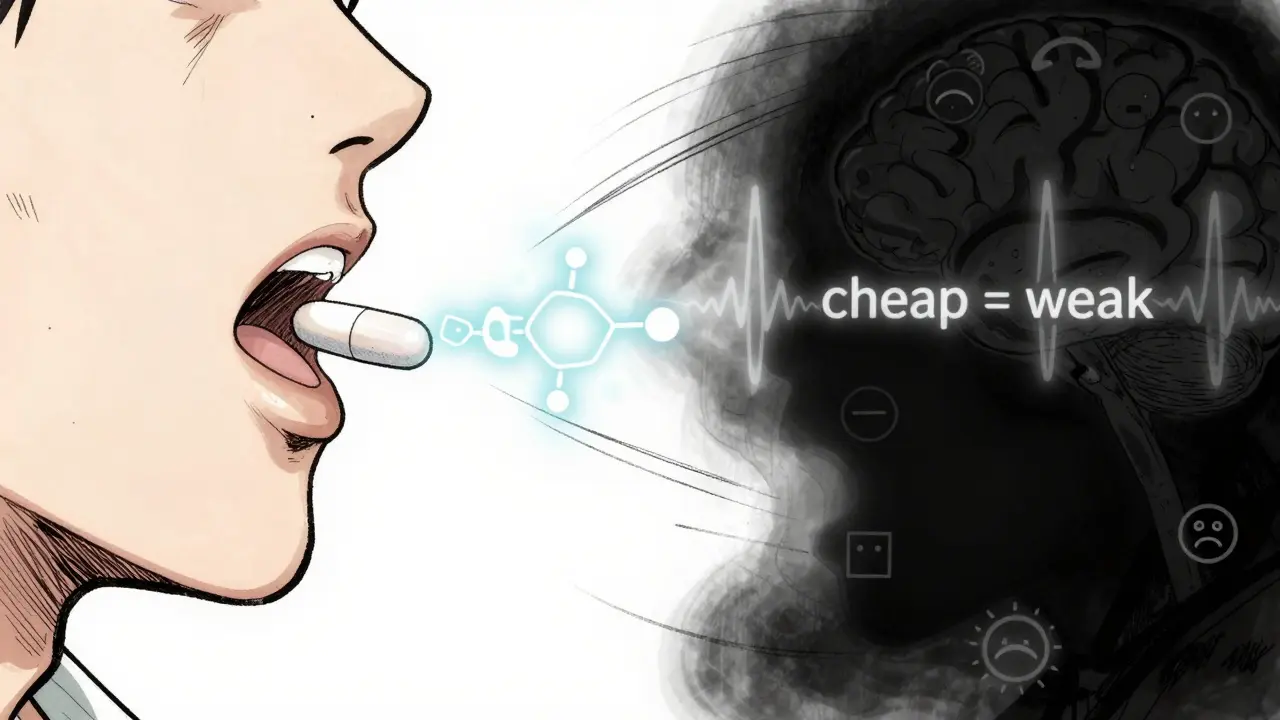
The Hidden Cost of Mistrust
It’s not just about feelings. It’s about money and health. Generics make up 90% of prescriptions in the U.S. But only 27% of patients say they fully trust them. That gap costs the healthcare system over $14 billion a year. Why? People switch back to expensive brand drugs. They skip doses because they think the generic isn’t working. They end up in the ER because their condition worsened. One study found that patients who doubted their generic medication were 27% more likely to report side effects-even when the drug was identical to the brand. That’s not a side effect of the pill. It’s a side effect of fear. Meanwhile, the companies making generics are stuck. They can’t advertise like brand-name drug makers. They don’t have big TV campaigns. They rely on pharmacies and doctors to explain. But most pharmacists have less than two minutes per patient.What’s Working: Real Solutions from Real Clinics
Some places are fixing this-not with ads, but with conversation. Kaiser Permanente started handing out simple one-page sheets titled “Generic Medication Facts.” It lists: same active ingredient, same FDA approval, same safety standards, same effectiveness. Within six months, patient questions about generics dropped by over half. Adherence rose by nearly 20%. A trial in 15 pharmacies trained pharmacists to spend just 90 seconds saying: “This is the same medicine, just without the brand name. It’s been tested to work the same way. Many people save hundreds a year with no difference.” Patient trust increased by 39%. Even small changes help. Some pharmacies now put a small sticker on generic bottles: “FDA Approved. Same as Brand.” Patients notice. They ask. They remember.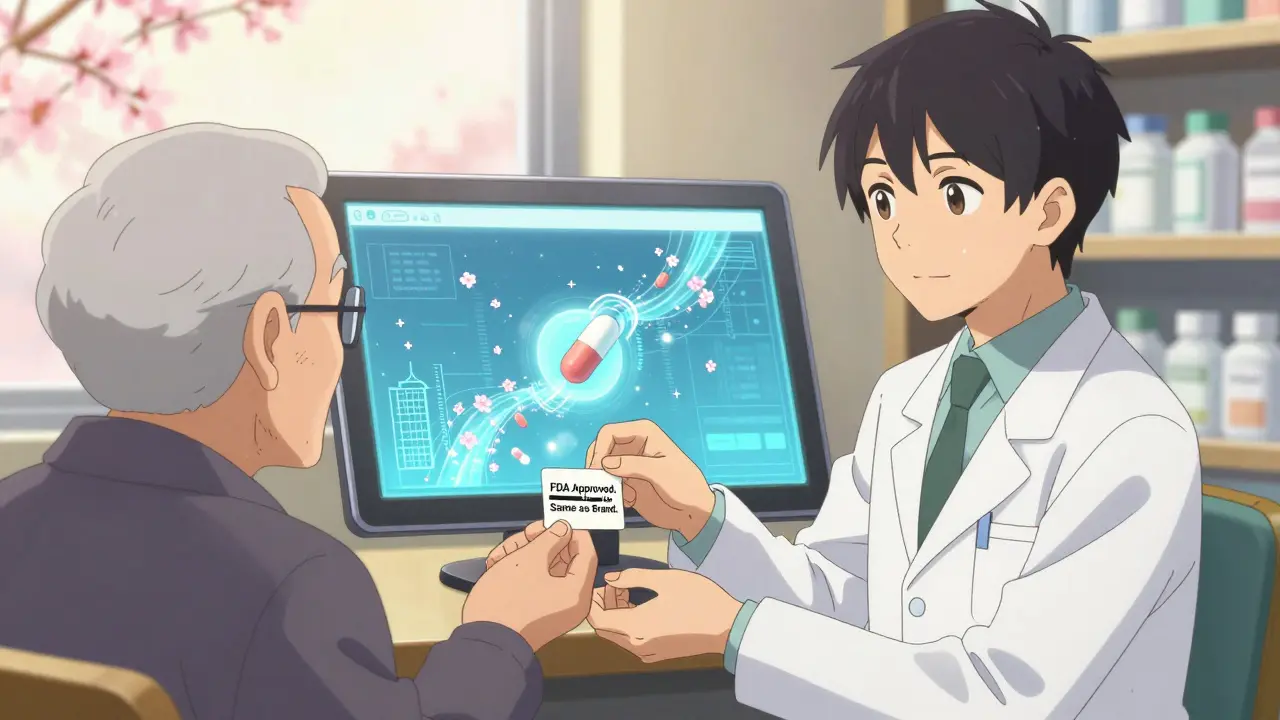
The Role of Authorized Generics and New Tech
Some brand-name companies are now selling their own drugs as generics-called “authorized generics.” These are made by the original manufacturer, just without the brand name. They’re identical in every way, down to the pill color. Sales of authorized generics grew 38% last year. Why? Because patients trust the original maker-even if it’s not on the box. New technology is also helping. Blockchain systems like MediLedger can now track every pill from factory to pharmacy. Patients might soon scan a code on their bottle and see the full supply chain: where it was made, tested, and shipped. That kind of transparency could erase doubts faster than any pamphlet.What Patients Need to Know
You don’t need to be a scientist to understand generics. Here’s what matters:- The active ingredient is identical. No shortcuts. No watered-down formula.
- The FDA requires proof. Every generic must show it works the same way in your body as the brand.
- Color, shape, or filler changes don’t affect effectiveness. Those are just for branding or cost-saving. They don’t change how the medicine works.
- If you feel different, talk to your pharmacist. Sometimes it’s your body adjusting. Sometimes it’s your mind.
- Generic doesn’t mean cheap. It means efficient. Billions saved each year go back into the system-helping more people get care.
What to Do Next
If you’re switching to a generic:- Ask your pharmacist: “Is this the same as the brand?”
- Ask your doctor: “Can we monitor how I’m doing in the next two weeks?”
- Don’t assume a bad experience means the drug is bad. Write down what changed-sleep, mood, pain levels-and bring it to your next visit.
- If you’ve had a good experience, share it. Online reviews work both ways.
Medicine isn’t just chemistry. It’s psychology. And when people believe they’re getting less, they often get less. But when they’re informed, trusted, and heard-they get better.
Are generic medications really as effective as brand-name drugs?
Yes. Generic medications must contain the same active ingredients, strength, dosage form, and route of administration as the brand-name version. The FDA requires them to meet strict bioequivalence standards, meaning they work the same way in your body. Studies show no meaningful difference in effectiveness for the vast majority of drugs.
Why do some people say generics don’t work for them?
Often, it’s not the drug-it’s the expectation. If you believe a cheaper pill must be weaker, your brain can trigger real symptoms, a phenomenon called the nocebo effect. Minor differences in inactive ingredients (like fillers or dyes) can also cause temporary side effects in sensitive individuals. But these aren’t signs the drug is ineffective-they’re signs your body is adjusting.
Can online reviews be trusted when deciding whether to take a generic?
Online reviews can highlight real experiences, but they’re not scientific evidence. People are more likely to post when something goes wrong. A single negative review can influence dozens, even if 90% of users had no issues. Look for patterns-not single stories. And always discuss concerns with your pharmacist or doctor.
Do pharmacists have enough time to explain generics to patients?
Most don’t. The average time a pharmacist spends explaining a prescription is under two minutes. But even a 90-second conversation-“This is the same medicine, just cheaper”-can boost patient trust by 40%. Some clinics now use printed handouts or digital tools to help fill the gap. If you’re unsure, ask for clarification. You have the right to understand what you’re taking.
What are authorized generics, and are they better?
Authorized generics are made by the original brand-name manufacturer but sold without the brand name. They’re chemically identical to the brand, down to the color and shape. Some patients trust them more because they come from the same company. They’re not more effective-but they can ease psychological concerns about quality.
Should I avoid generics if I take a drug with a narrow therapeutic index?
For some drugs-like warfarin, levothyroxine, or certain seizure medications-small differences in absorption can matter. But that doesn’t mean generics are unsafe. The FDA applies stricter bioequivalence rules (90-111%) for these drugs. If you’ve been stable on a brand, talk to your doctor before switching. But don’t assume generics are risky-many patients switch safely with proper monitoring.
15 Comments
Angel Molano
14 January, 2026Generics are just as good. Stop being a hypochondriac and take the damn pill.
Kimberly Mitchell
15 January, 2026The nocebo effect is a well-documented phenomenon in psychopharmacology, yet it's routinely dismissed by clinicians who fail to recognize the somatic manifestation of cognitive bias. Patients aren't 'imagining' side effects-they're experiencing conditioned responses to perceived pharmacological inferiority, which is a legitimate psychobiological outcome, not mere anecdote.
Moreover, the FDA's bioequivalence thresholds (80-125%) are statistically permissive and do not account for inter-individual pharmacokinetic variance, particularly in CYP450-metabolized drugs. This isn't conspiracy-it's pharmacokinetic reality.
When a patient reports altered efficacy after switching from brand to generic, it's often due to excipient sensitivity, not placebo. Propylene glycol, lactose monohydrate, or FD&C dyes can trigger subclinical inflammatory responses in susceptible individuals, leading to symptomatology indistinguishable from therapeutic failure.
The data you cite from Kaiser Permanente is cherry-picked. Their cohort was predominantly middle-class, educated, and had access to continuity of care. That's not representative of the broader population, especially in Medicaid or rural settings where pharmacy turnover is high and patient-provider communication is minimal.
And let's not pretend authorized generics are a panacea. They're still marketed as 'premium generics' to exploit psychological trust asymmetry. The brand manufacturer profits twice: once on the branded version, again on the 'same but trusted' generic.
The real issue? Systemic underfunding of clinical pharmacy services. Pharmacists aren't given time to counsel because the system incentivizes throughput over education. Fix the structural flaw, not the patient's perception.
Blaming patients for trusting online reviews ignores the fact that peer testimony is often their only source of reliable information in a system that treats them as transactional units, not humans.
Vinaypriy Wane
16 January, 2026I am from India, and here, generics are the only option for most people. But I have seen too many cases where the quality control is not there. Not because of FDA, but because of local manufacturers who cut corners. So when I read about people in the U.S. doubting generics, I understand. It's not always about psychology-it's about real, documented cases of substandard drugs.
Yes, many generics are fine. But the system that allows 100+ manufacturers to produce the same drug without consistent batch testing? That's a problem. And yes, online reviews are loud-but sometimes, they're the only warning system left.
I don't trust the system. I trust my experience. And if I feel different after switching, I go back to the brand-even if it costs me half my salary. Because my health isn't a cost-saving metric.
Diana Campos Ortiz
18 January, 2026i just switched to generic sertraline last month and honestly? i feel better. no weird headaches, no nausea, just steady. i was scared too, but my pharmacist said 'same molecule, different label' and that helped. i even posted a good review bc people need to hear this too. it's not magic, it's just medicine.
Robin Williams
19 January, 2026What if the real issue isn't the drug-but the fact that we've turned healing into a transaction? We don't trust pills because we don't trust the system that sells them. We don't trust doctors because they're rushed. We don't trust pharmacists because they're overworked. So we turn to Reddit because it's the only place where someone actually listens.
Generics aren't the problem. The indifference is.
Scottie Baker
20 January, 2026My uncle took generic metoprolol after his heart attack and ended up in the ER because his heart rate spiked. The doctor said 'it's the same!' but my uncle's body knew better. Now he's on brand and stable. Don't tell me it's all in his head. His body didn't lie.
Anny Kaettano
20 January, 2026Let’s acknowledge the emotional labor here. People aren’t just taking pills-they’re taking on the weight of systemic distrust. When you’re told, ‘It’s the same,’ but you feel different, that’s not just pharmacology-it’s grief. Grief for the safety you thought you had. Grief for the money you spent on brand names thinking you were investing in care. Grief that your pain is being dismissed as ‘psychological.’
So when a pharmacist says, ‘This is the same medicine, just cheaper,’ they’re not just giving information-they’re offering validation. That 90 seconds? That’s not a script. That’s a lifeline.
And for patients who’ve been burned? They’re not being irrational. They’re being cautious. And caution is a form of self-preservation, not ignorance.
Let’s stop calling them ‘misinformed’ and start calling them ‘survivors.’
Also-thank you for mentioning authorized generics. That’s the quiet hero here. Same pill. Same factory. Same peace of mind. Why aren’t we pushing this more?
Pankaj Singh
20 January, 2026Let’s cut the crap. The entire generic industry is a regulatory loophole. The FDA doesn’t require independent bioequivalence testing for every batch. Manufacturers submit one study, get approved, and then can change fillers, binders, coatings, and manufacturing sites without reapproval. That’s not ‘same drug.’ That’s a legal fiction.
And yes, the nocebo effect exists-but so does the placebo effect. Why are we only blaming patients for negative outcomes and not praising them for positive ones? Double standard.
Meanwhile, Big Pharma makes billions on authorized generics while pretending they’re not the same company. That’s not transparency. That’s manipulation.
Stop pretending this is about patient education. It’s about profit margins and liability avoidance.
Jesse Ibarra
21 January, 2026You people are pathetic. You’d rather believe some random Redditor who says their ‘anxiety came back’ than trust the most rigorously tested pharmaceutical system on the planet. You want to live in a world where ‘feeling different’ equals ‘the drug is bad’? Fine. But don’t cry when your insurance denies your $400 brand-name prescription because you chose to be a drama queen.
It’s not your body. It’s your ego. You want to feel special. You want your suffering to mean something. So you latch onto the idea that the generic is ‘cheating’ you.
Grow up.
laura Drever
22 January, 2026generics r fine unless they aint. i switched to generic omeprazole and got a rash. switched back. rash gone. not placebo. just bad batch. stop gaslighting us.
Randall Little
23 January, 2026It’s fascinating how Western medicine treats the mind and body as separate systems-until the mind starts causing physical symptoms. Then suddenly, it’s ‘nocebo effect!’ as if the brain doesn’t control the body.
But let’s flip it: if you tell someone a placebo will cure their pain and they get relief, is that ‘real’ healing? Yes. So why is the reverse-expecting harm and feeling it-not equally real?
Maybe the problem isn’t that patients are wrong. Maybe the problem is that we’ve designed a system that makes them feel powerless, then blames them for reacting to it.
Also, the fact that authorized generics are thriving tells us something: people don’t distrust generics. They distrust *unknown* manufacturers. The brand name isn’t the drug-it’s the brand.
Rosalee Vanness
23 January, 2026Let me tell you something that no one’s talking about: the color of the pill matters. Not because it changes the chemistry-but because it changes the story we tell ourselves. I was on blue sertraline for five years. My brain associated blue with calm. When I got switched to the generic-white, oval, no logo-I felt like I was taking something illegal. I didn’t even know why. I just felt… unsafe.
It took me three weeks to realize it wasn’t the drug. It was the lack of visual continuity. My brain had built a ritual around that blue pill. It was my anchor. Take away the anchor, and the whole system trembles.
That’s why I now ask for the same generic manufacturer every time. Not because it’s ‘better’-but because it’s *familiar*. And familiarity isn’t placebo. It’s psychological scaffolding.
Pharmacists need to ask: ‘Have you taken this version before?’ Not just ‘Do you want the generic?’
And if you’re a manufacturer? Don’t change the color. Don’t change the shape. Don’t change the imprint. If it works, leave it alone. People aren’t just taking medicine-they’re taking comfort.
I’ve seen patients cry because their pill changed. Not because they felt worse. Because they felt forgotten.
That’s the real cost of efficiency.
Trevor Davis
24 January, 2026As someone who’s been on generic thyroid meds for a decade, I can tell you this: consistency matters more than brand. I stick with the same manufacturer because if it works, don’t fix it. I’ve seen friends switch generics and have their TSH go haywire. It’s not the drug-it’s the batch variation. And yes, the FDA allows it.
But here’s the kicker: most doctors don’t know which manufacturer their pharmacy uses. So when a patient says, ‘I switched and now I’m exhausted,’ the doctor says, ‘It’s the same.’ But it’s not the same pill. It’s a different factory. Different binders. Different coating.
We need a system where the manufacturer code is printed on the bottle. Just like with insulin. Then patients can report bad batches. And pharmacists can track.
Until then, we’re all playing Russian roulette with our hormones.
James Castner
25 January, 2026At the core of this issue lies a profound epistemological dissonance: we live in an age where empirical data is the gold standard for truth, yet human experience-the lived, embodied, subjective reality of suffering-is dismissed as anecdotal, irrational, or psychosomatic. This is not merely a failure of communication; it is a failure of moral imagination.
The bioequivalence metrics established by the FDA are statistically robust, yes-but they are population-level constructs, not individualized guarantees. The 80-125% range is mathematically permissible, yet for a patient with a narrow therapeutic index, a 15% deviation may represent the difference between stability and crisis.
Moreover, the assumption that ‘if it’s chemically identical, then it must be therapeutically identical’ is a reductionist fallacy. The human body is not a test tube. It is a dynamic, adaptive, context-sensitive system influenced by circadian rhythm, gut microbiome, psychological stress, dietary intake, and environmental toxins-all of which interact with pharmacokinetics in ways we are only beginning to map.
Furthermore, the institutional erasure of the patient’s narrative-reducing their lived experience to ‘nocebo’-is not scientific rigor; it is epistemic violence. When a patient says, ‘I feel different,’ and the response is, ‘You’re wrong,’ the message is not, ‘Trust science.’ The message is, ‘Your body is not trustworthy.’
This is why the 90-second pharmacist script works: not because it imparts information, but because it imparts dignity. It says: ‘I see you. I hear you. Your experience matters.’
And if we want to close the trust gap, we must stop trying to ‘fix’ the patient’s perception-and start fixing the system that made them feel they needed to doubt in the first place.
Medicine is not just chemistry. It is covenant.
Angel Molano
27 January, 2026^ This is why people hate doctors. Overcomplicating simple things.