
Switching your child from liquid medicine to a chewable or tablet can feel like a win-no more spilled bottles, no more measuring cups, no more fighting over taste. But if you do it wrong, it can backfire. Kids might swallow the tablet whole, the medicine won’t work, or worse, they could end up with a stomach ache or a flare-up of their original condition. This isn’t just about convenience. It’s about making sure your child gets the right dose, at the right time, in a way their body can actually use.
Why Switch from Liquid to Chewable or Tablet?
Liquid medicines are messy. They need refrigeration. They expire faster-often in just 12 to 18 months. Measuring them out with a syringe or cup is prone to error. Studies show parents can make mistakes in dosing up to 20% of the time. That’s not a small margin. It could mean underdosing, which doesn’t help the illness, or overdosing, which can be dangerous. Chewable and tablet forms fix these problems. They don’t need cold storage. They last 24 to 36 months. And because they come in fixed doses, there’s no guessing. One tablet = one dose. No measuring. No spills. No forgotten doses. The global market for chewable medications is now worth nearly $19 billion, and it’s growing fast because parents and doctors are seeing the benefits. But here’s the catch: not all chewables are created equal. And not every child can handle them. A 5-year-old might crush a 160mg chewable tablet like candy. A 2-year-old might just gag on it. A 75-year-old grandparent helping out might not chew at all. That’s why the transition needs a plan.When Is It Safe to Switch?
The first question to ask: Can your child actually chew and swallow safely? Most pediatric chewables are designed for kids aged 2 and up. But that’s just a general guideline. Some kids develop chewing skills later. Others have conditions like autism, cerebral palsy, or oral motor delays that make chewing hard. If your child has trouble with solid foods-like meat, crackers, or apples-then a chewable tablet might not be safe yet. Talk to your pharmacist or pediatrician. They can use a simple screening tool called the Gugging Swallowing Screen to check if your child can handle solids. It’s quick, non-invasive, and tells you whether swallowing a tablet without chewing could cause choking or poor absorption. Also, check the label. Some chewables say “must be chewed.” Others say “can be chewed or swallowed whole.” That’s a big difference. If it says “must be chewed,” swallowing it whole could mean the medicine doesn’t dissolve properly. In one study, 12.7% of kids who switched from liquid potassium chloride to tablets had treatment failure because they swallowed them whole. That’s not rare. It’s common enough that hospitals now require education before the switch.How to Match the Dose Correctly
This is where most mistakes happen. You can’t just say, “The liquid was 5 mL, so I’ll give one tablet.” That’s wrong. Liquid medicines are measured by volume. Tablets are measured by weight. They’re not the same thing. For example: Tylenol Children’s Suspension has 160 mg of acetaminophen in every 5 mL. If your child needs 160 mg, that’s one chewable tablet. Easy. But if your child needs 120 mg, you can’t give them ¾ of a tablet. Chewables aren’t designed to be split. You’d need to stick with the liquid, or find a different tablet strength. Always check the FDA’s Orange Book or your pharmacy’s dosage guide. Use a trusted tool like the ISMP Medication Safety Calculator. Never guess. A 2022 report from the American Society of Health-System Pharmacists found that 87% of dosing errors during transitions came from incorrect volume-to-mass conversions. Also, watch out for hidden ingredients. Chewables often have more sugar, artificial flavors, or sweeteners than liquids. If your child has diabetes or is on a low-sugar diet, this matters. Some chewables contain sorbitol or xylitol-fine for most, but can cause diarrhea in sensitive kids.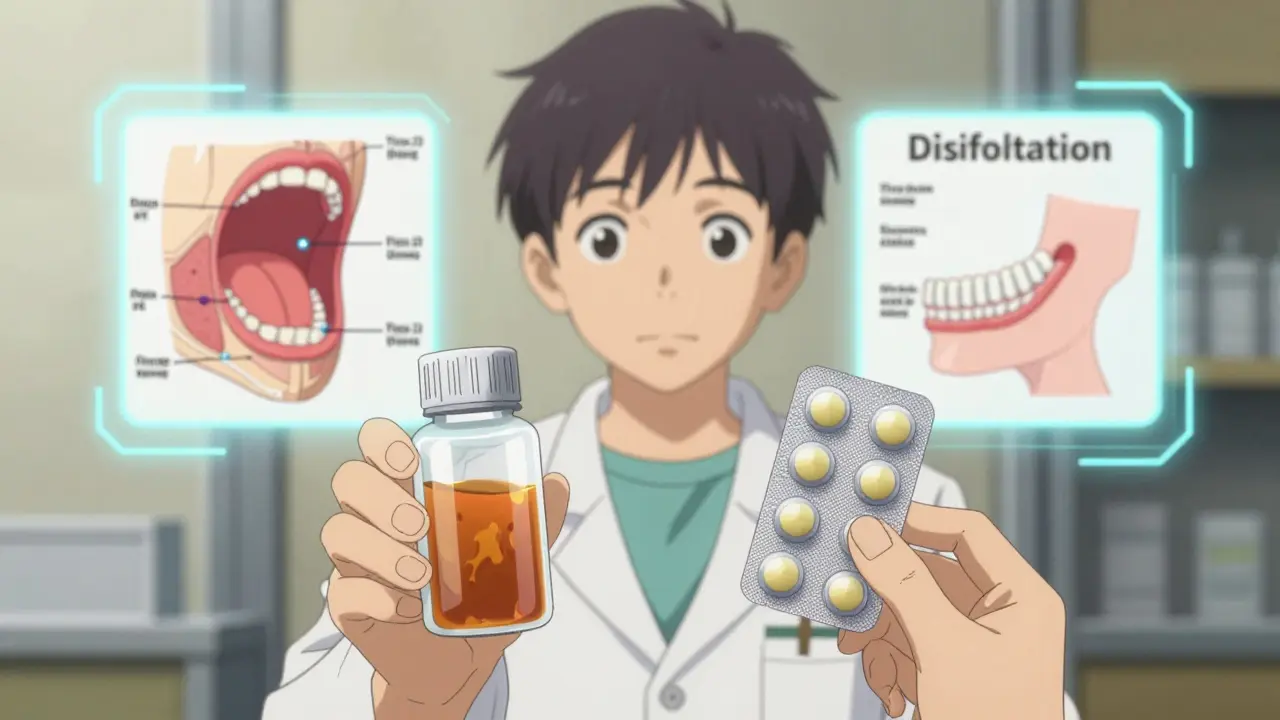
What to Look for in a Good Chewable Tablet
Not all chewables are made the same. Here’s what to check:- Hardness: Good chewables should be soft enough to crush between teeth but firm enough not to crumble. Experts say the ideal hardness is between 4 and 8 kiloponds. Too soft? It turns to dust in the bottle. Too hard? Your child can’t chew it.
- Disintegration time: It should break down completely in the mouth or stomach within 30 minutes. Look for tablets with sodium starch glycolate or microcrystalline cellulose-these are disintegrants that help the medicine release.
- Size: If the tablet is bigger than a dime, it’s probably too big for a young child. Some 500mg chewables are the size of a quarter. That’s fine for teens, but not for a 3-year-old.
- Taste: Taste matters more than you think. A 2023 review of 687 parent reviews on Drugs.com found that 22% of failures were because kids refused the chewable because it tasted “weird” or “bitter.”
How to Teach Your Child to Chew the Tablet
You can’t just hand over a tablet and hope for the best. You need to teach. Start by modeling it. Chew a piece of candy or a gummy vitamin in front of them. Say, “Watch how I bite it and chew it until it’s all gone.” Then let them try with a dummy tablet (like a sugar-free gummy) first. Tell them: “You need to chew this for at least 15 to 20 seconds. Don’t swallow it until it’s all mushy.” Some parents use a simple rhyme: “Chew, chew, chew, don’t swallow fast. Wait till it’s soft, then swallow last.” For kids who are resistant, try mixing the chewable with a spoonful of applesauce or yogurt. But don’t crush it first-unless the label says it’s okay. Crushing can change how the medicine works. A 2023 study at University College London found that 23% of transition failures happened because kids didn’t chew long enough. They’d bite once and swallow. The medicine didn’t dissolve. The infection came back.
When Not to Switch
Some medications just shouldn’t be switched. Here are the red flags:- High-dose drugs: If your child needs 750mg or more per dose, a chewable might be too big to swallow safely. Some medications, like certain antibiotics or seizure drugs, aren’t available in chewable form at all.
- Medications that need fast action: Liquids are absorbed faster. If your child needs quick relief-like for an asthma attack or severe pain-a chewable might take 30 to 60 minutes to kick in. Liquids can work in 15.
- Children under 2: Most chewables aren’t tested for safety under age 2. Stick with liquid unless your doctor says otherwise.
- Swallowing disorders: If your child has ever choked on food, has a history of reflux, or has a neurological condition, don’t switch without a speech therapist’s approval.
What to Do After the Switch
Don’t assume it’s done after the first dose. Follow up within 72 hours. Call your pharmacist or doctor. Ask: “Did the medicine work? Did they chew it? Did they have any stomach upset?” Keep a simple log: Date, time, dose, whether it was chewed, any side effects. You’ll spot patterns. Maybe they’re fine on weekdays but refuse on weekends. Maybe they’ll take it if it’s chocolate-flavored but not berry. If the child refuses the chewable, don’t force it. Go back to the liquid. Try again in a few weeks. Or ask your pharmacist if there’s a different flavor or brand available.What’s Next for Pediatric Medications?
The future is bright. Companies are now using 3D printing to make personalized chewables-doses tailored exactly to a child’s weight, with fun shapes and flavors. One company in Australia is testing tablets that dissolve in 60 seconds even if swallowed whole. That’s huge for kids who forget to chew. Regulators are catching up too. The European Medicines Agency now requires all pediatric chewables to be tested with machines that mimic a child’s jaw strength. That means better, safer products are coming. But for now, the best tool you have is knowledge. Know your child. Know the medicine. Know how to check if it’s working. And never skip the education step.Can I crush a chewable tablet and mix it with food if my child won’t chew it?
Only if the label says it’s okay. Some chewables are designed to release medicine slowly or have a special coating. Crushing them can change how the drug works-or make it unsafe. Always check with your pharmacist first. If it’s safe to crush, mix it with a small amount of applesauce, yogurt, or pudding. Give it right away-don’t store it.
My child swallowed a chewable tablet whole. What should I do?
Stay calm. If the tablet is small and your child isn’t choking, they’ll likely pass it without issue. But if the label says “must be chewed,” the medicine may not work properly. Call your pharmacist or doctor. Tell them the name of the medicine, the dose, and that it was swallowed whole. They’ll tell you if you need to give another dose or wait. Don’t give another dose unless instructed.
Are chewable tablets better than liquid for travel?
Yes, by far. Liquids need to be kept cool, can leak in bags, and require measuring tools. Chewables fit in a pocket. They don’t spill. They last longer. For trips, vacations, or school, they’re the clear winner-as long as your child can chew them properly.
Why do some chewables taste bad even though they’re made for kids?
Some medicines are naturally bitter-like antibiotics or iron supplements. Masking that taste is hard. Even the best flavorings can’t fully hide it. That’s why some kids refuse them. If your child hates the taste, ask your pharmacist if there’s a different brand or if the medication is available in another form, like a dissolvable strip or oral suspension.
Can my child take chewable vitamins and medicine at the same time?
Sometimes, but not always. Some medications interact with vitamins-like iron and calcium, or antibiotics and zinc. Always check with your pharmacist before combining them. Give them at least 2 hours apart if you’re unsure. And don’t assume a chewable vitamin is harmless-it can still affect how the medicine works.
If you’re switching your child from liquid to chewable medicine, you’re making a smart move-but only if you do it right. Take the time to learn the dose, teach the chewing, and watch for signs it’s working. Your child’s health depends on it.
10 Comments
Napoleon Huere
27 January, 2026It’s wild how we treat medicine like it’s just a snack. We switch kids from liquid to chewables like it’s a flavor upgrade, but half the time we’re just swapping one problem for another. The real issue isn’t the tablet-it’s that we expect kids to magically understand pharmacology. We don’t teach them how to swallow a pill, we just hand it over and hope for the best. It’s like giving someone a chainsaw and saying, ‘Just don’t cut your foot off.’
Shweta Deshpande
29 January, 2026Oh my goodness, this post is such a blessing! I’ve been so stressed trying to get my 4-year-old to take her antibiotics, and I had no idea about the disintegration time or hardness ratings for chewables. I thought all chewables were basically the same-turns out, I was giving her one that was basically a rock! I called our pharmacist today and they recommended the ChewSmart™ ones, and guess what? She actually chewed it without crying! I even made a little chart with stickers for each day she does it right. She’s now my little medicine champion 🌟
Aishah Bango
29 January, 2026Parents these days are so lazy. You want convenience? Fine. But don’t blame the medicine when your kid gags on a tablet because you didn’t bother to teach them how to chew. My cousin’s kid swallowed a whole tablet and ended up in the ER. And now she’s mad at the manufacturer. Newsflash: if you don’t read the label, you’re not a victim-you’re a liability. Stop outsourcing parenting to Big Pharma.
Simran Kaur
30 January, 2026My heart just swelled reading this. In India, we have so many grandparents helping with meds, and they often just give the tablet with water and say, ‘Swallow it, beta.’ No chewing, no checking. I cried when I read about the Gugging Swallowing Screen-I wish we had that in our village clinic. I’ve started showing videos of how to chew to my aunties, and now we even have a little rhyme we sing: ‘Chew, chew, chew, don’t swallow fast!’ My nephew took his medicine like a pro yesterday. Small wins, ya? 💛
Neil Thorogood
31 January, 2026So let me get this straight-we’ve got $19 BILLION in chewable meds, but we still can’t make one that doesn’t taste like regret? 😭 I gave my kid a ‘cherry-flavored’ acetaminophen and he gagged so hard he threw up his breakfast. I swear, if the flavor was any worse, it’d be a public service announcement for why we need better chemists. Also, why do they always make the tablets the size of a hockey puck? 🤦♂️
Peter Sharplin
31 January, 2026One thing no one talks about: sugar content. I have a diabetic kid. Most chewables are basically candy with a side of medicine. I spent 45 minutes cross-referencing the Orange Book and my pharmacy’s database just to find a sugar-free option. There are maybe three brands that don’t have sorbitol or maltitol. If you’re managing a chronic condition, this isn’t a convenience-it’s a minefield. Always check the inactive ingredients. It’s not optional.
Betty Bomber
31 January, 2026My kid took a chewable whole last week. Didn’t choke, didn’t throw up. Just… didn’t get better. We went back to liquid. No drama. No trauma. Just… simpler. Sometimes the old way is the right way. Not every ‘upgrade’ is an upgrade.
Curtis Younker
1 February, 2026Y’all need to stop treating this like a chore and start treating it like a game. I turned pill-chewing into a family challenge. We got these little plastic chewable trainers (they’re like gummy bears but tasteless) and my daughter had to ‘chew like a dragon’ for 20 seconds before swallowing. We did it every night before bedtime. Now she asks for her medicine like it’s a treat. It’s not magic-it’s consistency. And yeah, I used a reward chart. So what? She’s alive and her fever’s gone. Win-win.
Nicholas Miter
2 February, 2026the label says 'must be chewed' so dont swallow it. but also dont crush it unless they say its ok. also if your kid is under 2 just stick with liquid. its not that hard. also check the dose. 160mg in 5ml is not the same as 160mg per tablet. i saw a mom give her kid half a tablet thinking it was half the dose. she was wrong. like really wrong. just read the thing. its right there.
Suresh Kumar Govindan
3 February, 2026It is my professional opinion, based on peer-reviewed literature and regulatory frameworks established by the WHO and EMA, that the commercialization of pediatric chewables represents a dangerous commodification of pharmaceutical care. The normalization of flavor masking and gamification of medication adherence reflects a systemic erosion of medical authority and parental responsibility. One must ask: who benefits? Not the child. Not the physician. The shareholder. And therein lies the conspiracy.